admin
admin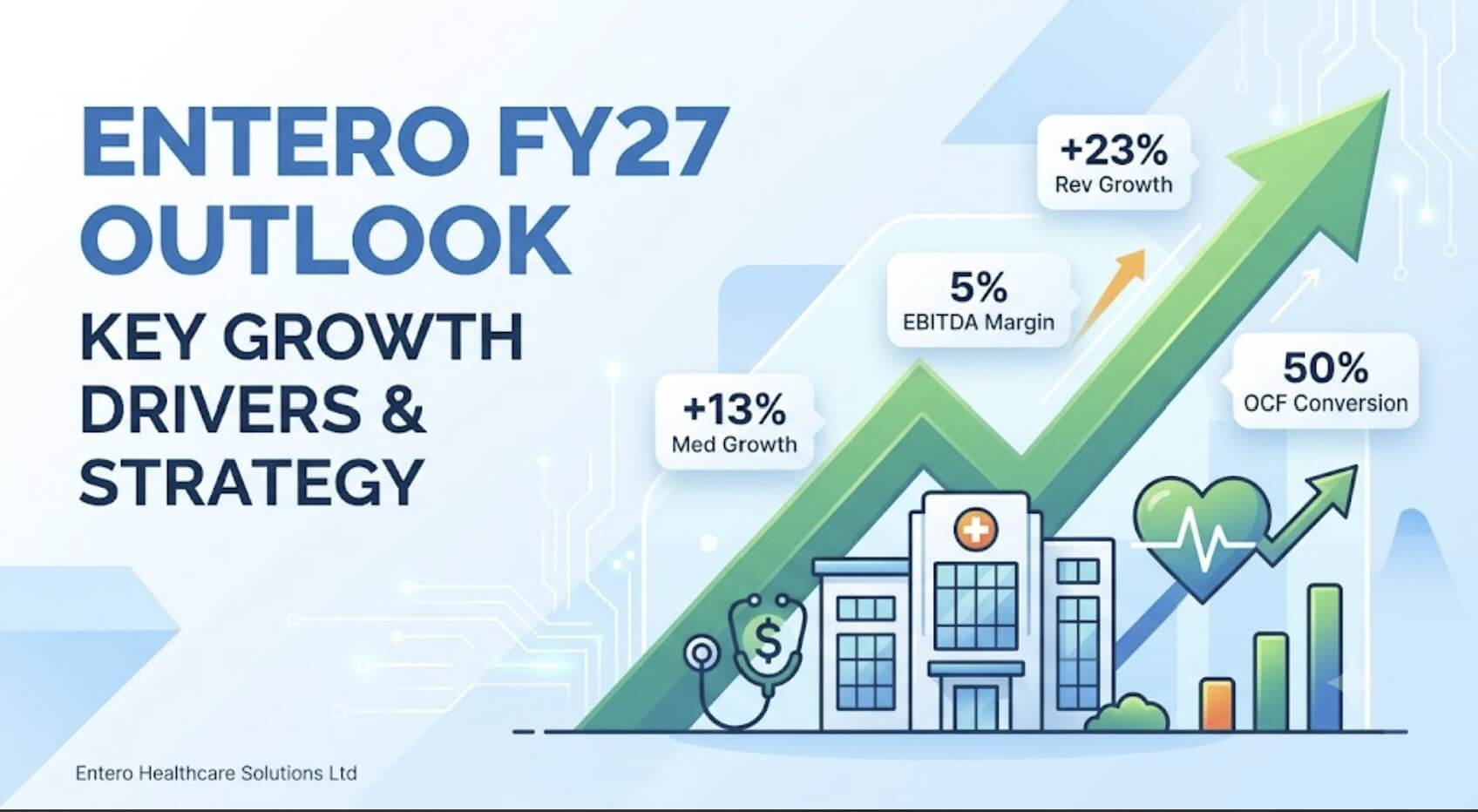
Entero Healthcare Q1 FY27 Earnings Analysis: Strategic Shifts and Margin Expansion
The Indian healthcare distribution sector is undergoing a massive transformation, shifting from highly fragmented, localized operations to organized, tech-enabled supply chains. At the forefront of this consolidation is Entero Healthcare Solutions Ltd. Following the conclusion of their Q1 FY27 earnings call, management has painted a clear picture of the company’s trajectory: prioritizing profitable growth, exiting low-margin legacy accounts, and aggressively expanding into the lucrative med-tech space.
For stock market investors and analysts, the Q1 FY27 update provided a treasure trove of actionable insights. Far beyond simple top-line revenue metrics, the earnings call highlighted a mature management team focused on operating leverage, cash flow conversion, and strategic market positioning.
This comprehensive analysis breaks down Entero Healthcare’s financial data, revenue growth strategies, profitability trends, and industry positioning to help you make informed investment decisions.
Explore more of our deep-dive analysis on top healthcare stocks for FY27 here.
1. Executive Summary: The Q1 FY27 Scorecard
Before diving into the granular data, it is crucial to understand the baseline guidance management has established for the remainder of the fiscal year. Entero Healthcare has firmly reiterated its FY27 guidance, signaling strong internal confidence in their operational execution.
Key Guidance Metrics at a Glance:
- Revenue Growth: ~23% Year-over-Year (YoY) on a consolidated basis.
- EBITDA Margin: 5% baseline, with potential upward revisions in H2 FY27.
- Cash Flow Conversion: 50% EBITDA to Operating Cash Flow (OCF) conversion.
- Effective Tax Rate: 22.5% for FY27.
- Medium-Term Growth (3-4 Years): >20% organic growth target.
What makes this guidance particularly compelling is the underlying quality of the earnings. The 23% revenue growth incorporates the calendarization effect of previous mergers and acquisitions (M&A) but notably excludes any new, unannounced M&A activities. This means the projected growth is highly visible and deeply rooted in the company’s existing infrastructure.
2. Revenue Analysis: Building a Predictable Top-Line
Entero Healthcare’s guidance of 23% YoY consolidated revenue growth is a standout figure, especially when compared to the broader pharmaceutical distribution industry, which typically grows at a low double-digit pace.
Organic vs. Inorganic Growth Dynamics
Historically, Entero has utilized a highly successful “roll-up” strategy, acquiring smaller, regional distributors to build a pan-India footprint. However, the FY27 guidance relies heavily on the organic compounding of these acquired assets.
By excluding new M&A from their 23% growth forecast, management is demonstrating the inherent pricing power and volume expansion capabilities of their current network. If the company decides to deploy capital for fresh acquisitions later in the year, this 23% figure could act as a conservative floor rather than a ceiling.
The “Addition by Subtraction” Strategy
One of the most revealing insights from the Q1 call was management’s deliberate decision to exit certain low-margin accounts. In the distribution business, it is incredibly tempting to chase pure top-line revenue by servicing high-volume, low-margin clients (such as massive government hospitals or hyper-discounted pharmacy chains).
However, Entero has chosen to walk away from revenue that does not meet their internal return on capital thresholds. This is a highly mature capital allocation strategy. While it may temporarily suppress absolute top-line numbers, it significantly improves the overall health of the revenue mix, ensuring that every rupee of sales contributes meaningfully to the bottom line.
3. Profit Trends and Margin Expansion
Revenue is vanity, but margins are sanity. For Entero Healthcare, Q1 FY27 was a masterclass in margin protection and expansion.
Defending the 5% EBITDA Margin
Distribution is a notoriously thin-margin business. Achieving and sustaining a 5% EBITDA margin is a significant milestone that places Entero in the upper echelon of global healthcare supply chain companies. Management confirmed that they successfully hit this 5% mark in Q1 and are now focused on establishing this as a permanent baseline.
Investors should closely monitor the Q2 FY27 results. Management has hinted that if operational performance remains robust, they may issue an upward revision to this guidance.
The Path to 6%+ Margins
Looking toward the medium term (3-4 years), management aspires to drive EBITDA margins “well above 6%.” How is a distributor going to squeeze out an extra 100 to 150 basis points of profitability? The answer lies in operating leverage.
As Entero’s revenue scales past the 20% growth mark annually, their fixed costs (warehousing, technology infrastructure, corporate overhead) will not grow at the same pace. This operating leverage means that incremental revenue drops directly to the bottom line at a much higher margin rate. Furthermore, the strategic shift toward high-margin business segments (discussed below) will artificially lift the gross margin profile of the entire company.
4. Cash Flow and Balance Sheet Health
In the B2B distribution sector, a company can show accounting profits while simultaneously going bankrupt if they fail to collect their receivables. Therefore, cash flow conversion is the ultimate litmus test of a distributor’s financial health.
The 50% OCF Conversion Metric
Entero has guided for an EBITDA to Operating Cash Flow (OCF) conversion rate of 50% on an annualized basis. This is a very healthy metric for a rapidly growing business.
- Why it matters: Rapid growth usually consumes massive amounts of working capital (inventory and accounts receivable). Generating 50% of EBITDA as cold, hard cash proves that Entero is managing its working capital cycle efficiently. They are collecting money from pharmacies and hospitals fast enough to fund their own inventory purchases, reducing their reliance on expensive external debt.
Tax Rate Advantages
The company guided for an effective tax rate of 22.5% for FY27. This favorable rate is heavily supported by deferred tax assets currently sitting on their balance sheet—likely a byproduct of historical losses or accumulated depreciation from their M&A spree. A lower tax outflow means higher Free Cash Flow (FCF) available for reinvestment, debt reduction, or future shareholder returns. Management will update the market on the FY28 tax outlook closer to the end of the current fiscal year.
5. Strategic Pivot: The Med-Tech Advantage
Perhaps the most exciting qualitative update from the Q1 FY27 call was Entero’s aggressive posturing in the Medical Technology (Med-Tech) and surgical consumables space. Management drew a distinct line between traditional pharma distribution and med-tech distribution.
Pharma vs. Med-Tech: A Tale of Two Markets
| Metric | Pharmaceutical Distribution | Med-Tech Distribution | Entero’s Strategic View |
| Competition | Extremely High (highly fragmented) | Low to Moderate | Med-Tech offers a distinct moat. |
| Distributor Count | Thousands of local players | Limited specialized players | Easier to capture market share. |
| Relationship Depth | Transactional (price-driven) | Deep, consultative relationships | Higher customer retention. |
| Margin Profile | Low (strictly regulated) | Higher (value-added services) | Boosts overall corporate EBITDA. |
The “Demand Generation” Play
In traditional pharma, a distributor simply moves a box of pills from point A to point B. The doctor generates the demand by writing a prescription.
In med-tech, management highlighted that Entero can actually play a role in commercial demand generation. Because the number of med-tech distributors is much smaller, Entero can build direct, sticky relationships with hospitals, surgeons, and procurement heads. They aren’t just order-takers; they become supply chain partners, educating hospitals on new surgical consumables and medical devices.
This structural advantage in med-tech is exactly what will drive the company toward its aspirational 6%+ EBITDA margin over the next few years. It faces less competition, commands higher margins, and features significant barriers to entry for smaller, unorganized distributors.
6. Industry Comparison & Sector Benchmarks
To understand Entero Healthcare’s valuation and performance, it helps to look at the broader landscape of Indian healthcare and global distribution peers.
For additional context on how the Indian healthcare sector is evolving globally, you can review the Indian pharmaceutical market trends detailed by the IBEF.
Entero is currently outperforming the unorganized sector by a massive margin. The traditional “mom-and-pop” stockists in India are struggling with tightening regulatory compliance, GST enforcement, and the working capital required to stock increasingly expensive specialty drugs.
By operating as an organized, corporate entity, Entero benefits from economies of scale. When compared to global peers like McKesson or Cardinal Health in the US, Entero’s 5% EBITDA margin is actually quite robust (global players often operate at 1.5% to 3% margins due to highly consolidated payer networks). Entero’s ability to extract 5% today, with a line of sight to 6%, highlights the structural inefficiencies in the Indian market that a tech-enabled player can exploit for profit.
7. Risk Factors and Potential Threats
No investment analysis is complete without a rigorous look at the downside risks. While the Q1 FY27 call was overwhelmingly positive, investors must monitor the following threats:
- Working Capital Stretching: The 50% OCF conversion relies heavily on hospitals and pharmacies paying their bills on time. If the Indian hospital sector experiences a liquidity crunch, Entero’s receivables could age rapidly, forcing them to take on short-term debt and destroying their cash flow conversion metrics.
- Regulatory Price Controls: The Indian government frequently intervenes in healthcare pricing (e.g., the National List of Essential Medicines). If price caps are applied aggressively to the med-tech devices that Entero distributes, it could compress the higher margins they are currently targeting.
- Integration Risks: While they have paused M&A in their FY27 guidance, their long-term 20% growth rate will likely require future acquisitions. Integrating disparate legacy IT systems and corporate cultures is notoriously difficult and can lead to margin leakage if not executed perfectly.
8. Actionable Insights for Investors
Based on the Q1 FY27 earnings data, here is how market participants should view Entero Healthcare Solutions Ltd:
- A Premium for Predictability: Entero is offering 20%+ compounding top-line growth with visible margin expansion. In today’s volatile market, companies that can confidently project 23% organic-driven growth command a premium valuation multiple.
- Monitor the Med-Tech Mix: Investors should closely watch the revenue contribution from the med-tech segment in upcoming quarters. If this segment grows faster than the traditional pharma segment, the 6% EBITDA margin target will be achieved much faster than the guided 3-4 year timeline.
- The Q2 Catalyst: Management explicitly stated that they might upgrade guidance after Q2. Investors looking for an entry point might find that strong Q2 results could act as an immediate catalyst for price rerating, as analysts revise their full-year earnings per share (EPS) estimates upwards.
- Quality of Earnings: By intentionally shedding low-margin accounts, Entero is prioritizing Return on Capital Employed (ROCE) over mere market share. This is the hallmark of a wealth-creating business. Investors should value this discipline, as it prevents the company from engaging in destructive price wars.
Conclusion: A Clear Runway for Profitable Growth
Entero Healthcare’s Q1 FY27 earnings call painted a picture of a company transitioning from its aggressive M&A “land grab” phase into a mature phase of operational excellence and margin optimization.
By reiterating a strong 23% revenue growth target, defending a 5% EBITDA margin, and successfully converting half of those profits into operating cash flow, management has proven their ability to execute in a complex market. Furthermore, their strategic pivot toward the higher-margin, lower-competition med-tech sector provides a clear runway to their goal of >6% margins in the coming years.
For long-term investors, Entero Healthcare represents a compelling play on the formalization and modernization of the Indian healthcare supply chain. As always, keep a close eye on their working capital cycles and any regulatory shifts, but the underlying fundamentals presented in June 2026 suggest a robust trajectory forward.
Disclaimer: This article is for educational purposes only and not financial advice. Investors should do their own due diligence before investing.
Disclaimer: The projections of potential returns are based on current market conditions and company performance. Actual results may vary due to various factors, including market dynamics, economic conditions, and changes in the competitive landscape. Investors should conduct their own research and consult with financial advisors before making investment decisions.
Multibagger Stocks breakout stocks
⚠️ Not SEBI Registered—just here to share insights | 🚫 No paid services—everything shared is entirely free! 🧠 Always Learning and excited to grow together in this journey of market exploration.
📲 Join Our Investor Communities
🔹 Join our Telegram Channel: Multibagger Hunts
🔹 Join our WhatsApp Channel: Click to Join
✅ Free access
✅ Instant alerts
✅ Curated research for serious investors
TwitterXWhatsAppThreadsTelegramFacebookLinkedInGmailEmailShare