admin
admin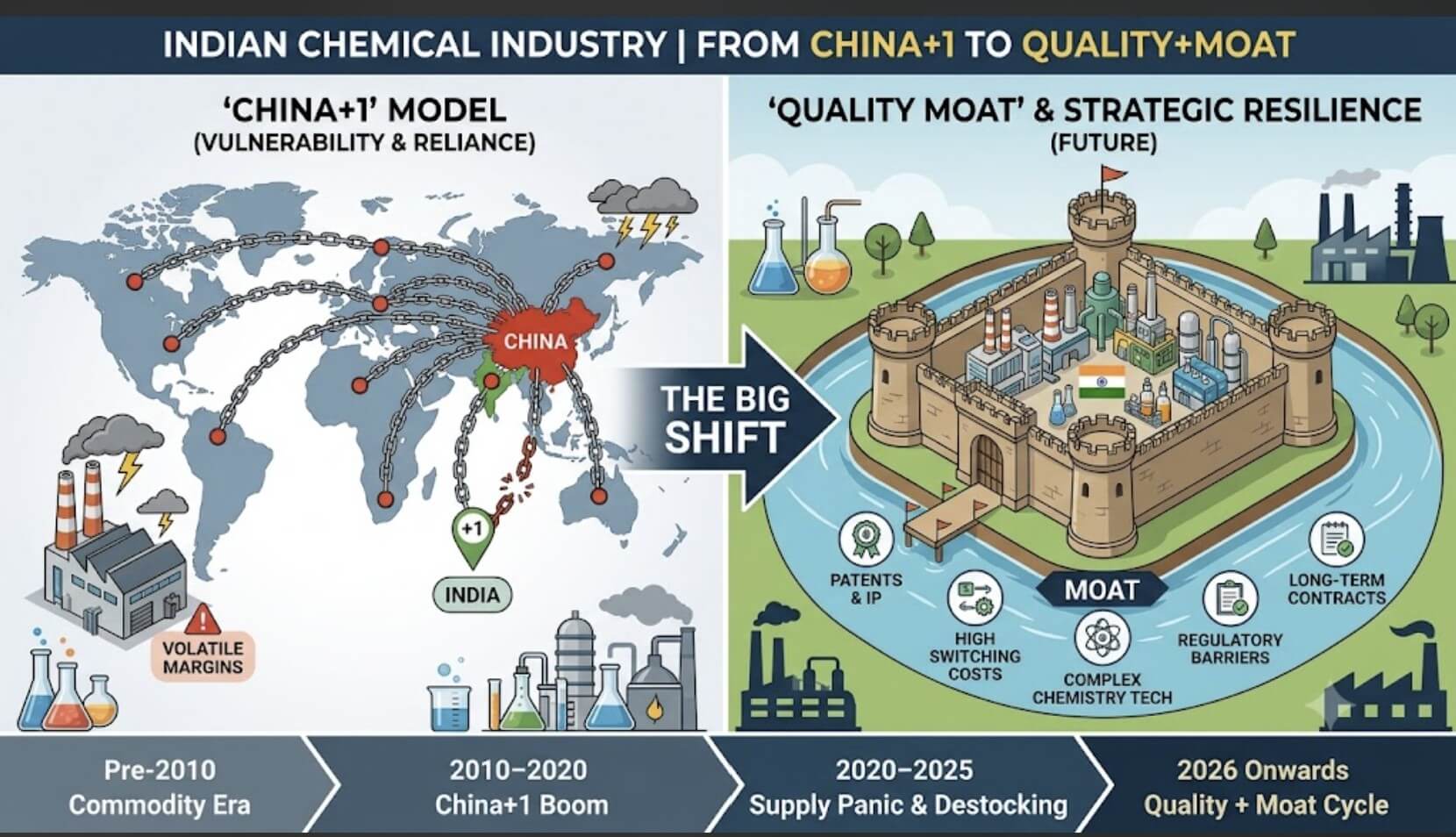
The Evolution of the Indian Chemical Industry: From China+1 to Quality Moat
The Indian chemical sector is undergoing a massive structural transformation. For over a decade, investors and market analysts have thrown around the term “China+1” to explain the meteoric rise of Indian chemical stocks. Driven by global supply chain realignments, Indian companies enjoyed unprecedented volume growth, margin expansion, and a massive valuation re-rating.
However, as we look toward 2026 and beyond, the narrative is fundamentally changing. The post-pandemic destocking cycle has ruthlessly exposed vulnerabilities in companies that relied solely on capacity additions rather than complex chemistries. The new era of wealth creation in this sector will not be driven merely by a geographic shift in manufacturing. It will be driven by the Indian Chemical Industry Moat—a combination of sticky customer relationships, deep R&D, regulatory barriers, and specialized technology.
If you are an investor looking to navigate this space, understanding this timeline and the impending “Quality + Moat” cycle is critical for identifying the next generation of wealth creators.
A Timeline of the Chemical Sector’s Evolution
To understand where the market is going, we must first analyze where it has been. The industry has moved through distinct phases, each defined by unique macroeconomic drivers and supply-demand dynamics.
Commodity Era
Pre-2010
Characterized by bulk chemicals like caustic soda and soda ash. Competition was driven purely by scale, cost-efficiency, and high asset turnover.
China+1 Boom
2010–2020
China’s strict environmental crackdowns disrupted global supply. India emerged as a reliable alternative, leading to a golden decade of volume and margin expansion for Indian producers.
Pandemic Supply Panic
2020–2022
COVID-19 and China’s Zero-COVID policies triggered global supply chain panic. Customers aggressively hoarded inventory, inflating demand and pushing chemical prices to record highs.
Destocking Downturn
2022–2025
As supply chains normalized and interest rates rose, holding high inventory became too expensive. Customers aggressively destocked, while a reopened China dumped excess capacity, leading to severe margin compression.
Quality + Moat Cycle
2026 Onwards
The destocking cycle normalizes. The focus shifts entirely to business quality. Companies with durable competitive advantages (moats), high switching costs, and complex technologies will capture the next upcycle.
Phase 1: Pre-2010 | The Commodity Era
Before 2010, the Indian chemical industry was largely viewed as a traditional, capital-intensive commodity business.
The Dominance of Bulk Chemicals
During this period, the sector was heavily focused on bulk and basic chemicals. Key products included:
- Caustic Soda (Sodium Hydroxide): Used in textiles, alumina, and soaps.
- Soda Ash: Primarily used in glass manufacturing and detergents.
- Sulfuric Acid & Nitric Acid: Foundational building blocks for fertilizers and industrial processes.
Low Differentiation and Cost-Driven Competition
In the commodity era, the molecular structure of a chemical produced by Company A was identical to that produced by Company B. Because there was low differentiation across producers, pricing power was virtually non-existent. Indian chemical manufacturers were “price takers,” meaning their profitability was entirely dependent on global commodity cycles.
Competition was driven mainly by scale and cost. Companies that could build the largest plants, secure the cheapest raw materials, and optimize logistics were the ones that survived. Operating margins were typically thin (often in the single digits), and earnings were highly volatile.
For further reading on how commodity cycles work, check out this guide on Commodity Market Cycles and Investing. (Outbound Link)
Phase 2: 2010–2020 | The China+1 Boom
The decade starting in 2010 marked the golden era for the Indian chemical industry. This was the birth of the famous “China+1” strategy, which fundamentally altered the trajectory of Indian manufacturing.
China’s Environmental Crackdown
For decades, China dominated the global chemical supply chain due to aggressive state subsidies, lax environmental regulations, and massive economies of scale. However, facing severe pollution crises in major cities, the Chinese government initiated a strict “Blue Sky” environmental crackdown.
- Thousands of non-compliant, highly polluting chemical plants in China were abruptly shut down.
- Industrial parks were relocated away from crucial waterways.
- This sudden removal of capacity sent shockwaves through the global supply chain.
India Emerges as the Primary Beneficiary
Global innovators and multinational corporations in the pharmaceutical, agrochemical, and industrial sectors panicked. They realized the massive risk of relying on a single country for their active ingredients and critical intermediates. They urgently searched for reliable alternatives, and India emerged as a major beneficiary.
India offered:
- A skilled workforce with deep expertise in chemistry.
- Respect for intellectual property (IP) rights.
- A democratic setup with stable export policies.
Valuation Premiums and Margin Expansion
Indian chemical companies gained new, sticky customers from the US, Europe, and Japan. As demand outstripped supply, Indian manufacturers enjoyed unprecedented pricing power. Volumes and margins improved significantly.
During this decade, the stock market took notice. Chemical stocks that historically traded at Price-to-Earnings (P/E) multiples of 10x to 15x were aggressively re-rated. As earnings grew, multiples expanded to 30x, 40x, and sometimes even 60x, rewarding investors with multi-bagger returns.
Phase 3: 2020–2022 | Pandemic Supply Panic
Just as the industry was consolidating its China+1 gains, the COVID-19 pandemic introduced an extreme anomaly into the global supply-demand equation.
The Shift from “Just-in-Time” to “Just-in-Case”
Historically, global supply chains operated on a “just-in-time” model to minimize inventory holding costs. However, COVID-19 disrupted global logistics, caused massive port congestion, and spiked freight rates by over 500%.
China’s draconian Zero-COVID policy further intensified supply concerns. Fearing they would run out of critical raw materials, global customers shifted to a “just-in-case” model. They built unusually high inventories.
The Agrochemical Hoarding Phenomenon
This panic was most visible in the agrochemical space. Ensuring food security became a national priority for countries worldwide. Distributors and farmers aggressively hoarded crop protection chemicals. Agrochemical inventories reportedly rose from a standard ~2 months of supply to an inflated ~4 months.
Strong demand during this period was an illusion. It partly reflected inventory stocking rather than actual end-user consumption. Chemical companies reported record-breaking revenues, but savvy investors realized this was a pull-forward of future demand.
Phase 4: 2022–2025 | The Destocking Downturn
Every artificial boom is eventually followed by a painful normalization. The period between 2022 and 2025 has been characterized by severe headwinds for the Indian chemical sector.
China Reopens and Dumps Capacity
When China finally abandoned its Zero-COVID policy, its domestic economy was sluggish, particularly its real estate sector. To keep their massive chemical plants running, Chinese manufacturers cut prices aggressively and began dumping excess supply onto the global market.
The High Cost of Holding Inventory
Simultaneously, global central banks aggressively raised interest rates to combat inflation. Higher interest rates dramatically increased inventory carrying costs. A distributor who previously borrowed at 2% to finance inventory was suddenly facing borrowing costs of 6% to 8%.
Margin Compression and Price Deflation
To survive, customers shifted back towards lean inventories. This triggered a massive destocking cycle. Distributors stopped ordering new chemicals and instead focused on clearing their existing stockpiles.
This destocking hit both volumes and realizations for Indian producers. Chemical margins compressed sharply. Several segments—particularly generic agrochemicals, dyes, and basic specialty chemicals—experienced significant price deflation. Stocks that were priced for perfection saw violent corrections.
(Internal Link Placeholder: Check out our detailed analysis on How to Analyze Chemical Stocks During a Downturn)
Phase 5: 2026 Onwards | The Quality + Moat Cycle
As we approach 2026, the major destocking cycle appears to be moving towards normalization. Channel inventories are returning to historical averages. However, the market has learned a harsh lesson: being classified as a “specialty chemical” company is no longer enough.
During the boom, any company that produced non-bulk chemicals was branded a “specialty” player and awarded a premium valuation. Today, the market is demanding proof. The focus has shifted from the sector label to genuine business quality. Companies with an authentic Indian Chemical Industry Moat are the ones that will emerge stronger and capture the next upcycle.
What Constitutes a “Moat” in the Chemical Industry?
A moat is a durable competitive advantage that protects a company’s profits from competitors. In the chemical sector, moats are built through several specific mechanisms:
1. High Switching Costs and Sticky Customers
In industries like pharmaceuticals, agrochemicals, and aerospace, the cost of failure is catastrophic. A slight impurity in a chemical intermediate can ruin an entire batch of life-saving drugs or cause regulatory bans. Therefore, once an innovator approves a chemical supplier, they are incredibly reluctant to change.
These sticky customers provide better demand visibility. High switching costs protect the manufacturer’s market position, allowing them to pass on raw material price fluctuations without losing the client.
2. Technology and R&D Advantages
True specialty chemical companies do not just manufacture; they innovate. They possess deep expertise in complex, hazardous chemistries—such as fluorination, phosgenation, or handling cyanide-based reactions.
Technology advantages can support superior margins. Companies that invest heavily in R&D to develop novel, green chemistries or continuous flow manufacturing processes create a technological gap that competitors cannot easily bridge.
3. Regulatory Barriers
The chemical industry is highly regulated. Getting approvals from bodies like the US FDA (for pharma intermediates) or the EPA (for agrochemicals) takes years and millions of dollars. These regulatory barriers can limit competition. A company that has already secured these approvals possesses a massive head start over new entrants.
4. Cost Leadership and Backward Integration
While specialty chemicals are less about price than commodities, cost advantages still strengthen competitiveness. The strongest companies are “backward integrated.” This means they produce their own raw materials rather than relying on imports. This protects them from supply chain shocks and preserves their profit margins during volatile times.
5. Long-Term Contracts (CSM Models)
Custom Synthesis and Manufacturing (CSM) is the pinnacle of the chemical moat. In this model, an innovator partners with an Indian chemical company to exclusively manufacture a patented molecule. These are usually backed by long-term contracts (3 to 10 years), which can drastically improve earnings visibility and insulate the company from spot-market price wars.
Investment Analysis: Comparing Business Quality
To illustrate the “Big Shift,” let’s look at how the fundamental metrics of a generic chemical manufacturer compare against a company with a genuine moat.
| Metric | Generic “China+1” Beneficiary | High-Quality “Moat” Chemical Company |
| Product Lifecycle | Mature, generic molecules | Patented or custom-synthesized molecules |
| Pricing Power | Weak (Price taker) | Strong (Cost-pass-through mechanisms) |
| Customer Relationship | Transactional (Purchase order based) | Strategic (Joint R&D, long-term contracts) |
| R&D Spend (% of Sales) | < 1% | 3% – 6% |
| EBITDA Margins | Volatile (10% – 15%) | Stable and High (20% – 28%) |
| Vulnerability to China | Extremely High | Low to Moderate |
Note: The table above represents industry averages to highlight the structural differences in business models.
Actionable Insights for Investors
As the focus shifts from macro tailwinds to micro fundamentals, investors must adapt their stock-screening frameworks. Here are key actionable insights to apply:
- Analyze R&D Investments: Look at the company’s annual report. Are they consistently spending on Research & Development? A rising R&D expenditure as a percentage of sales is a strong leading indicator of future margin expansion and moat development.
- Examine Customer Concentration vs. Stickiness: While having one customer account for 50% of revenue is a risk, having a diversified base of Fortune 500 innovators tied to multi-year contracts is a massive strength. Read conference call transcripts to understand client retention rates.
- Track Asset Turnover and ROCE: A high Return on Capital Employed (ROCE) over a 5-to-10-year cycle, despite macro downturns, proves the existence of a moat. Beware of companies that only showed high ROCE during the 2021 pandemic peak.
- Monitor Backward Integration: Check the management commentary for capital expenditure (capex) plans. Capex directed toward manufacturing raw materials internally (backward integration) is often a better sign of long-term sustainability than simply adding more capacity for end products.
Understanding the Risks
Even companies with strong moats operate within a volatile global ecosystem. Investors must be aware of the following risks:
- Geopolitical Tensions: The chemical industry relies heavily on crude oil derivatives. Conflicts in the Middle East or changes in global trade tariffs can suddenly alter raw material costs.
- Currency Fluctuations: Since most high-quality Indian chemical companies are export-oriented, they are exposed to foreign exchange risks, particularly the USD-INR currency pair.
- Stringent Domestic Regulations: India’s own environmental boards are becoming stricter. Companies failing to upgrade their effluent treatment plants (ETPs) risk sudden closures, mirroring what happened in China a decade ago.
The Big Shift: Conclusion
The narrative of the Indian chemical industry has permanently changed.
- First chemical boom: Driven purely by the China+1 geographical shift.
- Next potential cycle: Driven by Quality + Moat.
The era where a rising tide lifted all boats is over. Competitive advantage now matters far more than mere capacity addition. As global supply chains stabilize, only those Indian chemical companies armed with complex technologies, impenetrable regulatory approvals, and deeply integrated customer networks will thrive.
For investors, the mandate is clear: Stop looking for the next cheap chemical stock. Start looking for the companies building unbreachable fortresses around their profits. The companies with durable moats are the ones positioned to capture the exponential wealth creation of the next upcycle.
Disclaimer: This article is for educational purposes only and not financial advice. Investors should do their own due diligence before investing.
Disclaimer: The projections of potential returns are based on current market conditions and company performance. Actual results may vary due to various factors, including market dynamics, economic conditions, and changes in the competitive landscape. Investors should conduct their own research and consult with financial advisors before making investment decisions.
Multibagger Stocks breakout stocks
⚠️ Not SEBI Registered—just here to share insights | 🚫 No paid services—everything shared is entirely free! 🧠 Always Learning and excited to grow together in this journey of market exploration.
📲 Join Our Investor Communities
🔹 Join our Telegram Channel: Multibagger Hunts
🔹 Join our WhatsApp Channel: Click to Join
✅ Free access
✅ Instant alerts
✅ Curated research for serious investors
TwitterXWhatsAppThreadsTelegramFacebookLinkedInGmailEmailShare