admin
admin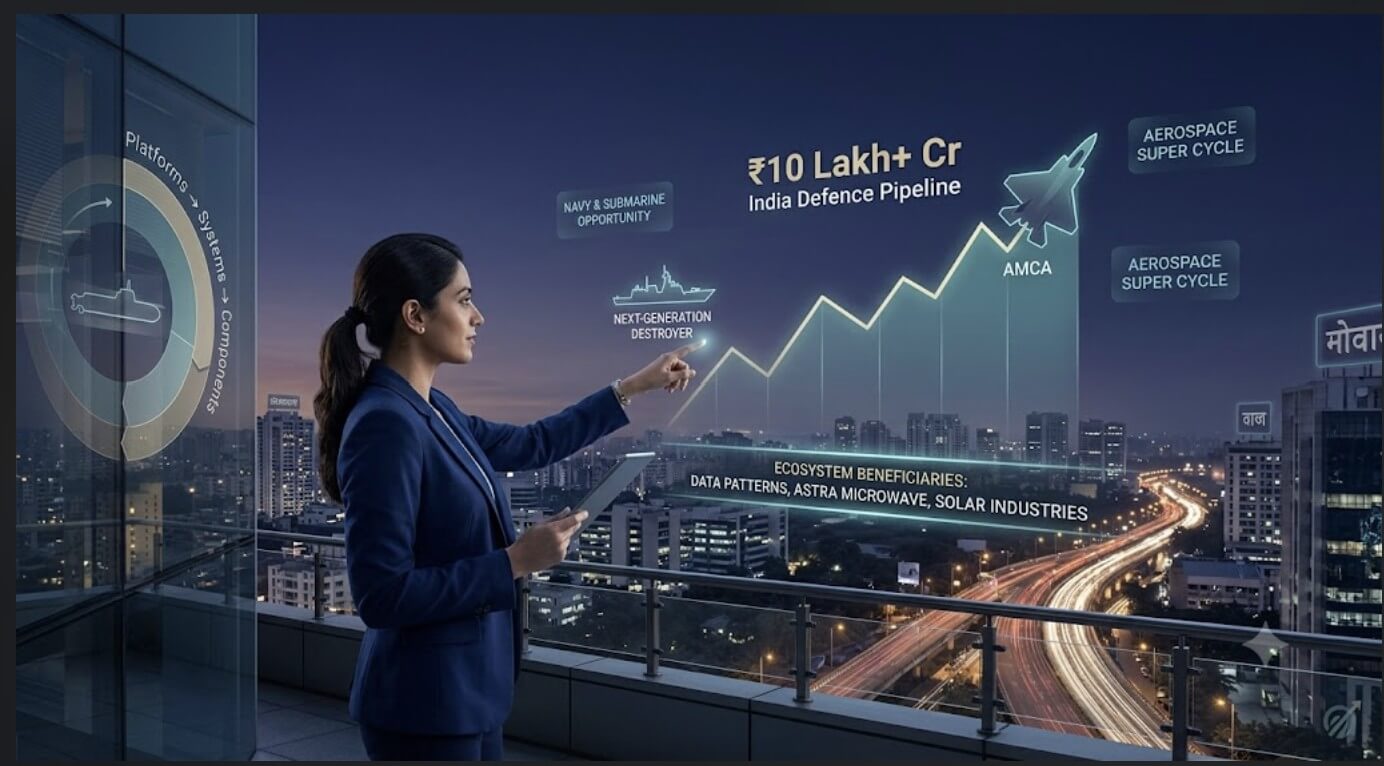
Introduction: A New Era of Indigenisation
The narrative surrounding domestic manufacturing has fundamentally shifted, and at the heart of this transformation is the India defence pipeline. With an estimated size exceeding ₹10 lakh crore, this pipeline is no longer just a collection of isolated procurement orders; it represents a multi-decade super cycle. Recent Defence Acquisition Council (DAC) approvals, including over ₹3.60 lakh crore cleared in the twelve months leading up to March 2026, highlight an aggressive push toward self-reliance. For investors, this creates a massive opportunity that extends far beyond the headline-grabbing prime contractors.
Read our comprehensive overview of the Indian manufacturing sector here.
1. Decoding the India Defence Pipeline Platforms
The core of this massive opportunity spans multiple domains—land, air, and sea. These large platform programs can create multi-year, predictable demand for suppliers.
Naval & Submarine Opportunities
The maritime domain is witnessing substantial capital allocation to secure the Indian Ocean region.
- Major Programs: Development of Next-Generation Destroyers and P-17B Frigates.
- Subsurface Strength: The P-75 Submarine program forms a major chunk of the opportunity, creating a baseline for indigenous submarine construction.
- Support & Warfare: Mine Counter Measure Vessels (MCMVs) and Landing Platform Docks (LPDs) will ensure long-term utilization for domestic shipyards.
Aerospace Expansion
Aerospace remains one of the highest-value segments of the India defence pipeline.
- Fighter Jets: The Advanced Medium Combat Aircraft (AMCA) represents a major long-term program, with bids for the indigenous fifth-generation jet recently extended to October 2026 and an initial ₹15,000 crore earmarked for prototypes. Additionally, the massive 114 Multi-Role Fighter Aircraft (MRFA) program is estimated at a staggering ₹3.25 lakh crore.
- Indigenous Upgrades: Tejas Mk2 adds indigenous demand, while Super Sukhoi modernizations and Do-228 upgrades ensure recurring maintenance and overhaul work.
Land Systems & Armoured Vehicles
The modernization of ground forces is shifting aggressively away from Soviet-era dependencies.
- Future Ready Combat Vehicle (FRCV): Estimated to be a ₹60,000 crore project, the FRCV will replace the aging T-72 tank fleet by 2030, securing decades of production for domestic vehicle manufacturers.
- Light Tanks: The Zorawar project adds immediate demand for specialized, high-altitude land combat systems.
2. Missiles & Air Defence Capabilities
Air defence and precision strike capabilities act as a crucial bridge in the India defence pipeline, integrating across various platforms.
- QRSAM (Quick Reaction Surface-to-Air Missile): Creates sustainable demand across sophisticated radar and ground-based missile systems.
- BrahMos-II: Adds a next-generation hypersonic missile opportunity to the portfolio.
- Deep Sourcing: Indigenous missile programs require specialized electronics, guidance systems, and propulsion units, expanding demand well beyond the primary integration contractors into smaller, niche tech firms.
3. The Second-Order Effect: Expanding the India Defence Pipeline
While a ₹1 lakh crore platform program creates exciting headlines, the true wealth-generation opportunity for investors often lies in the “Second-Order Effect.”
When prime contractors (like HAL or Mazagon Dock) win massive orders, they rely heavily on a deep supply chain. The defence super cycle is increasingly an ecosystem-wide opportunity, moving down the value chain from platforms to systems, and finally to components and raw materials.
Key Beneficiaries in the Defence Supplier Ecosystem
The opportunity extends well beyond traditional prime contractors. Domestic companies are rapidly moving up the value chain from mere component suppliers to critical technology developers and system integrators.
- Data Patterns & Astra Microwave: Highly exposed to the growing need for defence electronics, advanced radar, and RF systems.
- Apollo Micro Systems & Paras Defence: Key players participating in precision defence technologies and specialized subsystems.
- Solar Industries & Premier Explosives: Critical providers gaining massive exposure to the ammunition and explosives sector, which sees recurring demand.
- Bharat Forge & BEML: Benefiting from robust defence manufacturing, mobility solutions, and heavy engineering platforms.
Table: Value Chain Breakdown of the Defence Super Cycle
| Production Tier | Sector Examples | Investment Implication |
| Prime Platforms | Jets, Submarines, FRCV | High visibility, long gestation, robust order books. |
| Systems/Subsystems | Radars, Avionics, Propulsion | Recurring revenue, high margins, high technical barrier to entry. |
| Components/Materials | Precision Engineering, Alloys | Volume-driven, highly scalable as production ramps up. |
4. Indigenisation: Building Long-Duration Moats
The government’s focus on domestic sourcing, backed by Positive Indigenisation Lists, forces the industry to reduce dependence on imports. By mandating local procurement for massive projects like the FRCV, this policy shift ensures that defence capital expenditure remains within the country.
- Emergence of Tier-1/Tier-2 Suppliers: We are seeing the rise of strategic domestic suppliers capable of handling complex localization, decreasing reliance on foreign original equipment manufacturers (OEMs).
- Long-Duration Relationships: Platform programs span 10 to 30 years, creating sticky, long-duration supplier relationships that yield highly predictable cash flows for these underlying businesses.
Conclusion: Navigating the Defence Super Cycle
To summarize, a headline figure in the India defence pipeline is merely the tip of the iceberg. The broader transition of India from a major defence importer to a global manufacturing hub is cultivating a robust, vertically integrated ecosystem.
For stock market investors, the strategy should move beyond just chasing the largest platform manufacturers. By focusing on precision manufacturing, defence electronics, and ammunition suppliers, one can capitalize on the second-order effects of this unprecedented capital expenditure cycle.
Learn more about procurement policies at the Ministry of Defence.
This breakdown of the massive transport aircraft tender illustrates the execution challenges and domestic manufacturing mandates driving India’s aerospace pipeline.
Disclaimer: This article is for educational purposes only and not financial advice. Investors should do their own due diligence before investing.
Disclaimer: The projections of potential returns are based on current market conditions and company performance. Actual results may vary due to various factors, including market dynamics, economic conditions, and changes in the competitive landscape. Investors should conduct their own research and consult with financial advisors before making investment decisions.
Multibagger Stocks breakout stocks
⚠️ Not SEBI Registered—just here to share insights | 🚫 No paid services—everything shared is entirely free! 🧠 Always Learning and excited to grow together in this journey of market exploration.
📲 Join Our Investor Communities
Studying Online Economics Courses
🔹 Join our Telegram Channel: Multibagger Hunts
🔹 Join our WhatsApp Channel: Click to Join
✅ Free access
✅ Instant alerts
✅ Curated research for serious investors
TwitterXWhatsAppThreadsTelegramFacebookLinkedInGmailEmailShare