admin
admin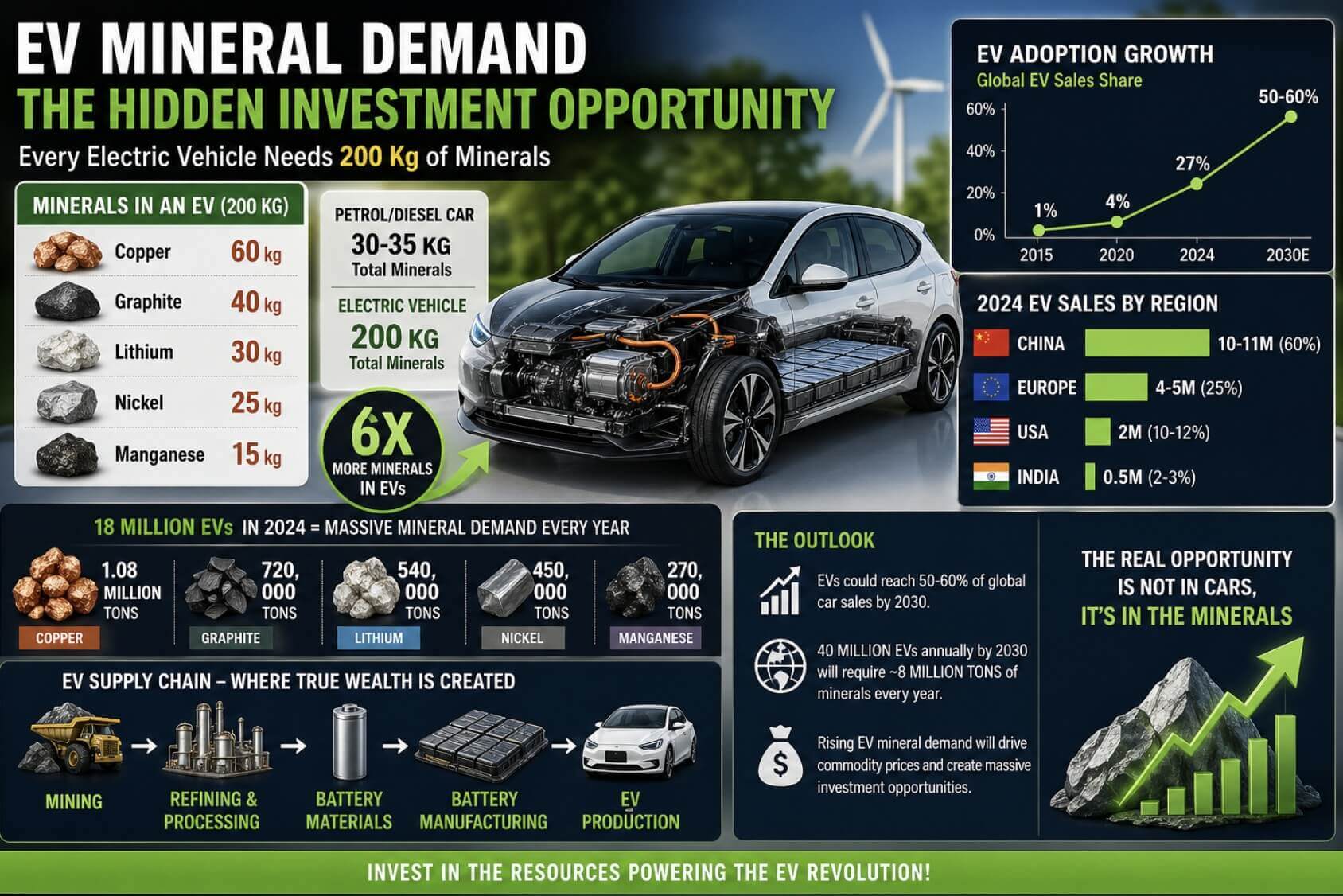
EV Mineral Boom: The Hidden Investment Opportunity Behind Electric Vehicles
The global shift toward electric vehicles (EVs) is often seen through the lens of car manufacturers—Tesla, BYD, or traditional automakers transitioning to electric. But that perspective misses the real story.
The true wealth in the EV revolution is not being created on the roads—it’s being extracted from the الأرض.
This is not just an automotive transition. It is a commodity supercycle in the making, driven by unprecedented demand for minerals like copper, lithium, graphite, nickel, and manganese.
If you are an investor and still focusing only on EV companies, you might be looking at the surface while ignoring the foundation.
1. The 200 kg Reality: EVs Are Mineral Machines
A modern electric vehicle requires approximately 200 kg of minerals, which includes:
- Copper – ~60 kg
- Graphite – ~40 kg
- Lithium – ~30 kg
- Nickel – ~25 kg
- Manganese – ~15 kg
Compare this with a traditional petrol or diesel car:
- Total minerals required – ~30–35 kg
👉 That’s nearly 6x more mineral intensity per EV.
What this means:
- Every EV sold significantly increases demand for mining output
- Supply chains are under pressure
- Commodity prices get structural support
This is not a temporary spike—it’s a multi-decade demand curve.
2. EV Adoption: From Negligible to Explosive Growth
Let’s look at how fast EV adoption has scaled:
| Year | EV Share of Global Car Sales |
|---|---|
| 2015 | ~1% |
| 2020 | ~4% |
| 2024 | ~27% |
| 2030 (Expected) | 50–60% |
In 2024 alone, around 18 million EVs were sold globally.
Regional Breakdown:
- China: 10–11 million (≈60% share)
- Europe: 4–5 million (≈25%)
- USA: ~2 million (≈10–12%)
- India: ~0.5 million (≈2–3%)
Insight:
India is still at an early stage, which means:
- Huge growth potential
- But currently minimal influence on global supply chains
3. The Real Opportunity: Minerals, Not Cars
Most investors think EV profits lie in:
- Car manufacturers
- Charging infrastructure
- Battery brands
But the real value chain looks like this:
Mining → Processing → Battery Manufacturing → EV Production
Where maximum control exists:
- Raw material extraction
- Refining and processing
- Battery-grade chemical production
Countries dominating this chain:
- Chile – Copper
- Australia – Lithium
- China – Graphite + battery manufacturing
- Africa – Emerging lithium and cobalt hubs
4. Demand Explosion: The Numbers Investors Can’t Ignore
With 18 million EVs sold annually:
- Copper demand: ~1.08 million tons
- Graphite demand: ~720,000 tons
- Lithium demand: ~540,000 tons
- Nickel demand: ~450,000 tons
- Manganese demand: ~270,000 tons
Future Scenario:
If global car sales reach 80 million annually, and:
- 50% are EVs → 40 million EVs
👉 Mineral demand could reach 8 million tons annually
Key takeaway:
This is not incremental demand.
This is exponential structural demand.
5. China’s Strategic Masterstroke
China understood this shift a decade ago and executed aggressively:
What China did right:
- Secured lithium mines in Africa
- Built dominant graphite processing capacity
- Established battery manufacturing leadership
- Controls 65%+ of global battery production
Result:
China doesn’t just build EVs—it controls the entire supply chain.
6. India’s Position: Opportunity or Missed Bus?
India has:
- 1.4 billion population
- One of the largest auto markets
- Strong manufacturing ambitions
But currently:
- EV adoption is low
- Mineral ownership is negligible
- Supply chain dependence is high
The concern:
India is focusing on:
- Charging infrastructure
- EV adoption policies
While missing:
- Resource acquisition
- Global supply chain integration
7. Commodity Supercycle: Is It Already Started?
A commodity supercycle occurs when:
- Demand grows structurally
- Supply cannot keep up
- Prices rise over long periods
Indicators we are seeing:
- Rising copper demand from electrification
- Lithium price volatility but strong long-term trend
- Graphite demand increasing with battery production
Why this cycle is different:
- Driven by policy + climate goals
- Backed by global government incentives
- Supported by irreversible technology shift
8. Investment Opportunities: Where Smart Money Flows
A. Copper – The Backbone of Electrification
- Used in wiring, motors, charging infrastructure
- EVs use 2–4x more copper than ICE vehicles
Investment angle:
- Copper miners
- Refining companies
- Infrastructure suppliers
B. Lithium – The Battery Core
- Essential for energy storage
- High demand volatility
Investment angle:
- Lithium mining companies
- Battery chemical producers
C. Graphite – The Silent Giant
- Largest component in battery by weight
- China dominates processing
Investment angle:
- Emerging graphite producers
- Non-China supply chains
D. Nickel & Manganese
- Used in battery chemistry
- Improve energy density and stability
Investment angle:
- Integrated mining companies
- Battery material suppliers
9. Risks Investors Must Not Ignore
1. Commodity Price Volatility
- Lithium prices can swing sharply
- Cyclical downturns possible
2. Technological Changes
- New battery tech may reduce certain minerals
- Solid-state batteries could disrupt demand mix
3. Geopolitical Risks
- Resource nationalism
- Export restrictions
4. Environmental Regulations
- Mining approvals becoming stricter
- ESG compliance costs rising
10. India-Specific Investment Strategy
Even though India lags globally, there are opportunities:
Focus Areas:
- Metal companies expanding into EV supply chain
- Battery manufacturing initiatives
- Recycling and circular economy
Strategy:
- Look for companies with backward integration plans
- Track government policies on critical minerals
- Monitor partnerships with global players
11. Future Outlook: 2030 and Beyond
By 2030:
- EV penetration could reach 50–60%
- Mineral demand could double or triple
- Supply shortages may emerge
What this means:
- Prices likely to remain elevated
- Mining companies could see massive valuations
- Supply chain control becomes geopolitical power
12. Final Investor Takeaway
This is not just about electric vehicles.
This is about control over the building blocks of the future economy.
Ask yourself:
- Are you investing in companies building cars?
- Or companies supplying the materials that make those cars possible?
Because history shows:
- Gold rush winners were not miners—but those supplying tools
- In EV revolution, minerals are the new gold
Quick Summary (For Fast Readers)
- EVs require 6x more minerals than ICE cars
- Global EV sales reached 18M in 2024
- Could hit 40M annually by 2030
- Massive demand for:
- Copper
- Lithium
- Graphite
- China dominates supply chain
- India is still early but has opportunity
- Commodity supercycle may already be underway
Conclusion
The EV revolution is not just reshaping transportation—it is redefining global resource economics.
Investors who recognize this early can position themselves ahead of one of the biggest wealth creation cycles of this decade.
Ignore it—and you may watch the next commodity boom pass by.
Disclaimer: This article is for educational purposes only and not financial advice. Investors should do their own due diligence before investing.
Disclaimer: The projections of potential returns are based on current market conditions and company performance. Actual results may vary due to various factors, including market dynamics, economic conditions, and changes in the competitive landscape. Investors should conduct their own research and consult with financial advisors before making investment decisions.
Multibagger Stocks breakout stocks
⚠️ Not SEBI Registered—just here to share insights | 🚫 No paid services—everything shared is entirely free! 🧠 Always Learning and excited to grow together in this journey of market exploration.
📲 Join Our Investor Communities
🔹 Join our Telegram Channel: Multibagger Hunts
🔹 Join our WhatsApp Channel: Click to Join
✅ Free access
✅ Instant alerts
✅ Curated research for serious investors
TwitterXWhatsAppThreadsTelegramFacebookLinkedInGmailEmailShare