admin
admin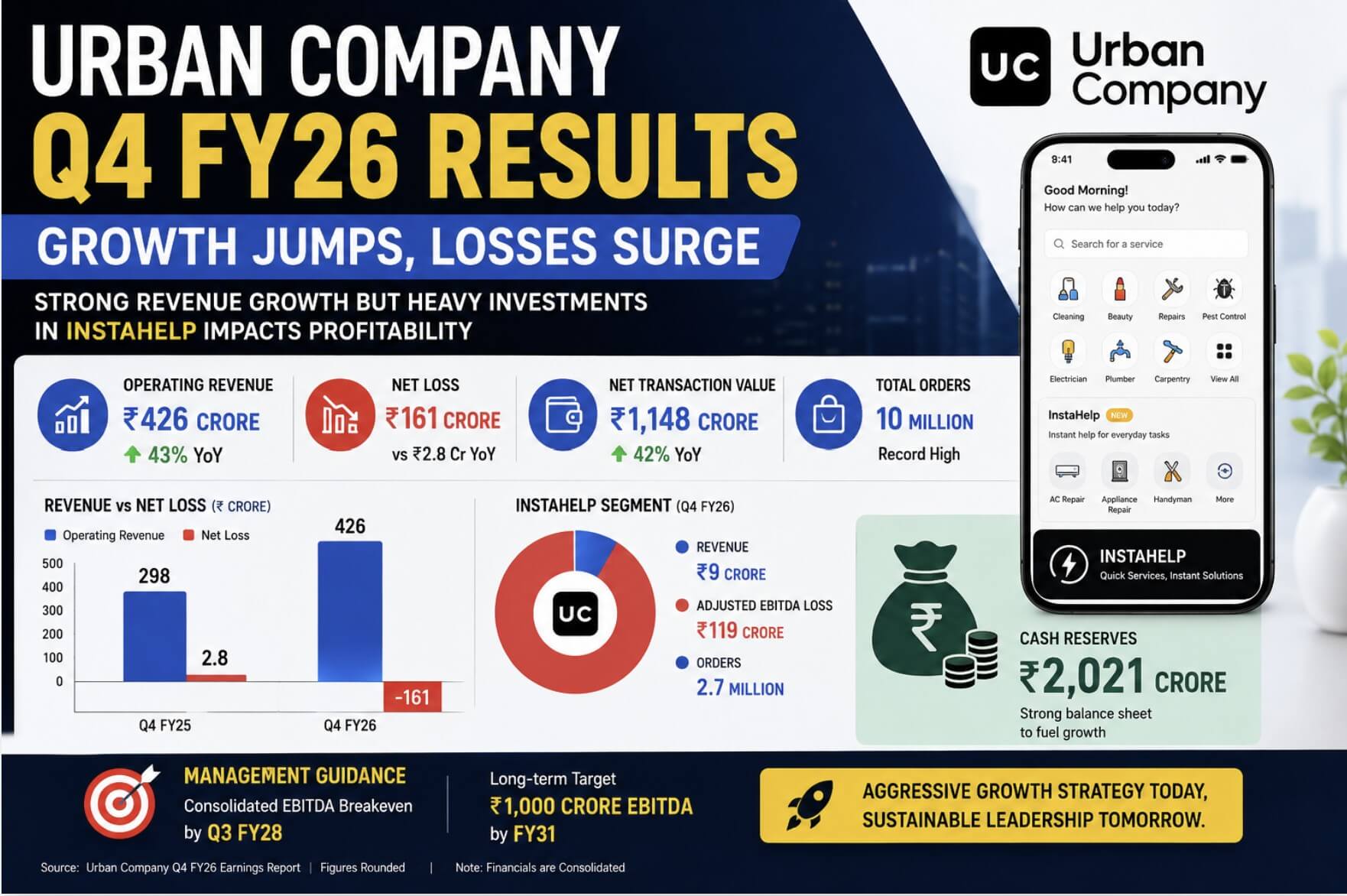
Urban Company Q4 FY26 Results Analysis: Growth vs Profitability Dilemma
Urban Company’s Q4 FY26 earnings present a classic high-growth startup paradox: rapid expansion with rising losses. While the company has delivered impressive topline growth and user traction, profitability remains distant due to aggressive investments—especially in its InstaHelp quick-service segment.
This detailed analysis breaks down the numbers, strategic decisions, risks, and long-term outlook to help investors understand whether this is a future giant in the making or a cash-burning concern.
1. Key Highlights from Q4 FY26
- Revenue: ₹426 crore (↑ 43% YoY)
- Net Loss: ₹161 crore (vs ₹2.8 crore last year)
- Adjusted EBITDA Loss: ~₹98 crore
- Net Transaction Value (NTV): ₹1,148 crore (↑ 42% YoY)
- Total Orders: 10 million (record high)
- InstaHelp Revenue: ₹9 crore
- InstaHelp EBITDA Loss: ₹119 crore
- Cash Reserves: ₹2,021 crore
👉 Quick Take:
Urban Company is scaling fast, but profitability has taken a backseat due to aggressive expansion.
2. Revenue Analysis: Strong Demand Momentum
Urban Company’s 43% YoY revenue growth signals strong demand across its platform.
What’s driving this growth?
- Expansion in Tier 2 & Tier 3 cities
- Increased repeat customer base
- Higher service frequency per user
- Growth in categories like cleaning, repair, and beauty
Why this matters:
- High revenue growth shows product-market fit is strong
- Indicates increasing consumer trust in service platforms
- Suggests Urban Company is becoming a habit-based platform
👉 Investor Insight:
Revenue growth above 40% in a scaled business is rare—this signals category leadership potential.
3. Profitability Breakdown: Where Things Went Wrong
Despite strong growth, losses surged dramatically.
Key reasons:
- Heavy investment in InstaHelp (quick-service vertical)
- Customer acquisition costs rising
- Subsidized pricing to gain market share
- Operational inefficiencies in scaling new services
Numbers tell the story:
| Metric | Q4 FY25 | Q4 FY26 |
|---|---|---|
| Revenue | ₹298 Cr (approx) | ₹426 Cr |
| Net Loss | ₹2.8 Cr | ₹161 Cr |
| EBITDA Loss | Moderate | Severe |
👉 Key Observation:
Losses have grown faster than revenue, which is a red flag in the short term.
4. InstaHelp: Growth Engine or Cash Burn Machine?
InstaHelp is Urban Company’s biggest strategic bet—and biggest concern.
Segment Snapshot:
- Revenue: ₹9 crore
- Orders: 2.7 million
- EBITDA Loss: ₹119 crore
What is InstaHelp?
A quick-response service model similar to hyperlocal delivery platforms—focused on instant home services.
Why Urban Company is betting big on InstaHelp
- Captures impulse demand
- Competes with emerging quick-service startups
- Improves customer engagement frequency
- Builds long-term ecosystem dominance
The Problem
- Extremely high cost per order
- Low ticket size
- Operational complexity
- Heavy discounting
👉 Investor Reality Check:
InstaHelp is currently value destructive, but could become a moat if scaled efficiently.
5. Cash Flow & Balance Sheet Strength
One major positive is Urban Company’s strong cash position.
Cash Reserves: ₹2,021 crore
This gives the company:
- Ability to sustain losses for multiple years
- Flexibility to invest aggressively
- Cushion against market downturns
But there’s a catch
If losses continue at current levels:
- Cash runway could shrink rapidly
- Future funding or dilution may be required
👉 Conclusion:
Strong balance sheet = time to execute, not a guarantee of success.
6. Management Strategy: Aggressive but Risky
Urban Company management is prioritizing growth over profits.
Key Guidance:
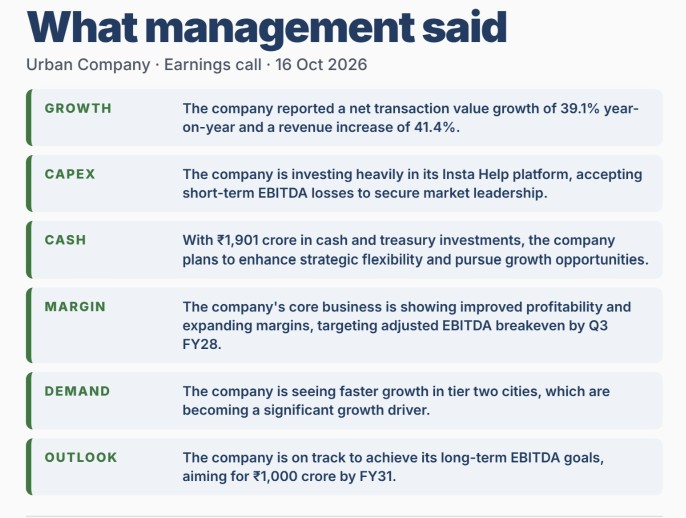
- EBITDA breakeven expected by Q3 FY28
- Long-term target: ₹1,000 crore EBITDA by FY31
Strategic Approach
- Capture market share early
- Build ecosystem dominance
- Monetize later
Pros of this strategy
- First-mover advantage
- Strong brand recall
- High customer stickiness
Cons
- Long wait for profitability
- Execution risks
- Dependence on external capital
👉 Investor Interpretation:
This is a high-risk, high-reward strategy.
7. Industry Comparison: Where Urban Company Stands
Urban Company operates in the home services marketplace, competing with:
- Local unorganized players
- Regional startups
- Gig platforms
Competitive Advantages
- Standardized service quality
- Verified professionals
- Strong app experience
- Brand trust
Challenges
- Low switching cost for customers
- Price sensitivity
- Supply-side management (service providers)
👉 Conclusion:
Urban Company leads the space but moat is not yet unbreakable.
8. Unit Economics: The Core Concern
The biggest concern lies in unit economics, especially in new segments.
Key Issues:
- High CAC (Customer Acquisition Cost)
- Low average order value
- High service delivery cost
- Incentives for service professionals
Why this matters
If unit economics don’t improve:
- Scaling will increase losses
- Profitability timeline may extend beyond FY28
👉 Critical Insight:
Growth without improving unit economics is unsustainable.
9. Market Sentiment & Investor Behavior
Despite losses, investor interest remains high.
Why?
- Strong growth story
- Large addressable market
- Platform scalability
But here’s the concern
Some investors may be:
- Overlooking profitability risks
- Betting purely on future potential
👉 Reality Check:
Markets often reward growth—but eventually demand profits.
10. Risks Investors Must Watch
Major Risks:
- Continued high cash burn
- Failure of InstaHelp model
- Rising competition
- Regulatory changes in gig economy
- Customer churn due to pricing
Hidden Risk
If Urban Company fails to achieve breakeven by FY28:
- Investor confidence may decline
- Valuations could compress
11. Future Outlook: Can Urban Company Turn Profitable?
Bull Case:
- InstaHelp becomes profitable
- Strong repeat customer base
- Improved margins over time
- Platform dominance
Bear Case:
- Losses continue rising
- Cash reserves deplete
- Growth slows down
- Competition intensifies
👉 Base Case (Most Likely):
Gradual improvement, but profitability will take time (3–5 years).
12. Strategic Turning Points to Watch
Investors should track:
- InstaHelp unit economics improvement
- Reduction in EBITDA losses
- Customer retention metrics
- Contribution margin trends
- Cash burn rate
13. Investment Perspective: Should You Be Bullish or Cautious?
Bullish View:
- High growth potential
- Strong brand
- Large market opportunity
Cautious View:
- No near-term profits
- Aggressive spending
- Execution risks
👉 Final Investor Take:
Urban Company is not a short-term profit story—it’s a long-term execution bet.
14. Final Verdict
Urban Company’s Q4 FY26 results highlight a clear strategic choice:
Sacrifice profits today to dominate tomorrow
While revenue growth and order volumes are impressive, the sharp rise in losses—especially from InstaHelp—raises concerns.
Bottom Line
- ✅ Strong growth
- ❌ Weak profitability
- ⚠️ High execution risk
- ⏳ Long wait for returns
Conclusion
The EV revolution is not just reshaping transportation—it is redefining global resource economics.
Investors who recognize this early can position themselves ahead of one of the biggest wealth creation cycles of this decade.
Ignore it—and you may watch the next commodity boom pass by.
Disclaimer: This article is for educational purposes only and not financial advice. Investors should do their own due diligence before investing.
Disclaimer: The projections of potential returns are based on current market conditions and company performance. Actual results may vary due to various factors, including market dynamics, economic conditions, and changes in the competitive landscape. Investors should conduct their own research and consult with financial advisors before making investment decisions.
Multibagger Stocks breakout stocks
⚠️ Not SEBI Registered—just here to share insights | 🚫 No paid services—everything shared is entirely free! 🧠 Always Learning and excited to grow together in this journey of market exploration.
📲 Join Our Investor Communities
🔹 Join our Telegram Channel: Multibagger Hunts
🔹 Join our WhatsApp Channel: Click to Join
✅ Free access
✅ Instant alerts
✅ Curated research for serious investors
TwitterXWhatsAppThreadsTelegramFacebookLinkedInGmailEmailShare