admin
admin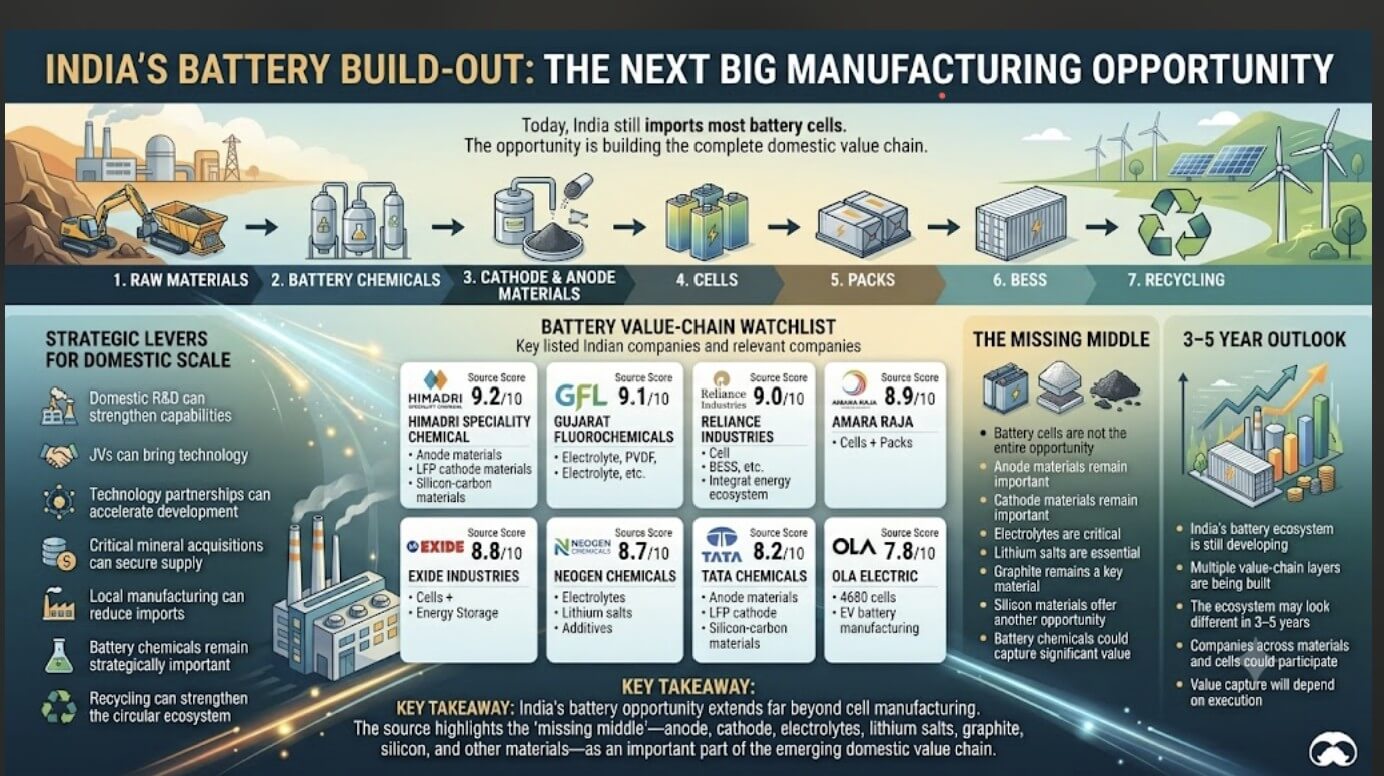
The India battery value chain is undergoing a massive industrial transformation as the country accelerates its clean energy transition. Today, India still imports most of its battery cells from overseas suppliers. However, domestic manufacturing capabilities are expanding at a rapid pace. Building an end-to-end domestic supply chain is now essential for long-term national security.
In addition, the market opportunity extends far beyond simple pack assembly. Investors and manufacturers must evaluate the complete chemical, material, and electromechanical ecosystem. Specifically, upstream chemicals and active materials offer higher margins and wider competitive moats. This comprehensive guide analyzes every layer of the India battery value chain, evaluates key listed stocks, and highlights major industrial trends.
1. Mapping the 7 Stages of the India Battery Value Chain
The production of an advanced energy storage system requires seven distinct steps. Consequently, each stage demands specific technological capabilities, capital investments, and regulatory standards.
Raw Materials ➔ Battery Chemicals ➔ Cathode & Anode ➔ Cells ➔ Packs ➔ BESS ➔ Recycling
+-----------------------------------------------------------------------------------+
|                        THE BATTERY VALUE-CHAIN PIPELINE                           |
+-----------------------------------------------------------------------------------+
| 1. RAW MATERIALS       | Lithium, Nickel, Cobalt, Graphite, Phosphate, Fluorspar  |
| 2. BATTERY CHEMICALS   | Electrolytes, Lithium Salts (LiPF6), PVDF, Additives     |
| 3. ACTIVE MATERIALS    | Cathode (LFP, NMC) & Anode (Synthetic Graphite, Silicon) |
| 4. CELL MANUFACTURING  | Li-ion, Sodium-ion, Prismatic, Cylindrical (4680)        |
| 5. PACK INTEGRATION    | Thermal Cooling, Enclosures, BMS Architecture            |
| 6. BESS SOLUTIONS      | Utility-Scale Grid Balancing, Renewable Integration      |
| 7. RECYCLING           | Hydrometallurgical Extraction, Black Mass Refining       |
+-----------------------------------------------------------------------------------+
Stage 1: Raw Materials Extraction and Refining
First, raw minerals must be mined and refined to chemical purities above 99.5%.
- Key upstream inputs include lithium, nickel, cobalt, high-purity graphite, phosphate, and fluorspar.
- India historically lacked commercial extraction of battery-grade lithium or cobalt.
- Therefore, the central government launched the Ministry of Mines critical mineral initiative to acquire foreign resource assets.
- Readers can explore our detailed analysis of critical mineral exploration policy to see how overseas corridors operate.
Stage 2: Specialty Battery Chemicals
Next, industrial chemical companies convert raw minerals into complex, functional battery compounds.
- Electrolytes: These liquids facilitate ion transport between cell electrodes.
- Lithium Salts: Chemical plants produce lithium hexafluorophosphate ($LiPF_6$) as a primary solute.
- Electrode Binders: Polyvinylidene fluoride (PVDF) binds active chemical particles to current collectors.
- Specialty Additives: Functional additives stabilize the solid electrolyte interphase (SEI) layer. As a result, they prolong battery cycle life.
Stage 3: Cathode and Anode Active Materials
Active materials determine cell energy density, safety, and operational longevity.
- Cathode Active Materials (CAM): Common chemistries include Lithium Iron Phosphate (LFP) and Nickel Manganese Cobalt (NMC).
- Anode Active Materials (AAM): Manufacturers rely primarily on synthetic and natural coated graphite.
- Silicon Additives: In addition, developers add silicon-carbon composites to boost overall anode capacity.
- Hard Carbon: This carbonaceous material serves as the primary host lattice in emerging sodium-ion designs.
Stage 4: Cell Fabrication
During this step, automated machinery coats active slurries onto metal foils.
- Operators run slitting, winding, and stacking lines inside controlled dry rooms.
- These cleanrooms must maintain atmospheric dew points below -40°C.
- Furthermore, plants produce diverse form factors such as cylindrical 4680 cans, prismatic cells, and pouch formats.
- Cell chemistries in India are splitting between standard lithium-ion and sodium-ion platforms.
Stage 5: Pack Integration and Assembly
Individual cells are connected into modules and enclosed within structural packs.
- Battery Management Systems (BMS): Microcontrollers monitor state-of-charge, cell balance, and thermal limits.
- Thermal Management: Cold plates, dielectric fluids, and heat pipes control operational temperatures.
- Consequently, localized pack packaging serves electric two-wheelers, passenger cars, and commercial haulage fleets.
- You can learn more about fleet electrification in our guide on Indian EV market expansion.
Stage 6: Battery Energy Storage Systems (BESS)
At the utility tier, companies assemble containerized BESS arrays for stationary grid stabilization.
- Large-scale BESS installations store intermittent solar and wind energy during the day.
- Then, they supply peak power to local grids during evening hours.
- Furthermore, these systems provide critical grid frequency control and defer transmission investments.
- Check out our research on renewable energy storage systems in India for additional market data.
Stage 7: Closed-Loop Battery Recycling
Finally, recycling completes the domestic circular economy.
- Spent batteries and factory scrap are shredded into “black mass”.
- Subsequently, hydrometallurgical processing leaches out battery-grade lithium, cobalt, and nickel salts.
- Recycled secondary minerals re-enter chemical production lines directly.
- Thus, domestic recycling minimizes dependency on volatile foreign mineral markets.
2. The “Missing Middle” in the India Battery Value Chain
Most media attention focuses on headline-grabbing cell assembly gigafactories. However, cell assembly alone captures a relatively modest portion of final product value. Industry veterans identify active materials and chemical synthesis as the “Missing Middle”. This critical layer represents the largest share of production cost and margin capture.
+-----------------------------------------------------------------------+
|                    TYPICAL LFP CELL COST BREAKDOWN                    |
+-----------------------------------------------------------------------+
|  Cathode Active Material (LFP)                | ~38% - 44%            |
|  Anode Active Material (Graphite/Silicon)     | ~12% - 15%            |
|  Electrolyte & Lithium Salts (LiPF6)          | ~10% - 14%            |
|  Separator, PVDF Binders & Additives          | ~6%  - 8%             |
|  Current Collectors (Copper & Aluminum Foils) | ~7%  - 9%             |
|  Cell Assembly, Labor, Depreciation & Energy  | ~14% - 17%            |
+-----------------------------------------------------------------------+
When an enterprise builds an assembly plant without domestic material suppliers, it must import over 70% of its input costs. This dynamic creates three major business implications:
- Assembly Margins Remain Compressed: Unintegrated cell fabricators operate under thin margins because raw commodity prices fluctuate constantly.
- Chemical Synthesizers Hold Pricing Power: In contrast, producers of purified $LiPF_6$ salts, PVDF binders, and specialty additives enjoy strong supplier power.
- Intellectual Property Safeguards Profits: Synthesizing uniform nano-scale cathode powders requires complex patents, specialized reactors, and long qualification timelines.
Therefore, true industrial self-reliance requires developing these chemical building blocks inside India. Without backward integration, cell manufacturers remain exposed to external supply disruptions.
3. Leading Indian Companies in the Battery Value Chain
Multiple listed Indian corporations are allocating substantial capital to build out manufacturing capacity. Below is a structured summary of ten prominent players, highlighting their segment focus and source performance scores.
+----------------------------------------------------------------------------------------------------------+
| Company Name                 | Score  | Primary Segment Focus              | Key Value Chain Placement   |
+----------------------------------------------------------------------------------------------------------+
| Himadri Speciality Chemical  | 9.2/10 | Anode, LFP Cathode, Silicon-Carbon | Battery Materials           |
| Gujarat Fluorochemicals (GFL)| 9.1/10 | LiPF6, Electrolytes, PVDF, Cathode | Battery Chemicals & Mat.    |
| Reliance Industries          | 9.0/10 | Integrated Cells, BESS, Sodium-Ion | Cells + BESS                |
| Amara Raja Energy & Mobility | 8.9/10 | Li-ion Cells, Packs, BESS          | Cells + Packs               |
| Exide Industries             | 8.8/10 | Li-ion Cells, Energy Storage       | Cells + Packs               |
| Neogen Chemicals             | 8.7/10 | Electrolytes, Lithium Salts        | Battery Chemicals           |
| Tata Chemicals               | 8.2/10 | Sodium-ion Chemistry, Soda Ash     | Sodium-ion / Raw Materials  |
| Ola Electric                 | 7.8/10 | 4680 Cells, In-house EV Packs      | Cells                       |
| Jupiter Wagons               | 7.3/10 | Battery Packs, Rail/Grid BESS      | Packs + BESS                |
| HBL Power Systems            | 7.2/10 | Specialized Defence & Indus. Cells | Battery Systems             |
+----------------------------------------------------------------------------------------------------------+
Himadri Speciality Chemical (Score: 9.2/10)
Himadri Speciality Chemical has established a commanding position in upstream battery materials.
- Core Competencies: The company leverages captive coal pitch streams to synthesize high-purity needle coke and synthetic anode materials.
- Product Portfolio: Himadri is scaling commercial output for synthetic graphite anodes, silicon-carbon composites, and LFP cathode materials.
- Investment Moat: Captive control of raw material precursors allows Himadri to maintain cost leadership over global merchant suppliers.
Gujarat Fluorochemicals (Score: 9.1/10)
Gujarat Fluorochemicals (GFL) applies its leadership in industrial fluoropolymers to manufacture critical battery chemicals.
- Core Competencies: The company controls captive fluorspar reserves and industrial hydrofluoric acid capacity.
- Product Portfolio: GFL manufactures formulated electrolytes, battery-grade $LiPF_6$ salts, PVDF electrode binders, and cathode precursors.
- Investment Moat: Very few global firms outside China possess integrated fluorochemical production lines, giving GFL a strong export advantage.
Reliance Industries (Score: 9.0/10)
Reliance Industries is constructing an integrated green energy ecosystem at Jamnagar.
- Core Competencies: Reliance deploys massive capital reserves, manages large-scale execution, and licenses proprietary global intellectual property.
- Product Portfolio: The business focuses on gigawatt-scale cell manufacturing, utility BESS containers, and sodium-ion platforms.
- Investment Moat: Reliance creates captive internal demand across its telecom networks, logistics fleets, and large solar parks.
Amara Raja Energy & Mobility (Score: 8.9/10)
Amara Raja is transforming its traditional industrial lead-acid business into an advanced chemistry enterprise.
- Core Competencies: It benefits from broad distribution networks, existing OEM relationships, and advanced pack engineering.
- Product Portfolio: Amara Raja is developing lithium-ion cell gigafactories, custom mobility packs, and commercial BESS containers.
- Investment Moat: Strong cash flows from its legacy battery division provide funding for long-term capital expenditure.
Exide Industries (Score: 8.8/10)
Exide Industries has committed significant resources toward large-scale automotive cell production.
- Core Competencies: Exide has partnerships with domestic vehicle manufacturers and leverages an extensive national service footprint.
- Product Portfolio: Through its dedicated subsidiary Exide Energy Solutions, the company manufactures LFP and NMC cells in collaboration with international technology partners.
- Investment Moat: Existing automotive supply agreements streamline commercial off-take for new cell production lines.
Neogen Chemicals (Score: 8.7/10)
Neogen Chemicals is translating its specialty organic chemistry capabilities into high-demand battery inputs.
- Core Competencies: The company specializes in complex organo-lithium synthesis and precise purification processes.
- Product Portfolio: Neogen produces formulated electrolytes, specialty lithium salts like $LiPF_6$, and functional chemical additives.
- Investment Moat: Technical licensing agreements with established Japanese chemical partners provide validated formulations.
Tata Chemicals (Score: 8.2/10)
Tata Chemicals anchors the inorganic raw material infrastructure of the Tata Group.
- Core Competencies: The company maintains global scale in soda ash processing and basic chemical manufacturing.
- Product Portfolio: It supplies basic chemical building blocks for sodium-ion batteries and conducts advanced recycling research.
- Investment Moat: Because sodium-ion cells rely on soda ash, Tata Chemicals serves as a foundational upstream supplier.
Ola Electric (Score: 7.8/10)
Ola Electric combines high-volume two-wheeler assembly with vertical cell integration.
- Core Competencies: The company excels at rapid consumer scaling, automated module design, and in-house software engineering.
- Product Portfolio: Ola is scaling production of proprietary large-format 4680 cylindrical cells at its Tamil Nadu gigafactory.
- Investment Moat: Captive internal consumption eliminates customer acquisition risks for every cell produced on-site.
Jupiter Wagons (Score: 7.3/10)
Jupiter Wagons is expanding from heavy railway rolling stock into industrial energy packaging.
- Core Competencies: The company offers specialized mechanical manufacturing, structural chassis engineering, and thermal packaging.
- Product Portfolio: It develops rugged battery packs for commercial vehicles, auxiliary train electrical systems, and stationary BESS platforms.
- Investment Moat: Captive access to Indian Railways procurement tenders delivers steady, predictable baseline order volume.
HBL Power Systems (Score: 7.2/10)
HBL Power Systems engineers customized power solutions for mission-critical industrial applications.
- Core Competencies: The enterprise maintains deep technical compliance for specialized defense, aviation, and railway safety equipment.
- Product Portfolio: HBL manufactures specialized electronic battery packs, electronic train safety units, and industrial storage systems.
- Investment Moat: Stringent regulatory defense certifications shield the company from aggressive commercial pricing pressure.
4. Chemistry Breakdown: Lithium-Ion vs. Sodium-Ion
Picking the right battery chemistry is crucial for the Indian operating environment. Consequently, domestic producers are investing in both lithium and sodium architectures.
+-------------------------------------------------------------------------------------------+
| Feature              | Lithium Iron Phosphate (LFP) | Sodium-Ion (Na-Ion)                 |
+-------------------------------------------------------------------------------------------+
| Raw Material Access  | Lithium import-dependent     | Abundant domestic soda ash reserves |
| Fire Safety / Temp.  | Excellent up to 55°C ambient | Superior thermal stability          |
| Cycle Life           | 3,000 - 6,000 cycles         | 2,000 - 4,000 cycles                |
| Volumetric Density   | 140 - 180 Wh/kg              | 100 - 160 Wh/kg                     |
| Estimated Pack Cost  | Baseline market benchmark    | 20% - 35% lower at full scale       |
| Primary Applications | Long-range EVs, Urban 2W     | Stationary BESS, Micro-EVs, 2W/3W   |
+-------------------------------------------------------------------------------------------+
Why Sodium-Ion Matters for India
Sodium-ion chemistry provides several strategic benefits:
- First, sodium uses common soda ash ($Na_2CO_3$), bypassing expensive lithium imports.
- Second, sodium does not react with aluminum at low voltages. Therefore, manufacturers use cheap aluminum foils on both electrodes instead of expensive copper.
- Third, sodium-ion batteries exhibit superior thermal stability during hot Indian summers.
- Finally, these cells can safely discharge to zero volts for transport without suffering damage, which lowers shipping risks and logistics costs.
5. Strategic Levers Powering the India Battery Value Chain
Building a domestic battery industry requires coordinated policy, capital, and engineering execution. Six primary strategic drivers are accelerating this build-out:
+---------------------------------------------------------------------------------------+
|                       STRATEGIC LEVERS FOR DOMESTIC SCALE                             |
+---------------------------------------------------------------------------------------+
| 1. DOMESTIC R&D           | National labs & universities refining local chemistries   |
| 2. JOINT VENTURES         | International technology transfers for production scale   |
| 3. RESOURCE SECUREMENT    | KABIL scouting lithium, nickel & cobalt overseas          |
| 4. LOCAL MANUFACTURING    | Deploying PLI allocations for ACC gigawatt facilities     |
| 5. SPECIALTY CHEMICALS    | Captive production of electrolytes, salts, and binders    |
| 6. RECYCLING SYSTEMS      | Hydrometallurgical plants recycling black mass locally    |
+---------------------------------------------------------------------------------------+
- Domestic Research Initiatives: Research institutions like IIT Madras and CECRI are engineering localized electrolyte recipes tailored for hot climates.
- International Technology Partnerships: Domestic companies are signing technology licensing agreements with global battery innovators to shorten learning curves.
- Government Resource Acquisition: Public joint ventures like KABIL are acquiring overseas mining interests to secure upstream supply chains.
- Production Linked Incentives (PLI): The Ministry of Heavy Industries administers the ACC PLI scheme to mandate domestic value addition over time.
- Specialty Chemical Expansion: Chemical platforms are scaling up domestic fluorochemical and lithium refining facilities.
- Urban Mining Networks: Modern hydrometallurgical recycling facilities are converting spent cells and production scrap into high-purity battery chemicals.
- Furthermore, to understand broader clean industrial investments, read our market review of green hydrogen ecosystem developments.
6. Investment Risks and Market Headwinds
While growth prospects are strong, participants in the India battery value chain face several structural risks:
+-------------------------------------------------------------------------------------------+
| Risk Factor               | Impact on Value Chain            | Mitigation Strategy        |
+-------------------------------------------------------------------------------------------+
| Raw Material Volatility   | Compresses margins for           | Index-linked contracts,    |
|                           | unintegrated cell fabricators    | circular scrap recycling   |
| Extended Payback Horizons | High depreciation during initial | Modular phased capacity,   |
|                           | 24 to 36-month plant ramp-ups    | strong debt structures     |
| Technology Shifts         | Early obsolescence if solid-     | Chemistry-agnostic lines,  |
|                           | state arrives quickly            | flexible dry-room setups   |
| Environmental Clearances  | Lengthy timelines for chemical,  | Industrial cluster zoning, |
|                           | refining, and recycling permits  | zero-liquid-discharge      |
+-------------------------------------------------------------------------------------------+
- Commodity Price Swings: Sudden drops or spikes in international lithium carbonate prices disrupt project economics.
- Extended Ramp-up Timelines: Building a gigafactory requires two to three years of construction, followed by delicate yield-optimization phases.
- Rapid Chemistry Evolution: Heavy capital commitments to standard NMC cells face disruption if LFP or solid-state designs gain share faster than expected.
- Strict Environmental Compliance: Battery chemical synthesis and cathode manufacturing demand zero-liquid-discharge facilities and thorough wastewater treatment.
7. The 3-to-5-Year Outlook for the India Battery Value Chain
The domestic battery sector will experience a major transformation over the next three to five years.
- Near-Term (Next 12–18 Months): Cell packagers will capture vehicle growth using imported cells, while early gigafactories begin test production.
- Medium-Term (Years 2–3): Major cell gigafactories will come online under the PLI scheme, lowering raw cell import dependence.
- Long-Term (Years 4–5): Upstream chemical and anode producers will supply high volumes of domestic materials, completing backward integration and expanding operating margins.
In conclusion, winning companies will not simply assemble imported components. Instead, the highest long-term returns will accrue to businesses that master specialty chemical synthesis, secure active materials, and establish closed-loop recycling loops.
Value Chain FAQ
Why is the India battery value chain strategically important?
India currently imports the vast majority of its battery cells. Developing a localized supply chain protects foreign exchange reserves, ensures energy security, and creates domestic high-tech manufacturing jobs.
What is the “Missing Middle” in battery manufacturing?
The “Missing Middle” refers to cathode materials, anode materials, electrolytes, lithium salts, and binders. While often overlooked, these chemical inputs represent over 70% of a battery cell’s material cost and hold the highest operating margins.
Which battery chemistry is best suited for India?
Lithium Iron Phosphate (LFP) is currently the leading choice due to its thermal safety and cycle life. However, sodium-ion technology is emerging as a strong alternative for stationary storage and urban two-wheelers because of abundant local raw materials and lower production costs.
Which battery chemistry is best suited for India?
Lithium Iron Phosphate (LFP) is currently the leading choice due to its thermal safety and cycle life. However, sodium-ion technology is emerging as a strong alternative for stationary storage and urban two-wheelers because of abundant local raw materials and lower production costs.
Disclaimer: The projections of potential returns are based on current market conditions and company performance. Actual results may vary due to various factors, including market dynamics, economic conditions, and changes in the competitive landscape. Investors should conduct their own research and consult with financial advisors before making investment decisions.
Multibagger Stocks breakout stocks
⚠️ Not SEBI Registered—just here to share insights | 🚫 No paid services—everything shared is entirely free! 🧠 Always Learning and excited to grow together in this journey of market exploration.
📲 Join Our Investor Communities
🔹 Join our Telegram Channel: Multibagger Hunts
🔹 Join our WhatsApp Channel: Click to Join
✅ Free access
✅ Instant alerts
✅ Curated research for serious investors
TwitterXWhatsAppThreadsTelegramFacebookLinkedInGmailEmailShare