admin
The India Battery Black Mass Export Ban: Policy Impact
The landscape of India’s circular economy has fundamentally shifted. The Directorate General of Foreign Trade (DGFT) under the Ministry of Commerce and Industry has officially implemented the India battery black mass export ban. By amending the export policy for unsorted waste and battery scrap from ‘Free’ to ‘Prohibited’, the government has effectively ring-fenced the nation’s critical mineral supply.
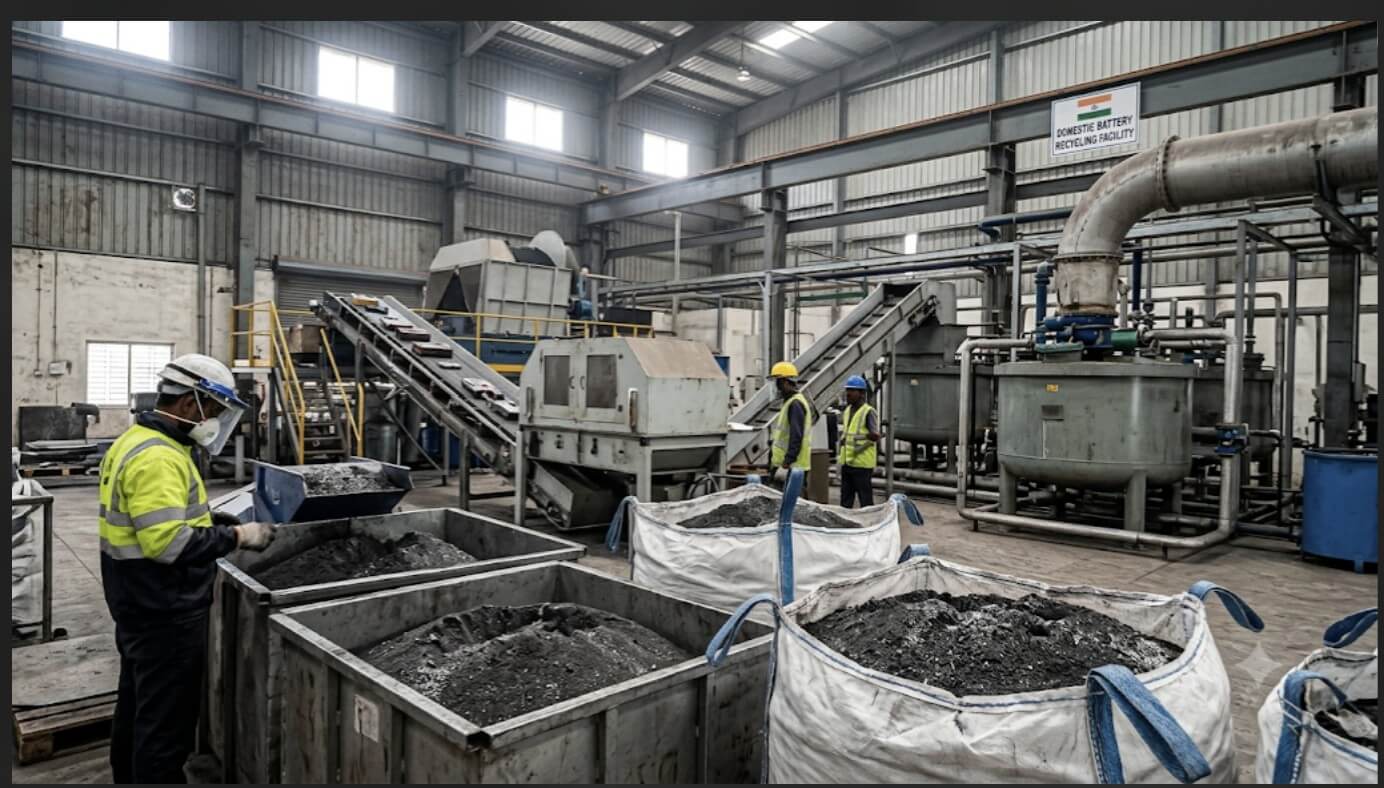
Black mass—the residual powder generated after crushing and shredding end-of-life lithium-ion batteries—is rich in highly valuable minerals like lithium, cobalt, nickel, and manganese.
The immediate impacts of this regulatory pivot include:
- Securing Domestic Feedstock: Historically, Indian recyclers struggled with capacity underutilization because premium battery scrap was exported to markets with larger refining capacities.
- Driving Urban Mining: By trapping the scrap domestically, the government is forcing the recovery of lithium and cobalt on Indian soil, directly supporting the National Critical Mineral Mission.
- Supply Chain Resilience: Recovering these materials locally reduces dependency on volatile international markets for raw EV battery materials, cementing a localized supply chain for the energy transition.
For investors, this policy is a massive tailwind for domestic recycling equities, effectively lowering their raw material acquisition costs and guaranteeing supply.
Industry Outlook and Supply Chain Shift
The Directorate General of Foreign Trade (DGFT) notification complements the government’s ₹1,500-crore incentive scheme aimed specifically at recycling critical minerals.
This combination of an export restriction and a direct financial incentive transforms the unit economics of battery recycling in India.
- Higher Capacity Utilization: Recyclers need high volumes of battery waste to run hydrometallurgical plants efficiently. The ban ensures that locally generated black mass feeds local infrastructure.
- Customs Duty Waivers: The recent removal of customs duties on the import of critical mineral waste further widens the feedstock funnel for Indian companies.
- Electric Vehicle (EV) Synergy: As EV adoption accelerates, battery waste generation is projected to grow exponentially. This creates a sustainable, long-term revenue pipeline for companies capable of extracting battery-grade materials.
For more on broader industry trends, explore our Battery Recycling Sector Analysis.
Stock Analysis: Revenue, Profit Trends, and Market Positioning
The impact of this policy depends entirely on a company’s installed capacity, processing technology, and operational scale. Here is a detailed breakdown of the primary beneficiaries.
1. Eco Recycling Ltd (ECORECO)
Eco Recycling is one of India’s earliest and most direct plays on organized e-waste and battery recycling.
- Market Positioning: ECORECO has evolved from standard IT asset disposition (ITAD) to advanced urban mining.
- Capacity & Operations: The company boasts a 25,200 MTPA e-waste capacity and has successfully brought online 6,000 MTPA of dedicated lithium-ion battery recycling capacity capable of producing black mass.
- Financial Data: For Q1 FY27, ECORECO reported revenues of ₹19.1 crore and a robust Profit After Tax (PAT) of ₹9.2 crore.
- Growth Driver: A 50:50 joint venture with US-based Electronic Recyclers International (ERI) provides ECORECO with global operational expertise.
2. Namo eWaste Management Ltd (NAMOEWASTE)
Namo eWaste represents a high-growth SME stock deeply embedded in the battery recycling ecosystem.
- Market Positioning: Aggressive capacity expansion makes Namo a prime beneficiary of increased domestic scrap availability.
- Capacity & Operations: The company has expanded its total capacity to 82,000 MTPA, which includes over 12,000 MTPA specifically for battery recycling. Their Nashik facility became fully operational in July 2025, and they are actively developing a hydrometallurgy facility to refine black mass into battery-grade lithium and cobalt in-house.
- Financial Data: Namo demonstrated explosive growth in FY26, with revenue climbing 29% YoY to ₹195 crore and PAT surging 70% YoY to ₹14.35 crore.
- Investor Note: While growth is stellar, investors must factor in the liquidity constraints and higher volatility typical of SME-listed equities.
3. Gravita India Ltd (GRAVITA)
Gravita India is a large-cap, diversified global recycling heavyweight.
- Market Positioning: Originally a lead-acid battery recycler, Gravita has aggressively diversified into aluminum, plastic, rubber, and lithium-ion.
- Capacity & Operations: Gravita recently commissioned a highly advanced 6,000 MTPA lithium-ion battery recycling plant in Mundra, Gujarat. Their overall multimaterial recycling capacity exceeds 476,000 MTPA, with aggressive targets to cross 800,000 MTPA by FY29.
- Financial Data: Gravita reported a 42% YoY surge in consolidated revenue to ₹1,475 crore for Q1 FY27, with a PAT of ₹106 crore.
- Growth Driver: Their sophisticated end-to-end extraction technology positions them to maximize margins from the newly captured domestic black mass.
4. Tata Chemicals (TATACHEM)
While primarily known for soda ash and specialty chemistry, Tata Chemicals is the strategic backbone of the Tata Group’s EV ecosystem.
- Market Positioning: Tata Chemicals operates active lithium-ion battery recycling operations to create a closed-loop supply chain for Tata Motors and Tata AutoComp.
- Growth Driver: Retaining high-quality black mass within India directly supports their chemical extraction processes, ensuring they have the raw material volume required to produce precursor cathode active materials (pCAM) for domestic cell manufacturing.
5. NILE Ltd and Maxvolt Energy
- NILE Ltd: Traditionally a pure-play secondary lead extractor recycling lead-acid batteries. While the immediate black mass ban focuses on lithium-ion, NILE benefits from the broader regulatory shift favoring formal recycling pathways and stricter Extended Producer Responsibility (EPR) enforcement.
- Maxvolt Energy: An emerging player in the lithium-ion battery pack manufacturing and recycling space. Increased feedstock availability lowers their raw material acquisition costs, accelerating their path to scale.
Industry Comparison & Sector Benchmarks
| Company | Core Focus | Total Processing Capacity | Recent Financial Benchmark | Strategic Advantage |
| Gravita India | Multimaterial (Lead, Li-ion) | 476,000+ MTPA | Q1 FY27 Rev: ₹1,475 Cr | Global scale, advanced hydrometallurgy |
| Eco Recycling | Pure E-waste & Li-ion | 31,200 MTPA | Q1 FY27 Rev: ₹19.1 Cr | ERI Joint Venture, high PAT margins |
| Namo eWaste | E-waste & Battery | 82,000 MTPA | FY26 Rev: ₹195 Cr | Rapid capacity expansion in Nashik |
| Tata Chemicals | Specialty Chem & Cell Supply | Enterprise Scale | Integrated Conglomerate | Captive demand from Tata Motors |
Potential Risks and Forward Outlook
While the India battery black mass export ban provides a definitive structural advantage, the sector is not without risks that require careful monitoring.
Forecasting Margin Expansion
The immediate financial forecast points toward margin expansion for Indian recyclers. Previously, domestic companies had to bid aggressively against international buyers to secure scrap. With export restricted, local supply outstrips immediate local processing capacity, which should naturally depress the cost of raw battery scrap in the short to medium term. Companies with operational hydrometallurgy plants (like Gravita and soon Namo eWaste) will capture the highest value by refining this cheaper scrap all the way to battery-grade lithium carbonate and cobalt sulphate.
Investment Risks to Monitor
- LME Commodity Price Volatility: The revenue of recycling companies is directly tied to global London Metal Exchange (LME) prices for lithium, cobalt, and nickel. If global commodity prices crash, the end-products generated from the recycled black mass will sell for less, compressing margins regardless of domestic feedstock costs.
- Infrastructure and Execution Lags: While companies are announcing massive capacity additions, India’s broader logistical infrastructure for safely transporting hazardous lithium-ion waste remains underdeveloped. Delays in commissioning hydrometallurgical plants will limit companies to selling lower-margin mechanical black mass rather than high-margin refined chemicals.
- Informal Sector Competition: Despite stringent Extended Producer Responsibility (EPR) mandates, a significant portion of e-waste still leaks into the unregulated, informal sector, though the black mass export ban will severely choke their ability to monetize it globally.
Ultimately, companies that successfully bridge the gap between mechanical shredding and chemical purification will dominate this newly protected market.
The battery black mass export ban by the Indian government is a massive turning point. Consequently, it completely changes the domestic circular economy. Furthermore, it alters the electric vehicle (EV) supply chain in India. By stopping the export of this highly valuable battery scrap, the government helps local businesses. As a result, it guarantees a large, low-cost supply of raw materials for domestic recyclers. Therefore, this new rule transforms the basic economics of urban mining in India.
In this deep guide, we will explore exactly what this ban means. First, we will look at how it helps raw material supply chains. Second, we will examine the financial impact on top Indian recycling stocks. Specifically, we will analyze Eco Recycling (ECORECO), Namo eWaste, Gravita India, and Tata Chemicals. Let us dive into the details.
What is the Battery Black Mass Export Ban?
Historically, India generated large amounts of old lithium-ion batteries. However, the country lacked the heavy infrastructure to process them well. Because of this, companies exported crushed battery scrap to other countries. This crushed scrap is known as “black mass.” Usually, it went to places like South Korea and China. There, massive refining plants extracted the core critical minerals.
Now, the battery black mass export ban changes this situation completely. The Directorate General of Foreign Trade (DGFT) made a strict new rule. Officially, they moved battery scrap and unsorted waste from the ‘Free’ export list to the ‘Prohibited’ list.
- Primary Goal: The main goal is to keep critical minerals inside Indian borders. These minerals include lithium, cobalt, nickel, and manganese.
- National Alignment: Furthermore, this decision aligns perfectly with the National Critical Mineral Mission. It also supports the broader “Make in India” initiative.
- Direct Impact: Consequently, domestic recyclers do not have to outbid international giants anymore. Thus, their raw material costs drop significantly.
For more background on how government rules shape this sector, you can read our internal Sector Overview: Battery Recycling in India.
The Strategic Importance of Black Mass
To fully understand this market shift, you must understand the material itself. First, we need to ask what black mass actually is.
When a lithium-ion battery dies, it undergoes several steps. First, workers discharge it. Next, they dismantle it carefully. Finally, machines shred the battery into tiny pieces. As a result, this process creates a dark, powdery substance. This powder is black mass. Importantly, this powder holds a very high concentration of active metals.
Here are the key metals found inside:
- Lithium: This is the core component of all modern EV batteries. Obviously, it is essential for storing energy.
- Cobalt: This metal provides thermal stability. Therefore, it keeps the battery from catching fire and extends its life.
- Nickel: This metal increases the total energy capacity. Consequently, it allows electric cars to drive longer distances.
- Manganese: Finally, manganese offers structural strength to the battery’s chemistry.
By enforcing the battery black mass export ban, India protects these metals. Therefore, the country ensures these strategic materials are extracted locally. Ultimately, this reduces India’s reliance on expensive imported minerals.
How the Ban Impacts Indian Stocks
The financial results for e-waste and battery recycling companies are huge. Indeed, the primary benefits are very clear.
- Much Cheaper Feedstock: Because exports are blocked, local supply increases fast. Therefore, the local supply of battery scrap will outgrow current processing capacity. Naturally, this leads to a sharp drop in raw material prices.
- Higher Plant Utilization: Previously, recyclers struggled to find enough raw material. Now, they will see their plant utilization rates spike. Consequently, they can absorb their fixed costs much better.
- Massive Margin Expansion: Companies now have lower input costs. Meanwhile, they still sell high-value output like battery-grade metal salts. Therefore, they will see substantial profit margin growth.
Next, let us break down the specific companies ready to win from this shift.
Top Battery Recycling Stocks to Watch
The biggest winners of the battery black mass export ban are specific companies. Specifically, these are companies that already built their extraction infrastructure.
1. Eco Recycling Ltd (ECORECO)
Eco Recycling is a true pioneer in the Indian e-waste management sector. Furthermore, they are one of the purest stock plays on urban mining.
- Market Position: Currently, they are moving aggressively into deep-tech battery recycling. They started in standard e-waste, but now focus on lithium-ion.
- Total Capacity: The company runs a large 25,200 MTPA e-waste facility. Additionally, they recently opened a dedicated 6,000 MTPA lithium-ion battery plant.
- Financial Growth: ECORECO shows excellent profitability. For instance, their Q1 FY27 revenue was ₹19.1 crore. Moreover, they achieved a massive Profit After Tax (PAT) of ₹9.2 crore.
- Policy Impact: ECORECO has a joint venture with US-based Electronic Recyclers International (ERI). Therefore, they have the exact technological edge needed here. They can efficiently process the new influx of domestic black mass. Thus, this ban directly accelerates their top-line revenue growth.
2. Namo eWaste Management Ltd
Namo eWaste is a high-growth SME stock. Specifically, it positioned itself very early for the battery waste boom.
- Capacity Expansion: Namo recently grew its total processing capacity to 82,000 MTPA. Importantly, this includes a brand-new 12,000 MTPA facility in Nashik. This new plant handles advanced battery recycling.
- Financial Data: The company posted great numbers recently. In FY26, revenue increased 29% YoY to ₹195 crore. Meanwhile, PAT skyrocketed by 70% to ₹14.35 crore.
- Policy Impact: Currently, Namo is building in-house hydrometallurgical capabilities. Because of the battery black mass export ban, they have an advantage. By the time their chemical plant opens, they will have guaranteed, low-cost feedstock.
3. Gravita India Ltd (GRAVITA)
People know Gravita globally for lead-acid battery recycling. However, Gravita is rapidly becoming a giant in lithium-ion extraction too.
- Global Scale: Gravita operates massive recycling facilities worldwide. In total, their capacity exceeds 476,000 MTPA.
- Lithium-Ion Focus: Recently, they opened a highly advanced 6,000 MTPA lithium-ion recycling plant. This facility is located in Mundra, Gujarat.
- Financial Data: Gravita is a strong large-cap compounder. For Q1 FY27, they reported consolidated revenues of ₹1,475 crore. Additionally, they posted a very strong PAT of ₹106 crore.
- Policy Impact: Gravita already possesses deep capital and engineering expertise. Therefore, they can extract maximum yield from black mass. Consequently, cheaper domestic supply will immediately boost their operating margins.
4. Tata Chemicals (TATACHEM)
Tata Chemicals takes an enterprise-scale approach to battery recycling. They focus on creating a closed-loop system.
- Strategic Role: They act as the chemical backbone of the Tata Group’s EV ecosystem. Specifically, Tata Chemicals recycles old packs to recover precursor cathode active materials (pCAM).
- Policy Impact: Tata Motors has an aggressive EV roadmap. Therefore, Tata Chemicals requires a highly secure, localized supply of critical minerals. The export ban effectively protects the exact materials they need. Thus, they can achieve true self-reliance in cell manufacturing.
5. NILE Ltd and Maxvolt Energy
- NILE Ltd: Traditionally, NILE focused on secondary lead extraction. However, the government is pushing for strict formalization in waste management. Therefore, more formal scrap will flow toward compliant companies like NILE.
- Maxvolt Energy: This is an emerging player in battery pack manufacturing and recycling. As a result of the policy shift, their barrier to entry drops. Ultimately, the ban reduces their raw material acquisition costs significantly.
For more deep-dive financials on these companies, check our Top E-Waste Stocks Guide.
Detailed Financial Analysis: Margin Expansion
Why do investors love the battery black mass export ban so much? Simply put, it comes down to basic math. It is all about the gap between input costs and output prices.
The Input-Output Spread
- Input Cost (Battery Scrap): Before the ban, Indian recyclers paid a high premium for scrap. Local informal collectors sold it to aggregators. Then, those aggregators exported it to China at high prices. Now, the law says they must sell the scrap domestically. Therefore, increased local supply creates much lower acquisition costs.
- Output Revenue (LME Prices): After processing, recyclers create end products. These include battery-grade lithium carbonate, cobalt sulphate, and nickel sulphate. Crucially, companies sell these products globally. The prices track the London Metal Exchange (LME).
Therefore, the end-product price stays globally pegged. However, the input cost is now artificially low due to domestic policy. Consequently, Indian recyclers will see massive profit margin expansion.
| Company | Key Revenue Source | Policy Benefit | Expected Margin Trend |
| ECORECO | Deep-tech Li-ion extraction | Much lower acquisition costs | Strong Expansion |
| Namo eWaste | High volume Nashik plant | Guaranteed local feedstock | Fast Expansion |
| Gravita | Global scale operations | Steady supply for Mundra | Stable, High-Volume |
Hydrometallurgy vs Pyrometallurgy
Not all recycling processes work the same way. Furthermore, the battery black mass export ban distinctly favors specific technologies.
- Pyrometallurgy (Smelting): This older method involves burning batteries at very high temperatures. Yes, it recovers valuable metals like cobalt and nickel. However, the lithium often burns up or gets lost in the slag. Additionally, the process uses massive amounts of energy. Consequently, it creates a lot of pollution.
- Hydrometallurgy (Chemical Leaching): This modern method is the future of the industry. Instead of fire, it uses liquid chemical solutions. These liquids selectively extract and purify the metals from the black mass. Therefore, it recovers lithium, cobalt, nickel, and manganese safely.
Companies like Gravita and Namo eWaste invest heavily in hydrometallurgy. Why? Because it yields ultra-pure, battery-grade materials. Recyclers can sell these materials back to EV makers at a huge premium. The battery black mass export ban is crucial here. It guarantees these expensive chemical plants will have enough volume to run profitably.
EPR Rules and Domestic Policy
The export ban does not work alone. Instead, strict domestic frameworks support it fully. The most important rules are the Battery Waste Management Rules (BWMR) and Extended Producer Responsibility (EPR) mandates.
Under EPR rules, battery makers and EV brands have legal duties. Companies like Tata Motors, Mahindra, and Ola Electric must recycle their old batteries. Specifically, the law demands they recycle a set percentage every year.
- First, they cannot just throw these batteries in a landfill.
- Second, they cannot sell them to informal, unregistered scrap yards.
- Third, they must buy “EPR Certificates.” They must buy these from registered, formal recyclers like Eco Recycling and Gravita.
Consequently, this creates a brilliant dual-revenue stream for recyclers. First, recyclers make money selling the recovered physical minerals. Second, they make pure profit selling EPR compliance certificates to car makers. Therefore, the battery black mass export ban ensures all this physical recycling happens entirely inside India.
Potential Risks for Investors
The general outlook is incredibly positive right now. However, smart investors must always weigh potential risks carefully.
- Commodity Price Drops: The biggest risk involves global metal prices. What if the global LME prices for lithium and nickel crash? If lithium prices drop, the revenue from recycled black mass decreases. Consequently, this could erase the benefits of having cheaper domestic feedstock.
- Execution and Delay Risks: Building a basic mechanical shredder is easy. However, building a chemical hydrometallurgical plant is extremely difficult. It requires exact science. Therefore, companies might fail to execute their chemical projects on time. If they fail, they must settle for selling low-margin intermediate powders.
- Informal Sector Leakage: India’s informal waste sector remains very large. The battery black mass export ban and EPR rules aim to fix this. However, regulators must enforce the rules strictly. If enforcement fails, formal listed companies could still face feedstock shortages.
Conclusion on the Export Ban
The battery black mass export ban is a massive, structural game-changer. The Indian government finally prioritized domestic resource security. Consequently, they handed a huge competitive advantage to formal recyclers.
For stock market investors, this sector offers a rare opportunity. Companies like Eco Recycling, Namo eWaste, Gravita India, and Tata Chemicals give you direct exposure. They sit right in the middle of the booming EV ecosystem. Soon, these companies will fully launch their advanced chemical capacities. When they do, the trapped domestic black mass will act as high-octane fuel. Ultimately, this will drive massive revenue growth and margin expansion for years.
Disclaimer: This article is for informational and educational purposes only and does not constitute financial advice. Stock market investments are subject to market risks. Please consult with a registered financial advisor before making any investment decisions.
Disclaimer: This article is for educational purposes only and not financial advice. Investors should do their own due diligence before investing.
Disclaimer: The projections of potential returns are based on current market conditions and company performance. Actual results may vary due to various factors, including market dynamics, economic conditions, and changes in the competitive landscape. Investors should conduct their own research and consult with financial advisors before making investment decisions.
Multibagger Stocks breakout stocks
⚠️ Not SEBI Registered—just here to share insights | 🚫 No paid services—everything shared is entirely free! 🧠 Always Learning and excited to grow together in this journey of market exploration.
📲 Join Our Investor Communities
🔹 Join our Telegram Channel: Multibagger Hunts
🔹 Join our WhatsApp Channel: Click to Join
✅ Free access
✅ Instant alerts
✅ Curated research for serious investors
TwitterXWhatsAppThreadsTelegramFacebookLinkedInGmailEmailShare