admin
The Dynamics of Breakout Stocks in India
Identifying breakout stocks in India requires more than just looking at daily percentage gainers. A true breakout occurs when a stock’s price moves above a defined resistance level—or below a support level—accompanied by a massive surge in trading volume. This combination signals a fundamental shift in market psychology and participation.
When a stock experiences a price spike with unusual volume, it indicates heavy institutional accumulation or a significant change in the company’s underlying fundamentals. Retail investors often make the mistake of chasing these sharp spikes blindly. Smart investing involves waiting for price retests, analyzing sustained volume, and understanding the corporate fundamentals driving the momentum.
Before diving into individual stock metrics, it is vital to review broader market conditions on the National Stock Exchange (NSE) to ensure these moves align with sector-wide strength rather than isolated anomalies. For a deeper dive into technical indicators, refer to our internal Volume Analysis Guide.
Performance Summary: High-Volume Breakouts
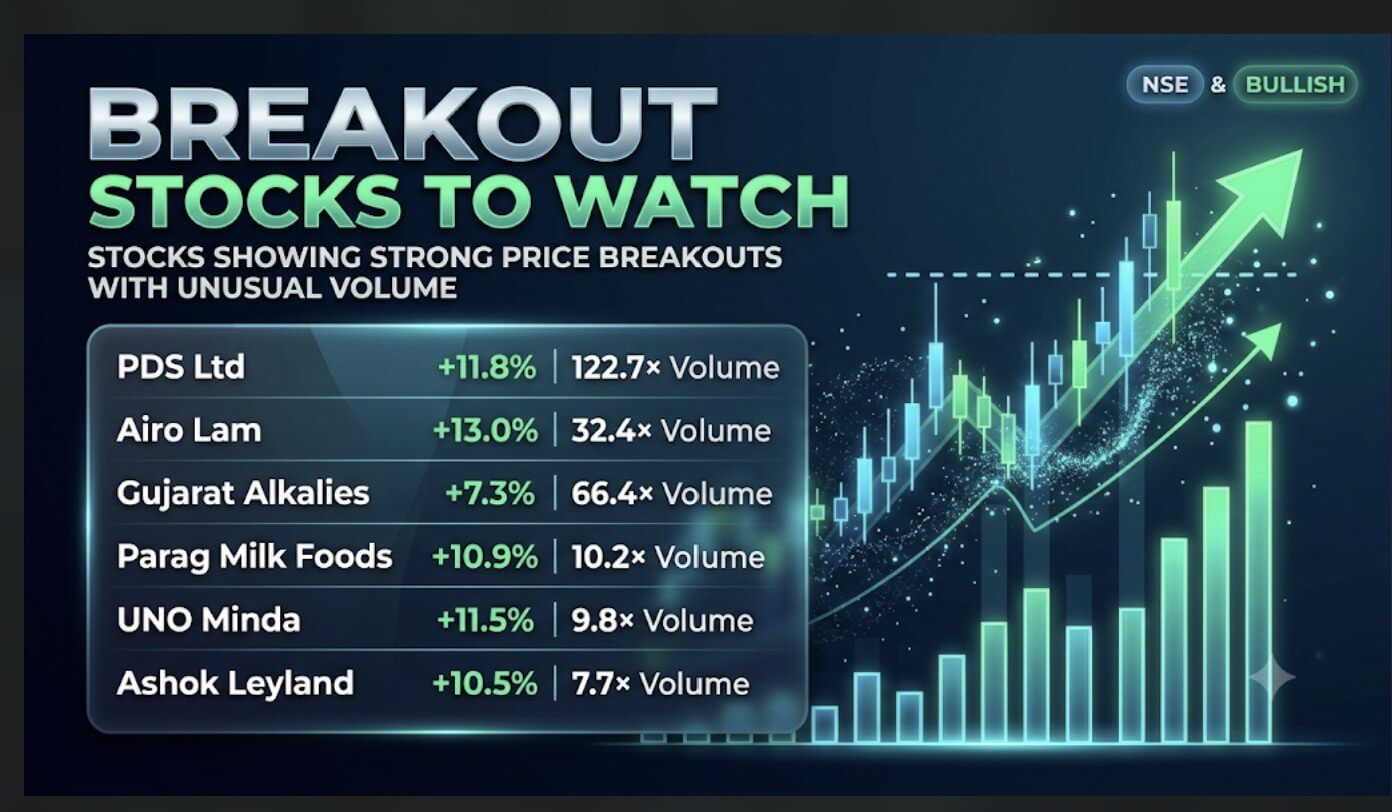
The following table highlights recent market anomalies where significant price action was supported by extreme volume multipliers.
| Company Name | Sector/Industry | Price Change | Volume Multiplier |
| PDS Ltd | Apparel & Sourcing | +11.8% | 122.7× |
| Airo Lam | Building Materials | +13.0% | 32.4× |
| Gujarat Alkalies | Chemicals | +7.3% | 66.4× |
| Parag Milk Foods | FMCG & Dairy | +10.9% | 10.2× |
| UNO Minda | Auto Ancillaries | +11.5% | 9.8× |
| Ashok Leyland | Commercial Vehicles | +10.5% | 7.7× |
| Rolex Rings | Auto Components | +8.9% | 6.9× |
| Hester Biosciences | Animal Healthcare | +4.1% | 11.1× |
Detailed Stock Analysis & Forecasting
To turn raw data into actionable insights, we must break down the financial positioning, revenue growth, and industry trends for each of these breakout stocks in India.
1. PDS Ltd: Global Supply Chain Dominance
PDS Ltd operates a highly scalable, asset-light business model focusing on global fashion infrastructure and sourcing.
- Market Positioning: The company connects global brands with manufacturing facilities primarily across Asia. Their transition from a traditional manufacturer to a supply chain manager reduces capital expenditure requirements.
- Revenue Analysis: PDS has consistently optimized its top-line growth by expanding into new geographies and adding high-margin brands to its portfolio. Revenue growth is heavily tied to the economic recovery in Western markets and shifting supply chains away from a singular reliance on China.
- Profit Trends: The shift toward customized, sustainable fashion sourcing has allowed PDS to command better margins. Their asset-light nature means return on capital employed (ROCE) remains superior to traditional textile mills.
- The Breakout Thesis: A 122.7× volume multiplier is exceptionally rare. This suggests aggressive institutional buying, potentially front-running a major corporate announcement, a lucrative global acquisition, or a significant block deal.
2. Airo Lam: Riding the Real Estate Boom
Airo Lam manufactures decorative laminates and panel products, placing it directly in the domestic consumption and real estate sectors.
- Industry Comparison: The building materials sector is highly fragmented. Airo Lam competes by focusing on premiumization, expanding its dealer network, and launching innovative textures.
- Revenue Analysis: India’s ongoing real estate upcycle and the boom in home renovations serve as structural tailwinds. As housing sales rise across Tier-1 and Tier-2 cities, demand for interior infrastructure naturally follows with a brief lag.
- Profit Trends: Operating margins in the laminate industry are heavily dependent on raw material costs (like kraft paper and chemicals). Airo Lam’s ability to pass on cost increases to consumers dictates its profitability.
- The Breakout Thesis: A 13.0% price surge backed by 32.4× volume indicates that smart money is betting on a strong quarterly earnings report or a major expansion in their distributor network.
3. Gujarat Alkalies & Chemicals (GACL)
GACL is a state-owned enterprise and one of India’s largest producers of caustic soda and allied chemicals.
- Market Positioning: The chlor-alkali sector is foundational to various industries, including textiles, alumina, paper, and water treatment. GACL holds a dominant market share in western India.
- Revenue Analysis: Chemical companies are cyclical. GACL’s revenue fluctuates with global caustic soda prices. However, recent government initiatives promoting domestic manufacturing have stabilized demand.
- Profit Trends: Power constitutes the highest cost in chemical manufacturing. GACL’s strategic investments in renewable energy and captive power plants are actively insulating their operating margins from grid price shocks.
- The Breakout Thesis: The 66.4× volume spike alongside a 7.3% price increase often precedes cyclical upturns in chemical spot prices or the commissioning of new, margin-accretive chemical plants.
4. Parag Milk Foods: Premiumizing Dairy
Known for brands like “Gowardhan” and “Go,” Parag Milk Foods is a heavy hitter in the fast-moving consumer goods (FMCG) dairy segment.
- Industry Comparison: While traditional dairy cooperatives focus on liquid milk, private players like Parag focus on value-added dairy products (VADP) such as cheese, paneer, and whey protein, where margins are substantially higher.
- Revenue Analysis: The transition from unorganized to organized dairy in India is a multi-decade growth story. Parag’s increasing footprint in modern retail and quick-commerce platforms is accelerating top-line growth.
- Profit Trends: VADPs command a 15-20% premium over standard liquid milk. As the product mix tilts toward cheese and specialized nutrition, EBITDA margins expand structurally.
- The Breakout Thesis: A 10.9% jump on 10.2× volume suggests market confidence in their debt-reduction strategies and improving operational efficiencies following previous inflationary pressures on procurement costs.
5. UNO Minda: The EV Transition Play
UNO Minda is a tier-1 supplier of proprietary automotive solutions to original equipment manufacturers (OEMs).
- Market Positioning: The company dominates in acoustic solutions (horns), alloy wheels, and automotive lighting. Crucially, they are aggressively positioning themselves as a core supplier for two-wheeler and four-wheeler Electric Vehicles (EVs).
- Revenue Analysis: Revenue growth outpaces the general auto industry due to increasing “kit value” per vehicle. As cars and bikes become more premium, they require more sophisticated electronics, sensors, and LED lighting.
- Profit Trends: High localization of components and joint ventures with global tech leaders have allowed UNO Minda to maintain robust double-digit EBITDA margins despite volatile raw material costs.
- The Breakout Thesis: The 11.5% breakout on 9.8× volume likely reflects OEM contract wins in the EV space or favorable domestic auto sales data reinforcing their earnings visibility.
6. Ashok Leyland: Commercial Vehicle Resurgence
The flagship company of the Hinduja Group, Ashok Leyland is the second-largest manufacturer of commercial vehicles in India.
- Industry Comparison: The CV sector is a direct proxy for the macroeconomic health of the country. Ashok Leyland competes closely with Tata Motors but has been aggressively expanding its light commercial vehicle (LCV) portfolio to balance the cyclicality of heavy trucks.
- Revenue Analysis: Massive government capital expenditure on infrastructure, mining, and road construction directly drives fleet operators to replace and expand their truck fleets.
- Profit Trends: Falling steel prices and price hikes taken over the last few quarters have led to significant margin expansion. Furthermore, the defense sector provides a high-margin, sticky revenue stream.
- The Breakout Thesis: A 10.5% move on 7.7× volume in a large-cap stock is a powerful signal. It points toward institutional confidence in a prolonged upcycle in freight demand and domestic infrastructure spending.
7. Rolex Rings: Forging Global Partnerships
Rolex Rings is a leading manufacturer of forged and machined components, primarily bearing rings and automotive parts.
- Market Positioning: The company leverages the “China-plus-one” strategy perfectly. Global Tier-1 auto suppliers are diversifying their supply chains away from China, and Indian forging companies are the primary beneficiaries.
- Revenue Analysis: With a strong export book, Rolex Rings generates significant revenue in foreign currencies, providing a natural hedge. Their expansion into non-auto segments like industrial machinery diversifies revenue risk.
- Profit Trends: Machined products yield better margins than raw forged parts. The company’s consistent investment in precision machining capabilities continues to push the blended margin profile higher.
- The Breakout Thesis: An 8.9% gain on 6.9× volume indicates accumulation. Investors are likely pricing in strong export order books and a robust runway for growth in the global auto-ancillary space.
8. Hester Biosciences: Niche Animal Healthcare
Hester is one of India’s leading animal healthcare companies, specializing in poultry and large animal vaccines.
- Industry Comparison: Animal healthcare has incredibly high barriers to entry due to stringent regulatory approvals and complex manufacturing requirements.
- Revenue Analysis: Growth is driven by national immunization programs and the commercialization of new vaccines (such as the Lumpy Skin Disease vaccine). The poultry industry’s stabilization also supports consistent demand.
- Profit Trends: Vaccines offer exceptionally high gross margins. Once R&D and facility setup costs are amortized, the operational leverage is immense.
- The Breakout Thesis: While the price move was a modest +4.1%, the 11.1× volume multiplier is the focal point. This suggests stealth accumulation by funds anticipating regulatory approvals or a successful rollout of new veterinary health products.
Actionable Strategy: How to Trade High-Volume Spikes
For investors researching breakout stocks in India, witnessing a massive volume spike is only step one. Executing a safe and profitable entry requires discipline and a strict adherence to technical parameters. Ensure you follow Technical Analysis Basics to safeguard your capital.
1. Wait for the Retest
Markets rarely move in a straight line. Following a massive breakout, stocks often pull back to retest the previous resistance level (which now acts as support).
- Actionable Insight: Do not chase the initial 10% spike. Place limit orders near the breakout level and wait for the stock to settle. A successful retest with lower volume indicates the breakout is genuine.
2. Verify Sustained Volume
A one-day wonder is dangerous. If a stock spikes on 50x volume on Monday but returns to its low average volume on Tuesday while the price bleeds, it is likely a bull trap.
- Actionable Insight: Monitor the stock for three to five trading sessions. You want to see above-average volume persist, indicating that institutional funds are building a position over time, not just executing a single block trade.
3. Analyze the Fundamental Catalyst
Technical price action tells you what is happening; fundamental analysis tells you why.
- Actionable Insight: Before investing, check corporate filings on the stock exchange. Did the company announce a stock split, a special dividend, a massive debt reduction, or a new CEO? Ensure the fundamental news justifies the technical excitement.
4. Implement Strict Stop-Losses
Even the best-looking breakouts can fail if broader market conditions sour.
- Actionable Insight: Always place a stop-loss slightly below the breakout candle’s low or the newly established support zone. If the stock falls back into its previous consolidation range, the breakout thesis is invalidated.
Disclaimer: The information provided in this article is for educational and informational purposes only. It does not constitute financial, investment, or trading advice. Equity investments are subject to market risks. Always conduct your own due diligence or consult aSecurities and Exchange Board of India (SEBI)registered financial advisor before making investment decisions. Past performance of these breakout stocks in India does not guarantee future returns.
Disclaimer: The projections of potential returns are based on current market conditions and company performance. Actual results may vary due to various factors, including market dynamics, economic conditions, and changes in the competitive landscape. Investors should conduct their own research and consult with financial advisors before making investment decisions.
Multibagger Stocks breakout stocks
⚠️ Not SEBI Registered—just here to share insights | 🚫 No paid services—everything shared is entirely free! 🧠 Always Learning and excited to grow together in this journey of market exploration.
📲 Join Our Investor Communities
🔹 Join our Telegram Channel: Multibagger Hunts
🔹 Join our WhatsApp Channel: Click to Join
✅ Free access
✅ Instant alerts
✅ Curated research for serious investorsTwitterXWhatsAppThreadsTelegramFacebookLinkedInGmailEmailShare