admin
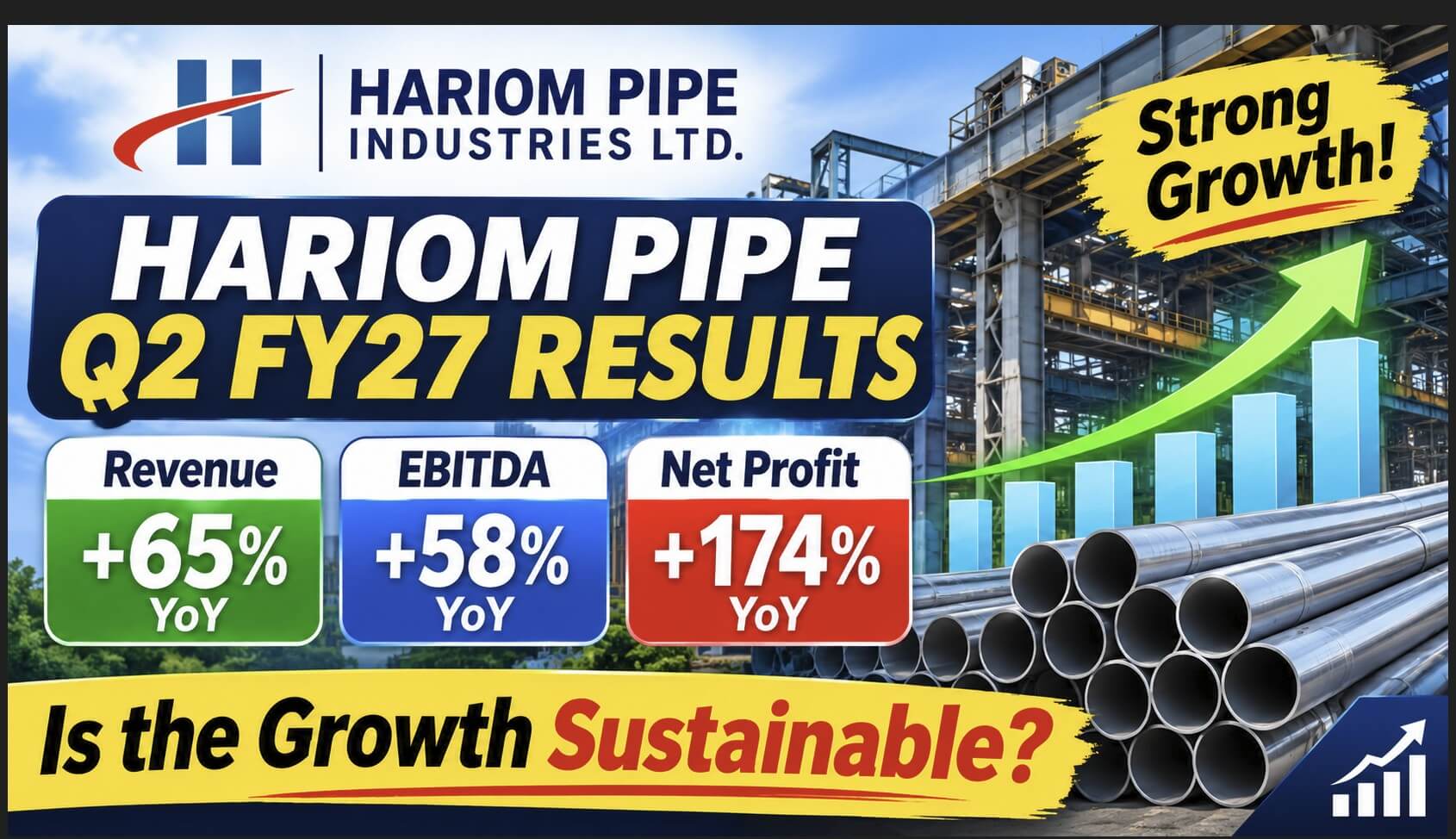
Hariom Pipe Industries Q2 FY27 results have delivered a strong improvement in revenue and profitability, with the company reporting substantial year-on-year and sequential growth during the September 2026 quarter. Revenue from operations increased 65%, while reported net profit surged 174% compared with the corresponding quarter of the previous financial year.
The latest performance is particularly interesting because profitability has improved much faster than revenue. EBITDA increased 58.4% year-on-year, while net profit expanded by nearly 174%. Sequentially, the company also reported encouraging improvements in revenue, EBITDA and earnings per share.
However, investors should look beyond the headline growth percentages. Steel manufacturing is a cyclical and capital-intensive business. Raw material prices, product realisations, capacity utilisation, working capital requirements and operating margins can significantly influence earnings.
In this detailed analysis, we examine Hariom Pipe Industries’ Q2 and H1 FY27 performance, revenue growth, EBITDA trends, profitability, business strengths, industry outlook, investment opportunities and potential risks.
Hariom Pipe Industries Q2 FY27 Results: Key Highlights
Hariom Pipe Industries Limited reported the following standalone financial performance for the quarter ended September 30, 2026.
Q2 FY27 Financial Performance
| Financial Metric | Q2 FY27 | YoY Growth | QoQ Growth |
|---|---|---|---|
| Revenue from Operations | ₹554.24 Cr | +65.0% | +29.1% |
| EBITDA | ₹67.66 Cr | +58.4% | +35.5% |
| EBITDA Margin | 12.2% | 12.7% previously | +58 bps |
| Net Profit (PAT) | ₹28.52 Cr | +173.9% | +64.3% |
| Net Profit Margin | 5.1% | +205 bps | +110 bps |
| EPS | ₹9.21 | +174.1% | +64.2% |
Important observations:
- Revenue crossed ₹550 crore during the quarter.
- EBITDA increased to ₹67.66 crore.
- Net profit reached ₹28.52 crore.
- Earnings per share improved to ₹9.21.
- Net profit growth significantly exceeded revenue growth.
- EBITDA margin improved sequentially by 58 basis points.
These numbers indicate a meaningful improvement in the company’s quarterly financial performance.
1. Revenue Analysis: 65% Year-on-Year Growth
Revenue growth is one of the most important indicators when evaluating a manufacturing company’s performance.
Hariom Pipe Industries reported revenue from operations of ₹554.24 crore in Q2 FY27, compared with approximately ₹336 crore in Q2 FY26.
This represents an impressive 65% year-on-year increase.
Sequentially, revenue increased by 29.1% from the previous quarter.
What does this revenue growth indicate?
There are several factors investors should examine when interpreting this performance.
1. Better operational activity
Higher revenue can reflect improved production, better capacity utilisation, increased dispatches or stronger customer demand.
2. Product mix and realisations
Steel manufacturers generate revenue from several product categories. Changes in the contribution of higher-value products can influence overall revenue and profitability.
3. Manufacturing recovery
The company’s previous-quarter operating environment is important when comparing the latest numbers. The company disclosed that operations at its Perundurai manufacturing unit were suspended following directions from the Tamil Nadu Pollution Control Board during the June 2026 quarter. The suspension directions were subsequently withdrawn, and operations recommenced on July 13, 2026.
This provides important context for the sequential recovery in Q2.
Investors should therefore distinguish between growth resulting from a recovery in manufacturing activity and growth resulting from a sustainable increase in underlying demand.
Why revenue growth matters
For an integrated steel manufacturer, higher production and sales can improve the utilisation of manufacturing facilities.
Better utilisation can potentially support:
- Improved absorption of fixed manufacturing expenses.
- Better operating efficiency.
- Higher contribution from manufacturing operations.
- Improved economies of scale.
- Stronger dealer and distribution activity.
However, revenue growth alone does not establish whether the business is becoming more profitable. EBITDA and cash flow trends must also be evaluated.
2. EBITDA Analysis: Operating Profitability Remains Important
EBITDA increased to ₹67.66 crore in Q2 FY27, registering 58.4% growth compared with the corresponding quarter last year.
Sequentially, EBITDA increased by 35.5%.
The important point is that EBITDA growth was lower than revenue growth on a year-on-year basis.
| Metric | YoY Growth |
|---|---|
| Revenue | 65.0% |
| EBITDA | 58.4% |
| Net Profit | 173.9% |
This difference deserves attention.
Although the company reported strong absolute EBITDA growth, the EBITDA margin declined from 12.7% to 12.2% year-on-year.
This represents a contraction of approximately 50 basis points.
Why should investors monitor EBITDA margins?
Steel manufacturing businesses are exposed to fluctuations in several operating expenses.
These include:
- Iron ore and sponge iron prices.
- Scrap and steel-related raw material costs.
- Power and fuel expenses.
- Transportation and logistics costs.
- Manufacturing and employee expenses.
- Changes in finished steel selling prices.
When raw material costs increase faster than finished-product realisations, margins can come under pressure.
On the other hand, better procurement, improved production efficiency and a favourable product mix can support profitability.
The sequential improvement of 58 basis points is encouraging. However, investors should wait for subsequent quarterly results before concluding that a sustained margin expansion cycle has started.
3. Net Profit Analysis: PAT Surges 174%
The most impressive aspect of the latest results is the increase in net profit.
Hariom Pipe Industries reported standalone net profit of ₹28.52 crore in Q2 FY27, compared with approximately ₹10.41 crore in Q2 FY26.
This represents a year-on-year increase of 173.9%.
On a sequential basis, net profit increased by 64.3%.
The reported net profit margin also improved to approximately 5.1%.
What makes the profit growth interesting?
Revenue increased by 65%, whereas net profit increased by nearly 174%.
This indicates that the company’s bottom-line performance improved considerably faster than its sales.
Possible contributors include:
- Improved operating leverage.
- Better utilisation of manufacturing capacity.
- Changes in depreciation and finance costs.
- Changes in the tax burden.
- Improvements in the overall cost structure.
The exact contribution of each factor should be evaluated using the complete profit and loss statement.
Investors should avoid assuming that this level of profit growth will automatically continue in future quarters.
EPS improvement
Earnings per share increased to ₹9.21 compared with ₹3.36 in Q2 FY26.
Sequentially, EPS improved from ₹5.61 in Q1 FY27 to ₹9.21 in Q2 FY27.
Higher EPS is encouraging because it indicates an improvement in reported earnings attributable to shareholders.
However, investors should also examine future dilution, particularly because the company has disclosed a convertible warrant issue.
4. H1 FY27 Performance: Looking Beyond One Quarter
While Q2 FY27 delivered impressive growth, the half-year performance provides a broader picture.
According to the reported H1 FY27 highlights:
| Financial Metric | H1 FY27 YoY Growth |
|---|---|
| Revenue | +23.4% |
| Net Profit | +34.8% |
The half-year numbers are important because they help investors assess whether the latest quarter represents a sustainable improvement or a recovery from a weaker period.
What do the H1 numbers tell us?
Revenue growth of 23.4% indicates that the company has delivered positive growth across the first six months of FY27.
Net profit growth of 34.8% is higher than revenue growth.
This suggests an improvement in overall profitability over the half-year period.
However, the H1 growth percentages are considerably lower than the Q2 growth rates.
This difference highlights why investors should not annualise the latest quarter’s growth without examining the first-quarter performance and the underlying operating conditions.
The next two quarters will be important in determining whether the company can maintain the improved earnings trajectory.
5. Understanding Hariom Pipe Industries’ Business Model
Hariom Pipe Industries operates in the iron and steel manufacturing sector.
The company has a diversified product portfolio serving construction, infrastructure, agriculture, power and industrial applications.
Its product portfolio includes:
- Mild Steel (MS) billets.
- Hot Rolled (HR) pipes and tubes.
- Cold Rolled (CR) pipes.
- Galvanised Iron (GI) pipes.
- Pre-Galvanised (GP) pipes.
- Hot Rolled coils.
- Cold Rolled coils.
- Pre-Galvanised coils.
- Scaffolding systems.
The company also has backward integration through its sponge iron manufacturing facility.
Why is backward integration important?
Backward integration can provide advantages in raw material sourcing and manufacturing control.
An integrated manufacturing model can potentially help companies:
- Improve control over input sourcing.
- Reduce dependence on external suppliers for selected inputs.
- Improve production planning.
- Manage manufacturing costs.
- Improve coordination between different production stages.
However, backward integration does not eliminate commodity price risks.
Steel prices, iron ore availability, energy costs and transportation expenses can still affect profitability.
For investors, the key question is whether integration translates into consistently better operating margins and cash generation.
6. Steel Industry Outlook: Infrastructure and Construction Demand
The long-term outlook for the Indian steel industry is closely connected to infrastructure development, construction, industrial expansion and manufacturing activity.
Several sectors contribute to domestic demand for steel products.
Infrastructure development
Roads, bridges, railway projects, industrial corridors and other infrastructure projects require significant quantities of steel.
Government and private-sector infrastructure investment can support demand for pipes, structural products and other steel-related materials.
Real estate and construction
Residential and commercial construction also contribute to demand for steel pipes and tubes.
MS, GI and other steel products are used in multiple applications, including structural frameworks, water distribution and fabrication.
Agriculture and irrigation
Steel pipes are used in irrigation infrastructure, water transportation and agricultural installations.
Government-supported irrigation and rural infrastructure projects can create additional demand opportunities.
Industrial manufacturing
Industrial buildings, warehouses, factories and engineering projects require steel products for structural and operational applications.
For manufacturers such as Hariom Pipe Industries, these markets provide multiple demand opportunities.
However, the actual benefit depends on competitive pricing, product quality, distribution reach, production capacity and customer relationships.
7. Competitive Positioning: What Investors Should Examine
The steel pipe industry is competitive, with established manufacturers and regional players operating across different product categories.
Investors should evaluate Hariom Pipe Industries using several important parameters.
Product diversification
A broad portfolio allows a manufacturer to serve multiple customer segments. However, product diversification should translate into better sales and profitability.
Backward integration
Integrated manufacturing can support cost control and supply-chain efficiency.
Distribution network
Dealer relationships and geographic reach are important in a fragmented market.
Manufacturing efficiency
Capacity utilisation, production costs and plant efficiency influence operating margins.
Financial discipline
A manufacturing company should generate adequate operating cash flow to support working capital, capital expenditure and debt servicing.
A strong quarterly profit announcement is encouraging, but the sustainability of these competitive advantages matters more over the long term.
8. Important Corporate Developments to Monitor
Apart from quarterly earnings, investors should monitor the company’s capital allocation and expansion plans.
One development disclosed in the company’s recent corporate filings is the preferential allotment of 15 lakh convertible warrants at ₹343.03 per warrant.
The aggregate issue value is approximately ₹51.45 crore, with 25% of the consideration received at allotment. The balance is payable upon conversion in accordance with the applicable terms.
Why does this matter?
Convertible warrants can provide additional funds for business expansion and other corporate requirements.
However, conversion can also increase the number of outstanding shares.
Existing shareholders should therefore monitor:
- The number of warrants converted.
- The utilisation of funds raised.
- The impact on outstanding equity shares.
- The return generated on additional capital.
- Whether expansion creates sufficient incremental earnings.
Investors should not automatically consider fundraising positive or negative. The ultimate impact depends on how efficiently the funds are deployed.
9. Key Positives from Hariom Pipe Q2 FY27 Results
The latest results offer several encouraging observations.
1. Strong revenue growth
Revenue increased 65% year-on-year, demonstrating a substantial improvement in quarterly sales.
2. Strong net profit growth
PAT increased nearly 174%, significantly outperforming revenue growth.
3. Sequential recovery
Revenue, EBITDA and net profit all increased compared with Q1 FY27.
4. Improved sequential EBITDA margin
The EBITDA margin improved by 58 basis points quarter-on-quarter.
5. Positive H1 performance
H1 revenue and net profit increased 23.4% and 34.8%, respectively.
6. Diversified product portfolio
The company operates across multiple steel product categories, serving different industrial and infrastructure markets.
7. Integrated manufacturing structure
Backward integration provides an opportunity to improve operating efficiency and manufacturing control.
These factors make the latest quarterly performance worth monitoring.
10. Risks Investors Should Not Ignore
Despite the strong Q2 FY27 performance, investors should consider the following risks before making an investment decision.
Raw material price volatility
Steel manufacturing companies are exposed to changes in iron ore, sponge iron, scrap and other input prices.
A sharp increase in input costs without a corresponding increase in selling prices can reduce margins.
Steel price fluctuations
Steel is a cyclical commodity-linked industry.
Changes in domestic and international steel prices can affect product realisations and profitability.
Working capital requirements
Manufacturing businesses require substantial working capital to maintain inventories, manage receivables and meet supplier obligations.
Investors should examine inventory days, debtor days and operating cash flow.
Debt and interest expenses
Steel manufacturing requires significant capital investment.
Higher borrowing costs can affect profitability, particularly during periods of weaker demand.
Environmental and regulatory compliance
The previously disclosed Perundurai plant suspension demonstrates the importance of regulatory compliance.
Investors should monitor environmental clearances, plant operations and regulatory disclosures.
Equity dilution
The company’s convertible warrants may result in additional shares upon conversion.
This should be considered when evaluating future EPS growth.
Cyclical demand
Infrastructure and construction activity can change with economic conditions, interest rates and government spending.
Investors should avoid valuing a cyclical manufacturer solely on the basis of one strong quarter.
11. What Should Investors Track in Q3 and Q4 FY27?
The next two quarters will be particularly important.
Instead of focusing only on headline revenue growth, investors should track the following indicators.
| Parameter | What Investors Should Monitor |
|---|---|
| Revenue growth | Whether sales momentum continues |
| EBITDA margin | Whether the 12% range can be sustained |
| Net profit | Consistency of earnings growth |
| Capacity utilisation | Improvement in manufacturing efficiency |
| Raw material costs | Stability of input costs |
| Working capital | Inventory and receivable management |
| Debt | Borrowing levels and interest expenses |
| Operating cash flow | Whether accounting profits convert into cash |
| Warrants | Conversion and deployment of funds |
Three possible performance scenarios
Bullish scenario
If revenue continues growing, EBITDA margins stabilise or improve, and operating cash flow remains healthy, the company could deliver further earnings growth.
Moderate scenario
If revenue growth continues but margins remain under pressure, earnings growth may moderate.
Bearish scenario
If steel prices weaken, raw material costs rise or manufacturing operations face disruptions, profitability could decline despite the company’s diversified product portfolio.
These are analytical scenarios, not management guidance or price forecasts.
12. Is Hariom Pipe Industries Worth Tracking After Q2 FY27?
The Q2 FY27 performance has improved the company’s near-term earnings picture.
Revenue growth of 65%, EBITDA growth of 58.4% and net profit growth of 173.9% are encouraging.
The sequential improvement is another positive factor.
However, there are two important points investors should remember.
First, EBITDA margin declined year-on-year despite the increase in revenue. This suggests that operating profitability has not expanded at the same rate as sales.
Second, H1 growth is lower than Q2 growth. The company must demonstrate that the latest improvement can continue across subsequent quarters.
My assessment
Hariom Pipe Industries deserves a place on the watchlist for investors tracking small-cap manufacturing and steel-sector companies.
The strongest positive is the improvement in earnings.
The most important concern is whether the company can sustain its margins and convert accounting profits into operating cash flow.
For investors evaluating the company over a two-to-three-year period, the following factors should carry more weight than a single quarter’s profit growth:
- Consistent revenue expansion.
- Stable or improving EBITDA margins.
- Better cash flow generation.
- Controlled debt levels.
- Efficient capital allocation.
- Successful execution of expansion plans.
Valuation is equally important. A good company can become an unattractive investment if purchased at an excessive valuation.
Investors should compare the current market capitalisation, trailing earnings, forward earnings expectations and enterprise value with relevant listed peers before deciding on an entry price.
Frequently Asked Questions (FAQs)
1. What was Hariom Pipe Industries’ revenue in Q2 FY27?
Hariom Pipe Industries reported standalone revenue from operations of ₹554.24 crore in Q2 FY27, representing 65% year-on-year growth.
2. What was Hariom Pipe Industries’ net profit in Q2 FY27?
The company reported standalone net profit of ₹28.52 crore, an increase of 173.9% compared with Q2 FY26.
3. What was Hariom Pipe Industries’ EBITDA in Q2 FY27?
Standalone EBITDA stood at ₹67.66 crore, registering 58.4% year-on-year growth.
4. What was the EBITDA margin in Q2 FY27?
The EBITDA margin stood at 12.2%, compared with 12.7% in Q2 FY26. It improved by 58 basis points sequentially.
5. What was the EPS of Hariom Pipe Industries in Q2 FY27?
Reported EPS was ₹9.21, compared with ₹3.36 in Q2 FY26 and ₹5.61 in Q1 FY27.
6. How did Hariom Pipe Industries perform in H1 FY27?
H1 FY27 revenue increased 23.4% year-on-year, while net profit increased 34.8%.
7. Is Hariom Pipe Industries a good long-term investment?
The latest results show encouraging earnings growth. However, a long-term investment decision should also consider valuation, debt, cash flow, working capital, margin sustainability and the company’s execution of expansion plans.
8. What should investors monitor after Q2 FY27?
Investors should monitor Q3 and Q4 revenue growth, EBITDA margins, raw material costs, capacity utilisation, cash flow, debt and warrant conversion.
Conclusion: Strong Q2 Performance, But Sustainability Is Key
Hariom Pipe Industries’ Q2 FY27 results represent a strong improvement in quarterly financial performance.
Revenue increased 65%, EBITDA grew 58.4%, and net profit surged 173.9%. Sequential improvements across key financial indicators also provide encouraging signs.
The company’s integrated manufacturing structure, diversified steel product portfolio and exposure to infrastructure and construction demand offer potential long-term growth opportunities.
However, the decline in year-on-year EBITDA margin, cyclical steel industry dynamics, working capital requirements and potential equity dilution deserve careful attention.
The key question for investors is no longer whether Hariom Pipe Industries delivered a strong Q2 FY27. It is whether the company can sustain its earnings momentum and improve cash generation over the coming quarters.
The next two quarterly results should provide better clarity on the sustainability of this growth.
Disclaimer
This article is intended for educational and informational purposes only. It is not investment advice or a recommendation to buy, sell or hold any security. Stock market investments are subject to market risks, including the risk of capital loss. Readers should independently evaluate company financial statements, regulatory disclosures, valuations and their own risk tolerance before making investment decisions
Disclaimer: This article is for informational and educational purposes only and does not constitute financial advice. Stock market investments are subject to market risks. Please consult with a registered financial advisor before making any investment decisions.
Disclaimer: This article is for educational purposes only and not financial advice. Investors should do their own due diligence before investing.
Disclaimer: The projections of potential returns are based on current market conditions and company performance. Actual results may vary due to various factors, including market dynamics, economic conditions, and changes in the competitive landscape. Investors should conduct their own research and consult with financial advisors before making investment decisions.
Multibagger Stocks breakout stocks
⚠️ Not SEBI Registered—just here to share insights | 🚫 No paid services—everything shared is entirely free! 🧠 Always Learning and excited to grow together in this journey of market exploration.
📲 Join Our Investor Communities
🔹 Join our Telegram Channel: Multibagger Hunts
🔹 Join our WhatsApp Channel: Click to Join
✅ Free access
✅ Instant alerts
✅ Curated research for serious investors
TwitterXWhatsAppThreadsTelegramFacebookLinkedInGmailEmailShare