admin
India’s Aerospace Boom: 8 Key Stocks and the 7-Stage Value Chain Explained
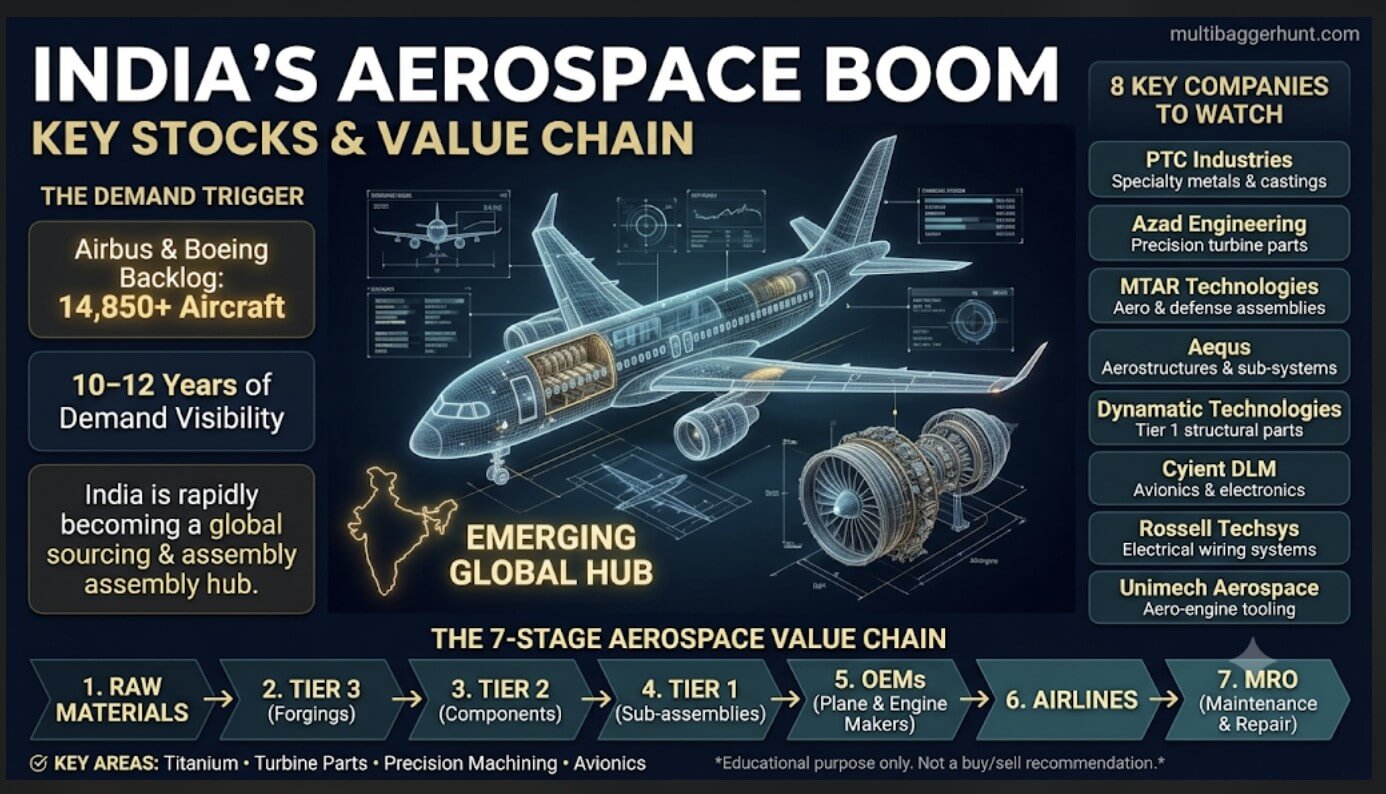
Global commercial aviation is facing a massive supply gap today. Specifically, combined order backlogs at Airbus and Boeing have crossed 14,850 aircraft. Because of this huge backlog, India aerospace stocks are gaining serious attention from long-term market learners. This order book gives aircraft makers 10 to 12 years of clear demand visibility.
At the same time, India is rapidly emerging as a global aerospace manufacturing hub. Historically, India held only a 1% to 2% share in global aviation supply chains. However, global plane makers are now shifting orders toward Indian suppliers at a record pace. Understanding India aerospace stocks requires looking closely at the seven stages of the industry value chain.
Why India Is Becoming a Global Aerospace Manufacturing Hub
For decades, India was mainly a buyer of foreign planes. Today, however, India is becoming a trusted builder of critical aircraft parts. Several powerful trends are driving this shift:
- Record Global Order Backlogs: Currently, Airbus commercial aircraft orders exceed 9,000 jets. Meanwhile, Boeing commercial market demand supports over 6,000 planes on order. Therefore, neither company can meet delivery targets without new suppliers.
- Global Supply Chain Shifts: Western plane makers want to reduce their reliance on single-country suppliers. For example, sanctions on Russian titanium forced global firms to find new metal sources. As a result, certified Indian plants are winning long-term export contracts.
- Skilled Labor Shortages in the West: Many machine shops in the US and Europe face rising wages and retiring workers. In contrast, India offers skilled engineers and lower production costs. Consequently, global firms are moving precision work to Indian factories.
- Rising Sourcing by Global Giants: Boeing now sources over $1.4 billion worth of goods from India every year. Similarly, Airbus has crossed $1.5 billion in annual Indian sourcing. Moreover, Airbus plans to push this figure past $2 billion before 2030.
- Massive Domestic Fleet Growth: Indian airlines have ordered more than 1,600 new planes. Therefore, global makers are setting up local assembly lines in India to win market share.
Understanding the 7 Key Stages of the Aerospace Value Chain
Before analyzing individual India aerospace stocks, you must understand how an aircraft is built. Aviation manufacturing is very different from making regular car parts. Every part must pass strict safety rules and quality audits. Furthermore, getting approved by a global plane maker can take three to five years.
Here is how the 7-stage aerospace value chain works from raw metal to daily flights:
1. Raw Materials (Titanium, Superalloys, and Specialty Metals)
Every aircraft starts with advanced metals and carbon composites. Jet engines face extreme heat and pressure during every flight. Therefore, builders need aerospace-grade titanium, nickel superalloys, and special steels.
- Key Features: Setting up melting furnaces requires heavy upfront spending and years of testing. However, once a supplier wins approval, plane makers rarely switch vendors.
2. Tier 3 Suppliers (Castings, Forgings, and Basic Machining)
Next, Tier 3 companies turn raw metal blocks into shaped parts using customer blueprints. They use advanced CNC machines, casting molds, and forging presses.
- Key Features: Profit margins depend on running machines at high capacity and recycling scrap metal. In addition, moving from simple parts to complex shapes boosts profitability.
3. Tier 2 Suppliers (Engine Parts, Actuators, and Avionics)
Tier 2 firms build working parts that go straight into engines, landing gear, or cockpit systems. Common products include turbine blades, fuel nozzles, wire harnesses, and circuit boards.
- Key Features: Winning a part number on a major jet engine takes years of testing. Once approved, however, that single part can generate steady revenue for 15 to 20 years.
4. Tier 1 Suppliers (Major Sub-Assemblies and Structures)
Tier 1 players combine hundreds of smaller parts into large aircraft sections. For instance, they build complete doors, wing flaps, fuselage sections, and landing gear units.
- Key Features: Tier 1 contracts bring large order values per plane. On the other hand, these firms must manage complex supply chains and carry higher inventory.
5. Original Equipment Manufacturers (OEMs)
OEMs design, test, assemble, and sell complete aircraft and jet engines. Major airframe OEMs include Airbus and Boeing. Meanwhile, engine OEMs include GE Aerospace, Safran, Pratt & Whitney, and Rolls-Royce. In India, Hindustan Aeronautics Limited (HAL) is the leading defense OEM.
- Key Features: OEMs spend billions of dollars on research and design. In return, they enjoy strong pricing power and steady spare-part sales.
6. Commercial Airlines and Operators
Airlines buy or lease planes to fly passengers and cargo across routes. In India, the Directorate General of Civil Aviation (DGCA) regulates flight safety and airline rules. According to IBEF aviation industry reports, India is one of the fastest-growing air travel markets globally.
- Key Features: Airlines generate high revenue but earn very thin net profits. Specifically, high fuel costs, plane lease rents, and ticket price wars hurt airline margins.
7. Maintenance, Repair, and Overhaul (MRO)
A commercial plane flies for 25 to 30 years. During this time, it needs regular safety checks, part replacements, and engine overhauls. MRO companies handle all of this ongoing maintenance work.
- Key Features: MRO demand depends on total flight hours rather than new plane orders. Therefore, engine MRO businesses enjoy steady cash flows across all market cycles.
Summary Table: Comparing the 7 Aerospace Value Chain Stages
| Value Chain Stage | Main Products or Services | Entry Barriers | Profit Margin Profile | Working Capital Needs |
| 1. Raw Materials | Titanium, superalloys, specialty steel | Very High (4–7 years for approval) | High (20%–30%+ EBITDA) | High (Long metal cycles) |
| 2. Tier 3 Suppliers | Castings, forgings, CNC machined parts | Moderate to High | Moderate (14%–20% EBITDA) | Moderate to High |
| 3. Tier 2 Suppliers | Engine blades, actuators, wire harnesses | Very High (Part-level audits) | High (22%–32%+ EBITDA) | Moderate |
| 4. Tier 1 Suppliers | Aircraft doors, wing flaps, fuselages | High (Scale & risk sharing) | Moderate (12%–18% EBITDA) | High (Large inventory) |
| 5. OEMs | Complete jets, helicopters, engines | Extreme (Global duopoly) | High on jet engines | Very High |
| 6. Airlines | Passenger and cargo flights | Regulatory & fleet cost | Low & Cyclical | Low (Upfront ticket cash) |
| 7. MRO | Engine repair, heavy checks, spares | High (DGCA/FAA approvals) | Moderate to High | Moderate |
8 Key India Aerospace Stocks to Track Across the Value Chain
Investors studying India aerospace stocks often track eight specialized companies. Each firm sits at a different stage of the supply chain and serves distinct global clients.
1. PTC Industries Limited
- Value Chain Position: Stage 1 (Raw Materials) and Stage 3 (Precision Castings).
- Business Overview: Through its subsidiary Aerolloy Technologies, PTC makes titanium and superalloy ingots, billets, and castings. Moreover, it supplies certified parts to global leaders like Safran and Airbus.
- Key Strength: PTC is building integrated titanium melting and recycling plants in India. Because global plane makers want non-Russian titanium, this facility holds high strategic value.
- Risk Factor: Investors must watch how fast new melting capacity ramps up. In addition, the stock trades at steep forward valuation multiples.
2. Azad Engineering Limited
- Value Chain Position: Stage 2 (Tier 2 Engine Components).
- Business Overview: Azad makes precision turbine blades and airfoils for jet engines, defense systems, and power turbines. It has qualified around 1,700 parts and holds an order book near ₹6,500 crore.
- Key Strength: Turbine blades spin at extreme speeds under intense heat. Therefore, customer approvals take years, and Azad enjoys EBITDA margins above 30%.
- Risk Factor: Expanding capacity requires heavy machine spending. Furthermore, high P/E multiples leave little room for execution delays.
3. MTAR Technologies Limited
- Value Chain Position: Stage 2 and Stage 3 (Precision Assemblies).
- Business Overview: MTAR builds precision parts for aerospace, defense, space rockets, and clean energy. For example, it supplies actuators for the Tejas fighter jet and parts for ISRO launch vehicles.
- Key Strength: MTAR excels at ultra-tight engineering tolerances. As a result, it has built decades-long ties with national space and defense labs.
- Risk Factor: Clean energy orders still form a large share of revenue. Consequently, quarterly sales can look lumpy when clean energy shipments pause.
4. Aequs Limited
- Value Chain Position: Stage 3 and Stage 4 (Aerostructures and Machining).
- Business Overview: Listed in late 2025, Aequs runs a dedicated aerospace manufacturing zone in Belagavi, Karnataka. It supplies machined parts and landing-gear items to Airbus, Boeing, and Safran.
- Key Strength: Aequs houses forging, machining, heat treatment, and surface finishing in one cluster. Thus, global clients save time and shipping costs.
- Risk Factor: Investors should track bottom-line net profit growth and return on equity as factory utilization improves.
5. Dynamatic Technologies Limited
- Value Chain Position: Stage 4 (Tier 1 Aerostructures).
- Business Overview: Dynamatic is a major Tier-1 supplier with plants in India and the UK. Specifically, it makes flap-track beams for the Airbus A320 and all doors for the Airbus A220.
- Key Strength: Being a sole-source Tier-1 supplier ties its revenue directly to Airbus monthly plane deliveries.
- Risk Factor: Non-aerospace units and high valuation multiples mean investors must watch pure aerospace margin trends closely.
6. Cyient DLM Limited
- Value Chain Position: Stage 2 and Stage 4 (Avionics and Electronics).
- Business Overview: Cyient DLM builds safety-critical circuit boards, cockpit boxes, and cable harnesses for global defense and aviation firms.
- Key Strength: Electronic parts face faster approval cycles than heavy metal airframe parts. As a result, its aerospace vertical has seen rapid top-line growth.
- Risk Factor: Electronic assembly carries lower operating margins (around 9% to 12%) than precision metal machining.
7. Rossell Techsys Limited
- Value Chain Position: Stage 2 (Electrical Wiring Systems).
- Business Overview: Rossell Techsys builds complex wire harnesses and electronic panels for Boeing, Lockheed Martin, and Honeywell.
- Key Strength: Modern jets use miles of custom electrical wiring. Therefore, Rossell benefits from strong multi-year order visibility.
- Risk Factor: Roughly 40% of its revenue comes from Boeing. Because of this concentration, any slowdown at Boeing affects near-term orders.
8. Unimech Aerospace and Manufacturing Limited
- Value Chain Position: Stage 2 and Stage 7 Support (Engine Tooling).
- Business Overview: Unimech builds custom engine assembly tools, lifting beams, and transport stands for engine makers and MRO shops. It also makes precision flying parts.
- Key Strength: Custom engine tools require fast engineering and exact tolerances. Consequently, Unimech earns strong gross margins above 65%.
- Risk Factor: Nearly 90% of its sales come from exports. Thus, US trade tariffs and currency swings remain key variables to monitor.
Quick Comparison of 8 Key Indian Aerospace Companies
| Company Name | Primary Stage | Main Product Focus | Key Global Customers | Main Risk to Watch |
| PTC Industries | Stage 1 & 3 | Titanium melting & engine castings | Safran, Airbus | Plant ramp-up & high valuation |
| Azad Engineering | Stage 2 | Jet engine airfoils & turbine blades | Global aero-engine OEMs | Heavy capex & steep P/E multiple |
| MTAR Technologies | Stage 2 & 3 | Actuators, rocket & defense parts | ISRO, HAL, global primes | Clean energy order lumpiness |
| Aequs | Stage 3 & 4 | Machined aerostructures & gear parts | Airbus, Boeing, Safran | Improving net profit margins |
| Dynamatic Tech | Stage 4 | Aircraft doors & flap-track beams | Airbus (A320, A220) | Airbus build-rate changes |
| Cyient DLM | Stage 2 & 4 | Cockpit electronics & PCBAs | Global avionics OEMs | Lower operating margins |
| Rossell Techsys | Stage 2 | Wire harnesses & avionics panels | Boeing, Lockheed Martin | High dependence on Boeing |
| Unimech Aerospace | Stage 2 & MRO | Engine tooling & flying parts | Aero-engine OEMs & MROs | ~90% export & tariff exposure |
(Related reading: Check out our guide on Indian Defence Manufacturing Stocks and learn How to Analyze Order Book to Revenue Ratios for industrial companies.)
Key Opportunity Areas for Long-Term Growth
Across the aviation sector, four specific areas offer the best growth potential for Indian manufacturers:
- Aircraft Engine Parts: Jet engines make up roughly 25% to 30% of a plane’s total cost. Moreover, engines need frequent spare parts over their 25-year life. Therefore, suppliers of blades, casings, and seals enjoy both new-build and replacement demand.
- Titanium and Superalloys: Aerospace metals carry the highest entry barriers in manufacturing. Domestic melting and scrap recycling allow Indian firms to capture high-margin global orders.
- High-Precision Engine Tooling: Every new jet engine and repair shop needs custom assembly stands and gauges. Because production runs are small and complex, tooling makers earn high margins.
- Avionics and Electrical Harnesses: Modern aircraft rely more on digital systems and electric actuators. Consequently, electronic and wiring content per plane continues to rise every year.
Answering the Key Question: Which Value-Chain Stage Offers the Strongest Investment Potential?
When studying India aerospace stocks, one vital question stands out: Which stage of the value chain creates the strongest long-term wealth?
Looking at profit margins, entry barriers, and return ratios, Stage 1 (Raw Materials) and Stage 2 (Tier-2 Precision Engine Components) offer the strongest investment potential. Engine MRO (Stage 7) ranks closely behind them.
Here is why these stages outperform other layers of the aviation industry:
- Why Airlines (Stage 6) Struggle: Airlines face fierce ticket competition, volatile fuel prices, and high fixed lease costs. Even when passenger traffic booms, airline shareholders often see weak returns.
- Why Tier-1 Suppliers (Stage 4) Face Pressure: Tier-1 aerostructure firms win big contracts, yet they carry heavy inventory. In addition, global plane makers often demand annual price cuts from Tier-1 vendors.
- Why Stage 1 and Stage 2 Win:
- High Switching Costs: Once an engine blade or titanium alloy passes flight tests, OEMs almost never switch suppliers. Re-testing a new vendor costs too much time and money.
- Superior Profit Margins: Specialized Tier-2 component and tooling makers often earn 22% to 32%+ EBITDA margins. As a result, they can fund new machines from internal cash flows.
- Repeat Spare-Part Demand: Engine parts wear out under extreme heat. Therefore, Stage 2 suppliers benefit from steady aftermarket sales long after a plane is delivered.
(Further reading: Explore our breakdown of India’s Aviation MRO Infrastructure Growth to see how domestic maintenance hubs are expanding.)
Key Risks and Valuation Rules Every Investor Must Know
While the 10-to-12-year aerospace demand cycle is clear, buying at the right valuation remains critical. Even a great manufacturing business can deliver poor stock returns if you overpay for it.
- Stretched Stock Valuations: Many listed Indian aerospace firms trade at trailing P/E multiples between 80x and 200x. Such high prices already assume years of flawless profit growth. Therefore, any small quarterly miss can trigger sharp stock corrections.
- Plane Delivery Delays: Airbus and Boeing sometimes slow down monthly production due to part shortages or safety audits. When OEM assembly slows, orders for Indian suppliers get pushed back.
- Long Working Capital Cycles: Aerospace factories must hold costly certified metals for 120 to 200 days before shipping finished goods. Always check whether accounting profits turn into real operating cash flow.
- Customer and Export Concentration: Many Indian suppliers earn 40% to 90% of their revenue from exports or a single global client. Thus, trade tariffs or currency swings can impact quarterly margins.
5-Point Checklist for Evaluating India Aerospace Stocks
Before adding any aerospace company to your research watchlist, test it against these five rules:
- Check the Order Book Ratio: Divide the confirmed order book by annual sales. A ratio between 2.5x and 5.0x shows healthy multi-year demand without execution overload.
- Track Qualified Part Numbers: Look for steady yearly growth in OEM-approved part numbers. More approved parts prove the company is winning customer trust.
- Separate Pure Aerospace Sales: Check how much revenue comes from true aviation versus legacy auto or general engineering units. Pure aerospace divisions deserve higher quality ratings.
- Watch Fixed-Asset Turnover: New furnaces and CNC machines cost a lot upfront. Verify that sales per rupee of fixed assets are rising as plants scale up.
- Respect Valuation Margins of Safety: Compare the stock’s P/E and EV/EBITDA ratios against realistic three-year earnings growth rather than hype.
Key Takeaway
The 14,850+ aircraft backlog at Airbus and Boeing gives India’s aerospace sector a rare, multi-decade growth runway. As global plane makers source more parts from India, local firms across titanium, engine blades, avionics, and tooling are gaining global market share.
However, profits are not shared equally across the 7-stage aerospace value chain. The strongest competitive moats sit in Stage 1 (specialty raw materials) and Stage 2 (tier-2 engine and mission-critical parts). For disciplined learners, balancing this long-term growth story against high stock valuations and working-capital needs is the key to smart analysis.
Disclaimer: This article is for informational and educational purposes only and does not constitute financial advice. Stock market investments are subject to market risks. Please consult with a registered financial advisor before making any investment decisions.
Disclaimer: This article is for educational purposes only and not financial advice. Investors should do their own due diligence before investing.
Disclaimer: The projections of potential returns are based on current market conditions and company performance. Actual results may vary due to various factors, including market dynamics, economic conditions, and changes in the competitive landscape. Investors should conduct their own research and consult with financial advisors before making investment decisions.
Multibagger Stocks breakout stocks
⚠️ Not SEBI Registered—just here to share insights | 🚫 No paid services—everything shared is entirely free! 🧠 Always Learning and excited to grow together in this journey of market exploration.
📲 Join Our Investor Communities
🔹 Join our Telegram Channel: Multibagger Hunts
🔹 Join our WhatsApp Channel: Click to Join
✅ Free access
✅ Instant alerts
✅ Curated research for serious investors
TwitterXWhatsAppThreadsTelegramFacebookLinkedInGmailEmailShare