admin
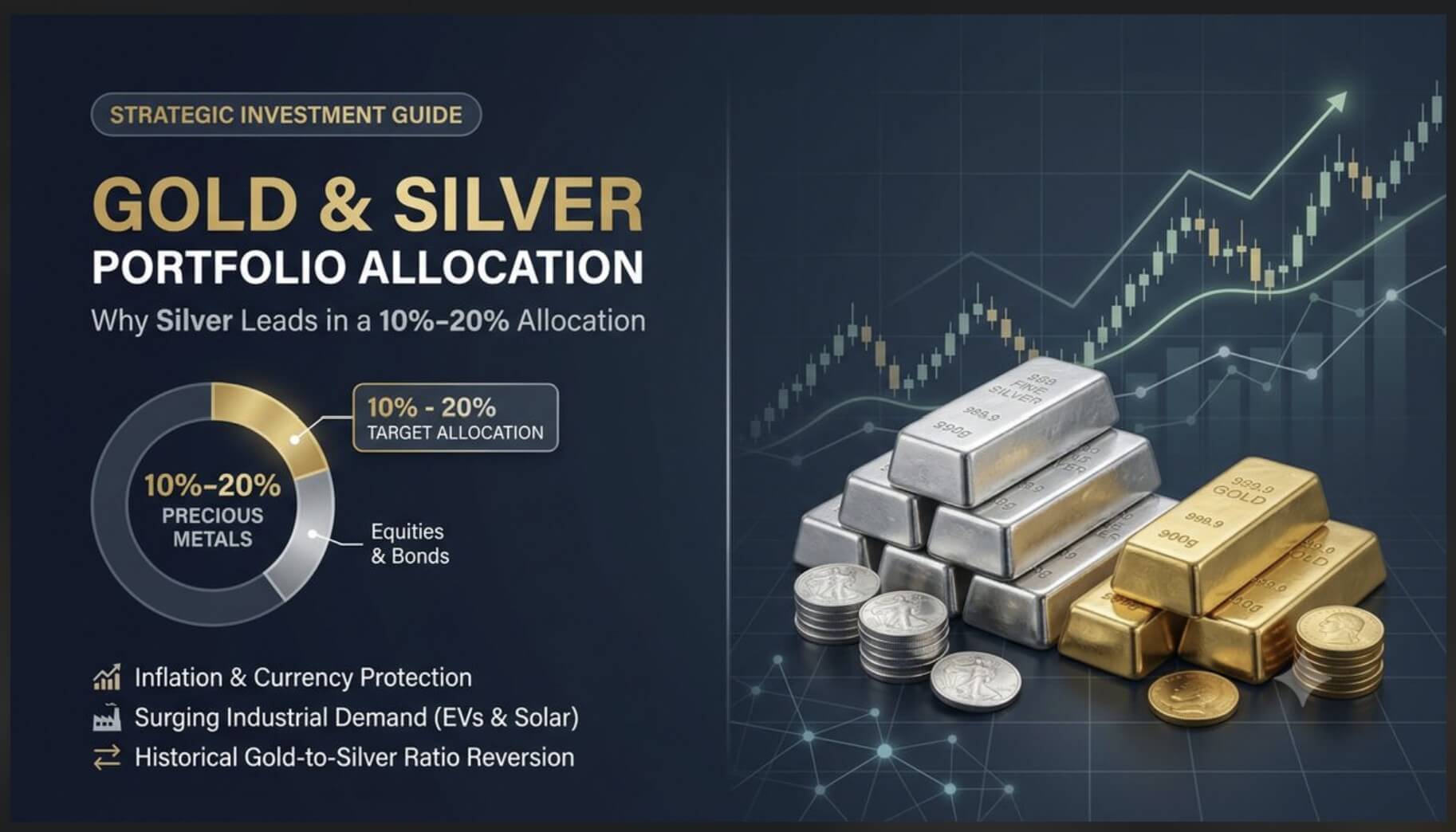
Building a resilient investment portfolio requires more than picking high-growth stocks or locking in fixed-income yields. Over long market cycles, inflation, currency debasement, and geopolitical shocks steadily erode the purchasing power of paper assets. Therefore, many disciplined investors maintain a dedicated Gold and Silver portfolio allocation of 10% to 20%.
Within this precious metals sleeve, a compelling long-term case favors weighting Silver more heavily than Gold. While Gold remains the premier monetary anchor for central banks and conservative savers, Silver combines precious metal scarcity with rapidly expanding industrial demand. However, every market thesis carries uncertainty. Silver’s high price volatility means any bullish projection can fail or take years to play out, so independent research remains essential before committing capital.

Why a 10–20% Gold and Silver Portfolio Allocation Works
Most retail portfolios suffer from heavy concentration in domestic equities and cash equivalents. When inflation accelerates or economic growth stalls simultaneously, traditional stock-and-bond portfolios often decline together. Consequently, adding precious metals introduces an asset class with low long-term correlation to corporate earnings.
A 10% to 20% Gold and Silver portfolio allocation strikes a practical balance between meaningful downside protection and long-term compounding:
- Below 10% lacks portfolio impact: A 2% or 3% position in precious metals rarely offsets a 25% drawdown in equities during a severe bear market.
- Between 10% and 20% provides meaningful insurance: For example, a 15% allocation that rallies 30% during an inflationary shock cushions overall portfolio losses by 4.5%. That gain gives investors liquidity to rebalance into discounted stocks.
- Above 20% creates opportunity cost: Precious metals do not pay dividends, interest, or cash flows. As a result, over-allocating beyond 20% can drag down multi-decade wealth creation during extended equity bull markets.
Investors can monitor real-time commodity price action, multi-timeframe moving averages, and volume breakouts directly on the TradingCharts Terminal alongside broader Multibagger Hunt equity research to evaluate how precious metals behave across market cycles.
Gold vs. Silver: Core Market Dynamics and Structural Differences
Although Gold and Silver often move in the same direction during macroeconomic shifts, their underlying supply and demand engines differ dramatically. Understanding these structural contrasts explains why both metals play complementary roles inside a balanced Gold and Silver portfolio allocation.
Gold is primarily a monetary and reserve asset. Roughly two-thirds of annual gold demand comes from central bank reserves, institutional bars, coins, and jewelry. Meanwhile, industrial applications represent less than 10% of total consumption. According to data tracked by the World Gold Council, sovereign central banks have consistently accumulated physical gold to diversify foreign exchange reserves away from single-currency concentration.
Silver, by contrast, is a hybrid monetary and industrial metal. More than half of global silver consumption comes from industrial manufacturing, electronics, solar photovoltaics, and automotive electrification. Because Silver’s total market capitalization is roughly one-tenth the size of Gold’s, capital inflows into Silver produce much sharper percentage price swings.
| Evaluation Factor | Gold (XAU) | Silver (XAG) | Portfolio Impact |
|---|---|---|---|
| Primary Demand Driver | Central banks, sovereign reserves, wealth preservation | Industrial electronics, solar energy, EVs, retail investment | Gold stabilizes; Silver amplifies upside |
| Industrial Demand Share | Under 10% of total annual consumption | Over 55% of total annual consumption | Silver tracks global manufacturing growth |
| Market Size & Liquidity | Deep, multi-trillion-dollar institutional liquidity | Roughly 10x smaller market than Gold | Silver experiences sharper price breakouts |
| Price Volatility (Beta) | Moderate; lower drawdowns in recessions | High; typically 1.5x to 2.5x Gold’s daily move | Requires strict position sizing in Silver |
| Supply Elasticity | Dedicated primary gold mines respond to price | ~70% mined as a byproduct of copper, lead, zinc | Silver supply cannot quickly scale up |
| Inflation Hedge Profile | Strong monetary hedge against currency debasement | Dual hedge against inflation and industrial bottlenecks | Complementary protection across cycles |
| Ideal Holding Horizon | 5 to 15+ years as core capital insurance | 5 to 10+ years across industrial capex cycles | Best held through multi-year trends |
The Long-Term Bullish Case for Silver Over Gold
Weighting Silver higher inside a Gold and Silver portfolio allocation rests on three measurable market fundamentals: persistent physical supply deficits, structural industrial demand, and historical valuation ratios.
1. Multi-Year Structural Supply Deficits
Unlike fiat currencies, physical silver cannot be printed to meet rising demand. Market reports published by The Silver Institute confirm that the global silver market recorded its sixth consecutive annual structural deficit in 2026. Cumulative supply shortfalls since 2021 now exceed 740 million ounces.
Several supply bottlenecks keep the physical market tight:
- Byproduct mining constraints: Roughly 70% to 75% of newly mined silver comes as a secondary byproduct from copper, lead, zinc, and gold mines. Even when silver prices rally strongly, mining companies do not immediately open new silver mines unless base metal prices also justify capital expenditure.
- Declining ore grades: Major legacy silver mines in Mexico, Peru, and China face aging infrastructure and lower ore concentrations. Consequently, global mine output stays constrained near 834 to 850 million ounces annually.
- Limited above-ground inventories: Almost every ounce of gold ever mined sits in central bank vaults or jewelry. Conversely, most industrial silver used in tiny electronic components ends up in landfills, permanently removing it from circulation.
2. Irreplaceable Industrial Demand in Electrification and AI
Silver possesses the highest electrical and thermal conductivity of any metal on the periodic table. Therefore, engineers cannot easily substitute cheaper metals like copper or aluminum in high-efficiency applications without sacrificing performance or energy efficiency.
Three major industrial growth engines support long-term silver consumption:
- Electric Vehicles (EVs) and Charging Networks: Battery electric vehicles require roughly twice as much silver per unit as internal combustion cars due to power electronics, battery management systems, and high-voltage wiring.
- AI Data Centers and High-Performance Computing: The rapid expansion of artificial intelligence infrastructure requires massive upgrades to power grids, server motherboards, high-speed connectors, and thermal management systems.
- Next-Generation Solar Photovoltaics: While solar panel manufacturers continually thrift silver paste per watt to cut costs, global gigawatt installations continue to expand across Asia, Europe, and North America.
3. The Gold-to-Silver Ratio Mean Reversion
Experienced commodity investors closely monitor the Gold-to-Silver Ratio, which measures how many ounces of silver it takes to purchase one ounce of gold. Over the past century, this ratio has fluctuated widely. It often spikes above 80:1 during financial panics and compresses toward 40:1 or 50:1 during mature precious metal bull markets.
When the ratio trades above 80:1, Silver is historically inexpensive relative to Gold. In past bull cycles—such as 2003–2011 and 2020–2021—Silver lagged Gold during the early defensive phase of the rally. Afterwards, Silver dramatically outperformed Gold on a percentage basis once industrial recovery and retail momentum accelerated. Investors can chart relative strength spreads between Gold and Silver futures in real time using custom indicators on the TradingCharts Terminal.
Practical Models for Your Gold and Silver Portfolio Allocation
Knowing that a 10% to 20% Gold and Silver portfolio allocation makes sense is only the first step. How you divide that allocation between the two metals depends on your risk tolerance, investment timeline, and broader asset mix.
| Investor Profile | Equities & Growth | Fixed Income & Cash | Gold Weight | Silver Weight | Total Metals | Strategic Objective |
|---|---|---|---|---|---|---|
| Conservative Wealth Preserver | 55% | 35% | 6% | 4% | 10% | Prioritize low volatility and capital defense |
| Balanced Long-Term Investor | 65% | 20% | 6% | 9% | 15% | Combine inflation insurance with Silver upside |
| High-Conviction Macro Investor | 70% | 10% | 7% | 13% | 20% | Maximize exposure to Silver’s industrial deficit |
Disciplined Rebalancing Rules
Because Silver is far more volatile than Gold, a 9% Silver position can quickly swell to 14% after a strong multi-month rally. Implementing systematic rebalancing rules turns volatility into a repeatable advantage:
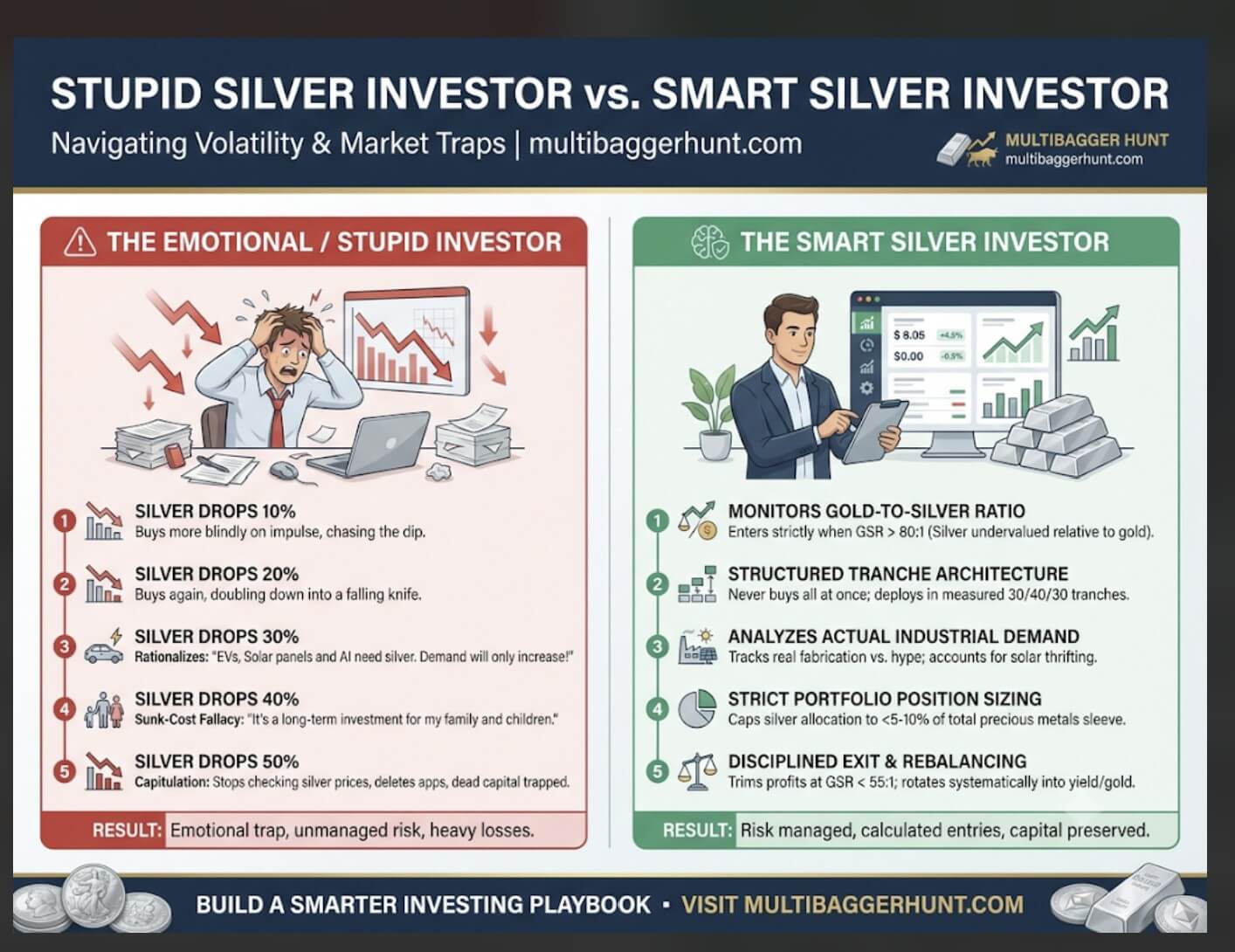
- Threshold rebalancing: If your combined precious metals slice grows from 15% to 20% of your total portfolio, trim the excess 5% and reallocate proceeds into undervalued equities or short-term debt.
- Ratio-based rotation: When the Gold-to-Silver ratio compresses sharply below 50:1 after a parabolic silver surge, consider rotating a portion of Silver profits into Gold to lock in purchasing power.
- Staggered accumulation: Instead of deploying your entire target allocation in a single lump sum, divide purchases across four to six tranches over several months to smooth out entry prices.
Investment Vehicles: Choosing the Right Way to Buy Gold and Silver
Modern investors have multiple ways to build a Gold and Silver portfolio allocation without dealing with cumbersome physical storage. Choosing the right vehicle depends on whether your goal is long-term wealth preservation, tax efficiency, or active tactical trading.
- Gold and Silver Exchange-Traded Funds (ETFs): ETFs backed by physical bullion offer high daily liquidity, transparent pricing, and effortless execution through standard brokerage accounts. Furthermore, investors avoid making charges, purity verification issues, and vault storage fees while paying a modest annual expense ratio.
- Commodity Futures and Spot Contracts: Active traders who want capital efficiency and intraday liquidity often trade standardized gold and silver contracts on regulated exchanges like the Multi Commodity Exchange of India (MCX) or COMEX. However, futures require strict stop-loss discipline because leverage magnifies both gains and losses.
- Physical Coins and Bullion Bars: Holding physical 999-purity silver bars or 24-karat gold coins eliminates counterparty risk entirely. On the other hand, buyers must account for dealer premiums, Goods and Services Tax (GST) or local sales taxes, and secure bank locker storage.
- Precious Metal Mining Equities: Shares of primary silver and gold producers offer operational leverage to rising metal prices. Nevertheless, mining stocks carry company-specific risks, including rising energy costs, labor disputes, regulatory changes, and equity market correlation.
For readers comparing asset classes across Indian equities and commodities, explore our latest stock market and sector analysis guides alongside technical price scans on TradingCharts Market Analytics to avoid emotional buying at short-term peaks.
Risk Analysis: When a Bullish Silver Thesis Can Go Wrong
No market thesis is guaranteed. Even the strongest long-term supply-and-demand forecast can fail, stall, or suffer severe drawdowns before proving right. Therefore, managing a Gold and Silver portfolio allocation requires understanding five specific risks that can invalidate a bullish Silver outlook.
1. Global Manufacturing Recessions and Trade Tariffs
Because industrial applications account for more than half of Silver demand, an economic downturn hits Silver much harder than Gold. If global factory activity contracts or new cross-border tariffs disrupt supply chains, manufacturers reduce raw material orders. During the initial liquidity shock of a recession, Silver frequently sells off alongside industrial metals like copper before eventually recovering.
2. Industrial Thrifting and Material Substitution
Sustained high silver prices create an immediate financial incentive for manufacturers to use less silver. Solar cell producers continuously engineer thinner silver paste lines, while electronics makers experiment with copper-plated alternatives. If high prices accelerate industrial thrifting faster than new demand sectors grow, projected supply deficits can narrow or flip into temporary surpluses.
3. Rising Real Interest Rates and US Dollar Strength
Gold and Silver pay no yield. When central banks hold interest rates well above inflation—pushing real yields higher—institutional capital often favors government bonds and money market instruments over non-yielding metals. Similarly, a surging US Dollar makes dollar-denominated bullion more expensive for international buyers in emerging markets.
4. Severe Price Volatility and Behavioral Traps
Silver is notorious for sharp, nerve-testing corrections. Even inside multi-year bull markets, Silver routinely experiences 20% to 35% pullbacks within a few weeks. Investors who over-allocate beyond 20% or use excessive margin leverage often panic-sell near cyclical bottoms, turning temporary volatility into permanent capital loss.
5. Secondary Scrap Surges and ETF Outflows
When silver prices reach multi-year highs, consumers and industrial recyclers sell old silverware, jewelry, and electronic scrap back into the market. Rising secondary recycling supply combined with profit-taking from exchange-traded product holders can temporarily relieve physical tightness and cap near-term price rallies.
Due Diligence Checklist: How to Research Before You Invest
Blindly copying a portfolio allocation tip from social media or market commentary is never a substitute for personal conviction. When markets turn volatile, only investors who understand why they own an asset have the discipline to hold or rebalance rationally.
Before finalizing your Gold and Silver portfolio allocation, work through this five-step independent research checklist:
- Review Macroeconomic Indicators: Track real interest rates (nominal bond yields minus inflation), central bank balance sheet trends, and currency purchasing power in your home country.
- Verify Primary Supply and Demand Data: Read annual industry surveys directly from The Silver Institute and the World Gold Council rather than relying on sensational headlines.
- Analyze Long-Term Price Charts: Examine 5-year and 10-year monthly price charts on the TradingCharts Terminal to identify major support zones, historical resistance levels, and multi-year volatility ranges.
- Calculate After-Tax Returns: Check local capital gains tax rules, holding period requirements, and transaction costs for ETFs, physical bullion, and commodity derivatives in your jurisdiction.
- Stress-Test Your Risk Tolerance: Ask yourself whether you can comfortably hold your Silver position through a 30% temporary drawdown without disrupting your household finances or long-term goals.
Frequently Asked Questions (FAQ)
Is a 10–20% Gold and Silver portfolio allocation enough to protect wealth?
Yes. For most investors, dedicating 10% to 20% of total investable assets to Gold and Silver provides meaningful diversification against inflation and currency risk without sacrificing long-term growth from equities.
Why is Silver considered riskier than Gold?
Silver has a much smaller market size than Gold and relies heavily on industrial demand from manufacturing, solar, and electronics. Consequently, this combination causes Silver to rise faster during economic expansions and fall harder during industrial slowdowns.
How often should I rebalance my Gold and Silver portfolio allocation?
Reviewing your allocation every six to twelve months—or whenever your precious metals weight drifts more than 5% away from your target band—helps lock in gains during sharp rallies and accumulate metals during market pullbacks.
Should beginners start with Gold or Silver first?
Conservative beginners often build a foundation in Gold first to experience lower volatility. Afterwards, they can gradually add Silver ETFs or staggered tranches once they understand how commodity cycles behave.
⚠️ Not SEBI Registered—just here to share insights | 🚫 No paid services—everything shared is entirely free! 🧠 Always Learning and excited to grow together in this journey of market exploration.
⚠️ Not SEBI Registered—just here to share insights | 🚫 No paid services—everything shared is entirely free! 🧠 Always Learning and excited to grow together in this journey of market exploration.
📲 Join Our Investor Communities
🔹 Join our Telegram Channel: Multibagger Hunts → 🔹 Join our WhatsApp Channel: Click to Join →
✅ Free access
Share This Post
TwitterXWhatsAppThreadsTelegramFacebookLinkedInGmailEmailShare