admin
Introduction: Entero Healthcare Q2 FY27 Results
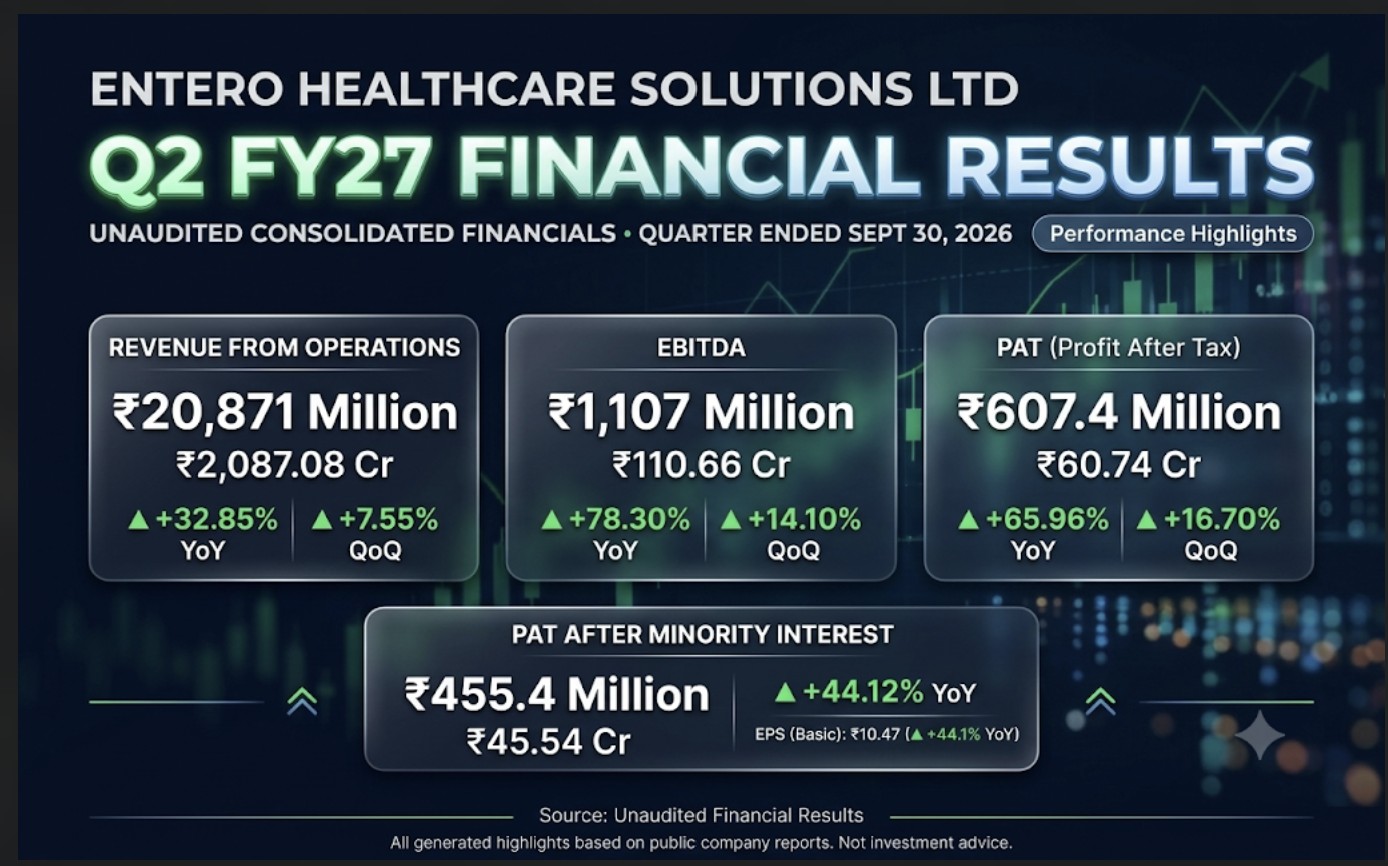
The Entero Healthcare Solutions Q2 FY27 Results highlight a strong quarter for one of India’s healthcare distribution companies. Revenue increased by 32.85% year-on-year, while EBITDA grew by an impressive 78.30%.
More importantly, profitability improved faster than revenue. The EBITDA margin increased from 3.95% in Q2 FY26 to 5.30% in Q2 FY27. This suggests that the company is beginning to benefit from better operating efficiency and economies of scale.
For investors, this is an important development.
Healthcare distribution is generally a high-volume, low-margin business. Companies must manage procurement costs, inventory, logistics, supplier relationships and customer payments carefully. Even a small improvement in operating margins can have a meaningful impact on profitability.
Entero’s latest performance raises an important question: Can the company maintain its revenue growth while expanding margins further?
In this article, we examine the quarterly financial performance, revenue growth, EBITDA expansion, profitability, business model, industry opportunities, valuation considerations and risks that investors should monitor.
The objective is not simply to highlight impressive financial numbers. It is to understand what these numbers mean for the company’s long-term business prospects.
1. Entero Healthcare Q2 FY27 Results: Financial Performance at a Glance
Entero Healthcare delivered strong growth across its major financial indicators during the September 2026 quarter.
The following table compares the reported consolidated financial performance of Q2 FY27 with Q2 FY26.
| Financial Metric | Q2 FY27 | Q2 FY26 | YoY Growth |
|---|---|---|---|
| Revenue | ₹2,087.08 Cr | ₹1,570.95 Cr | 32.85% |
| EBITDA | ₹110.66 Cr | ₹62.07 Cr | 78.30% |
| EBITDA Margin | 5.30% | 3.95% | +135 bps |
| PBT | ₹78.39 Cr | ₹44.63 Cr | 75.66% |
| Total PAT | ₹60.74 Cr | ₹36.60 Cr | 65.96% |
| PAT After Minority Interest | ₹45.54 Cr | ₹31.60 Cr | 44.12% |
| EPS | ₹10.50 | ₹7.28 | 44.10% |
| Other Income | ₹3.99 Cr | ₹4.79 Cr | -16.70% |
Key observations:
- Revenue crossed ₹2,000 crore during the quarter.
- EBITDA growth was more than twice the revenue growth rate.
- EBITDA margin improved by 135 basis points.
- Profit before tax increased by more than 75%.
- Profit attributable to shareholders increased by 44.12%.
- EPS increased from ₹7.28 to ₹10.50.
The most encouraging development is the improvement in operating profitability.
However, investors should distinguish between total consolidated PAT and profit attributable to shareholders. The latter is more relevant when assessing earnings available to the equity shareholders of the parent company.
2. Revenue Analysis: Can Entero Sustain 30% Growth?
Revenue increased from ₹1,570.95 crore in Q2 FY26 to ₹2,087.08 crore in Q2 FY27.
This represents year-on-year growth of 32.85%.
The company also reported sequential revenue growth of approximately 7.55% compared with the previous quarter.
This is important because consistent quarterly expansion can indicate that business momentum is continuing beyond a single reporting period.
What is driving the revenue opportunity?
Entero operates in the pharmaceutical distribution ecosystem.
Its business connects pharmaceutical manufacturers with pharmacies, hospitals and other healthcare providers.
This is an essential part of the healthcare supply chain. Medicines and medical products must reach customers reliably, and distribution companies play an important role in ensuring product availability.
Several factors can support long-term growth.
1. Increasing demand for healthcare products
India’s healthcare requirements continue to evolve.
Factors supporting the sector include:
- Increasing healthcare awareness.
- Growing demand for medicines.
- Expansion of hospitals and diagnostic facilities.
- Greater access to healthcare services.
- Increasing demand for specialised pharmaceutical products.
- Development of medical infrastructure.
These trends create opportunities for organised distributors with strong supply-chain capabilities.
2. Large product portfolio
According to the company’s reported business information provided for this analysis, Entero manages a portfolio of more than 82,500 products.
A broad portfolio can offer several advantages:
- Better product availability for customers.
- More opportunities for cross-selling.
- Stronger relationships with pharmaceutical manufacturers.
- Greater convenience for pharmacies and healthcare institutions.
- Potential improvement in distribution efficiency.
However, a large product catalogue alone does not guarantee profitability. Inventory management, product demand and working capital discipline remain equally important.
3. Expansion of the organised distribution market
India’s pharmaceutical distribution market remains fragmented.
Smaller regional distributors often operate independently, while organised players can potentially offer better technology, logistics and procurement systems.
Entero’s consolidation strategy aims to benefit from this opportunity.
If the company can integrate regional operations successfully, it may improve its competitive position and operating efficiency.
Revenue growth comparison
<PRIVATE></PRIVATE>
| Period | Revenue |
|---|---|
| Q2 FY26 | ₹1,570.95 Cr |
| Q2 FY27 | ₹2,087.08 Cr |
<PRIVATE></PRIVATE>
The increase of ₹516.13 crore in quarterly revenue demonstrates substantial business expansion.
However, investors should examine whether this growth comes from existing operations, new customers, acquisitions or a combination of these factors.
Organic growth is particularly important because it demonstrates the ability of the existing business to expand without depending entirely on acquisitions.
3. EBITDA Growth: The Most Important Highlight of the Quarter
One of the strongest highlights of the Entero Healthcare Q2 FY27 Results is the improvement in EBITDA.
EBITDA increased from ₹62.07 crore to ₹110.66 crore.
This represents year-on-year growth of 78.30%.
Revenue increased by 32.85% during the same period.
Why is this difference important?
It indicates that operating profitability is growing much faster than sales.
This is commonly known as operating leverage.
Understanding operating leverage
Operating leverage occurs when a company increases revenue faster than its operating expenses.
For example:
- A distributor has an established warehouse network.
- It already employs logistics and technology teams.
- It has existing supplier relationships.
- It has fixed operational infrastructure.
When sales increase, the company may be able to process additional business without increasing fixed costs at the same rate.
As a result, a larger proportion of incremental revenue can contribute to operating profit.
This is particularly relevant for distribution businesses.
EBITDA margin expansion
| Metric | Q2 FY26 | Q2 FY27 |
|---|---|---|
| EBITDA | ₹62.07 Cr | ₹110.66 Cr |
| EBITDA Margin | 3.95% | 5.30% |
The EBITDA margin improved by approximately 135 basis points.
This is a meaningful improvement in a business where margins are relatively thin.
For investors, the next question is whether the company can maintain this margin.
A temporary improvement may not justify a higher valuation. Sustainable margin expansion over several quarters would provide stronger evidence of improving business quality.
What could support further margin improvement?
Potential drivers include:
- Better procurement terms.
- Higher distribution volumes.
- Improved warehouse utilisation.
- More efficient transportation.
- Technology-led inventory management.
- Better product mix.
- Reduced duplication across acquired businesses.
These are potential drivers, not guaranteed outcomes. Investors should look for confirmation in subsequent quarterly results.
4. Profitability Analysis: PBT and PAT Growth
Entero’s profit before tax increased from ₹44.63 crore in Q2 FY26 to ₹78.39 crore in Q2 FY27.
This represents growth of approximately 75.66%.
Total profit after tax increased from ₹36.60 crore to ₹60.74 crore.
That represents year-on-year growth of 65.96%.
The improvement in PBT and PAT suggests that the benefits of higher operating profitability are flowing through to the bottom line.
Total PAT versus PAT attributable to shareholders
An important point investors should understand is the difference between consolidated PAT and PAT after minority interest.
| Particulars | Q2 FY27 |
|---|---|
| Total Consolidated PAT | ₹60.74 Cr |
| PAT After Minority Interest | ₹45.54 Cr |
| Difference | ₹15.20 Cr |
Why does this difference matter?
A consolidated company may operate through subsidiaries in which the parent company does not own 100% of the equity.
Therefore, a portion of the subsidiary’s profit belongs to minority shareholders.
For investors in Entero’s parent company, profit attributable to the parent company’s shareholders is the more relevant earnings figure.
In this case, ₹45.54 crore is the reported minority-adjusted profit.
Investors should monitor whether the minority interest remains proportionate to the company’s growth and whether future ownership changes affect earnings attributable to the parent.
EPS growth
Earnings per share increased from ₹7.28 to ₹10.50.
This represents approximately 44.10% growth.
EPS is important because it measures earnings attributable to each outstanding equity share.
However, investors should not evaluate a stock based on EPS growth alone.
The share price, valuation multiple, future earnings potential, cash flow and balance sheet must also be considered.
5. Why Entero’s Business Model Matters
To understand the company’s long-term potential, investors need to understand how pharmaceutical distribution works.
Pharmaceutical manufacturers produce medicines and healthcare products.
These products must reach pharmacies, hospitals, clinics and other healthcare institutions.
Distribution companies manage several important activities:
- Procurement from manufacturers.
- Warehousing and inventory management.
- Order processing.
- Transportation and delivery.
- Customer relationship management.
- Credit and payment collection.
- Product availability and supply-chain coordination.
The business requires significant operational infrastructure.
It also requires strong working capital management.
A distributor may generate substantial revenue but still face cash-flow pressure if customers delay payments or inventory remains unsold.
This is why investors should look beyond revenue and PAT.
A high-quality distribution business should demonstrate:
- Consistent revenue growth.
- Stable or improving operating margins.
- Efficient inventory turnover.
- Controlled receivable days.
- Healthy operating cash flow.
- Disciplined borrowing.
- Strong supplier and customer relationships.
Entero’s latest results show encouraging improvements in revenue and profitability. The next step is to determine whether these improvements are translating into sustainable cash generation.
6. Medical Technology: An Important Future Growth Opportunity
One of the interesting areas to monitor is Entero’s expansion into medical technology.
The company’s stated strategic ambition, as outlined in the supplied business summary, is to increase the contribution of medical technology to approximately 20% of total revenue over the next two to three years.
This could provide an additional growth opportunity beyond traditional pharmaceutical distribution.
Why is medical technology attractive?
Hospitals and healthcare institutions require a wide range of products and equipment.
These include:
- Medical devices.
- Diagnostic equipment.
- Hospital equipment.
- Surgical products.
- Patient monitoring systems.
- Other specialised healthcare technology products.
A distributor with established hospital relationships may have opportunities to expand into these categories.
Potential advantages
Medical technology expansion could help Entero:
- Diversify its revenue base.
- Increase its addressable market.
- Build stronger institutional relationships.
- Offer a wider range of products.
- Develop additional revenue streams.
However, investors should understand that medical technology distribution can have different economics compared with pharmaceutical distribution.
Institutional customers may require longer payment periods.
Some products may also involve installation, servicing, technical support and specialised inventory requirements.
Therefore, higher revenue does not automatically mean higher returns on capital.
What investors should monitor:
- Medical technology revenue contribution.
- Segment-level EBITDA margins.
- Receivable days.
- Inventory requirements.
- Capital employed.
- Return on capital employed.
The success of this strategy will depend on profitable growth rather than revenue expansion alone.
7. Organic Growth Versus Acquisitions
Entero has pursued expansion through consolidation and acquisitions.
This strategy can help a company increase its geographical presence, customer relationships and distribution capabilities.
However, acquisition-led growth comes with challenges.
These include:
- Integration costs.
- Different technology systems.
- Employee retention.
- Operational restructuring.
- Debt requirements.
- Minority shareholder interests.
- Different working capital practices.
For this reason, organic growth is particularly important.
According to the management outlook included in the supplied results summary, Entero is targeting approximately 23% organic revenue growth.
This is an important metric to track.
Why organic growth matters
Consider two companies:
Company A
- Revenue growth: 30%.
- Growth largely driven by acquisitions.
- Limited improvement in operating margins.
Company B
- Revenue growth: 25%.
- Growth largely driven by existing operations.
- Improving margins and cash flow.
Although Company A has higher reported revenue growth, Company B may demonstrate better underlying business quality.
The comparison illustrates why investors should examine the source of growth rather than focusing only on headline numbers.
For Entero, sustained organic growth combined with margin expansion would strengthen the long-term investment case.
8. Working Capital: The Biggest Metric Investors Should Watch
For a pharmaceutical distribution company, working capital management is critical.
Unlike many software or service businesses, distributors must purchase and maintain physical inventory.
They also frequently provide credit to customers.
This creates a potential mismatch between cash going out and cash coming in.
Three important working capital metrics
1. Inventory days
Inventory days indicate how long products remain in stock before being sold.
Higher inventory days may indicate:
- Slow-moving products.
- Excess inventory.
- Lower inventory efficiency.
- Increased risk of expiry or obsolescence.
2. Receivable days
Receivable days measure how long customers take to pay.
An increase in receivable days can indicate that more money is tied up in customer payments.
This is especially important when expanding into institutional healthcare and medical technology distribution.
3. Payable days
Payable days indicate how long the company takes to pay suppliers.
Strong supplier relationships may support favourable payment terms.
However, excessively stretching supplier payments can create operational and relationship risks.
Why working capital matters more than headline PAT
A company can report increasing profits while experiencing weak operating cash flow.
For example, sales may increase significantly, but customers may not pay on time.
The company must still fund inventory purchases, transportation and employee costs.
This can result in additional borrowing.
Therefore, investors should compare:
- PAT growth.
- Operating cash flow.
- Working capital requirements.
- Net debt.
- Finance costs.
For Entero, the sustainability of its growth will depend heavily on how efficiently it manages these factors.
9. Industry Outlook: India’s Healthcare Distribution Opportunity
India’s healthcare industry offers long-term structural opportunities.
Rising healthcare awareness, increasing medical infrastructure and expanding access to medicines can support demand for pharmaceutical and medical products.
However, the opportunity is not limited to revenue growth.
The industry is also undergoing changes in distribution and supply-chain management.
Key trends supporting the industry
Organised distribution
Larger distribution companies can potentially offer more reliable supply, technology integration and broader product availability.
Digital transformation
Technology can improve inventory planning, order processing and customer service.
Hospital infrastructure expansion
New hospitals and healthcare facilities create additional demand for medicines, equipment and medical supplies.
Specialised healthcare products
Increasing demand for specialised treatments and advanced medical equipment can create opportunities for distributors with appropriate capabilities.
For broader industry context, readers can explore the Forbes Healthcare section.
However, industry growth does not guarantee that every distribution company will generate attractive shareholder returns.
Competition, margins, working capital and valuation remain important considerations.
10. Is Entero Healthcare Stock Expensive? Understanding Valuation
A strong quarterly result does not automatically make a stock attractive at every price.
Investors must compare the company’s current market valuation with its future earnings potential.
For Entero, valuation analysis should consider the following factors.
Price-to-Earnings ratio
The P/E ratio compares the market price of a share with its earnings per share.
A higher P/E multiple may indicate that investors expect strong future growth.
However, it also increases the risk of a valuation correction if earnings growth disappoints.
EV/EBITDA
EV/EBITDA compares enterprise value with operating earnings before interest, taxes, depreciation and amortisation.
This metric can be useful when evaluating companies with different capital structures.
For a distribution business, investors should compare EV/EBITDA with other listed distribution companies, while accounting for differences in growth, leverage and profitability.
Return on capital employed
ROCE measures how efficiently a company uses its capital to generate operating profits.
This is particularly relevant for Entero because distribution requires inventory, warehouses and working capital.
A company that grows revenue rapidly but requires increasingly large amounts of capital may not create attractive returns for shareholders.
Valuation checklist
Before making an investment decision, examine:
- Current market capitalisation.
- Trailing twelve-month EPS.
- Forward earnings estimates.
- P/E ratio.
- EV/EBITDA.
- Net debt.
- Operating cash flow.
- ROCE.
- Working capital days.
- Historical valuation range.
The supplied quarterly figures alone are insufficient to calculate a reliable current valuation. Investors should use the latest share price and updated financial statements.
11. Key Positives in Entero Healthcare Q2 FY27 Results
The latest quarter provides several encouraging signals.
1. Strong revenue growth
Revenue increased by 32.85% year-on-year, crossing ₹2,000 crore.
2. Faster EBITDA growth
EBITDA increased by 78.30%, significantly exceeding revenue growth.
3. Margin improvement
The EBITDA margin expanded by 135 basis points.
4. Strong PBT growth
Profit before tax increased by approximately 75.66%.
5. Higher EPS
EPS increased from ₹7.28 to ₹10.50.
6. Medical technology opportunity
Expansion into medical technology could diversify the business and create additional growth opportunities.
7. Organised market consolidation
The fragmented nature of pharmaceutical distribution offers opportunities for companies with strong technology, procurement and logistics capabilities.
12. Major Risks Investors Should Not Ignore
Despite the encouraging results, investors should consider several risks.
1. Margin sustainability
The increase in EBITDA margin is encouraging.
However, investors need to determine whether the improvement is sustainable.
Competition, procurement costs and changes in product mix could affect future margins.
2. Working capital pressure
Higher sales may require additional inventory and customer credit.
If working capital requirements increase faster than revenue, cash flow could weaken.
3. Acquisition integration
Integrating acquired businesses requires management attention and operational investment.
Delays in integration could affect profitability.
4. Medical technology execution
Medical technology may provide diversification, but it can also involve higher receivables and specialised inventory.
The company must maintain financial discipline while expanding.
5. Minority interest
A meaningful portion of consolidated PAT is not attributable to the parent company’s shareholders.
Investors should monitor the impact of minority interests on reported EPS and shareholder earnings.
6. Valuation risk
A company can deliver excellent results and still experience a share-price correction if its valuation is too high.
Future returns depend on both earnings growth and the valuation investors are willing to pay.
13. What Should Investors Track in the Next Two Quarters?
The next two quarterly results will be important in assessing whether Entero can sustain its improved performance.
Here is a practical monitoring checklist.
| Metric | What investors should look for |
|---|---|
| Revenue growth | Sustained organic expansion |
| EBITDA growth | Growth ahead of revenue |
| EBITDA margin | Stability above recent levels |
| PAT attributable to shareholders | Consistent improvement |
| Operating cash flow | Healthy cash conversion |
| Receivable days | No significant deterioration |
| Inventory days | Efficient inventory management |
| Net debt | Controlled borrowing |
| Medical technology | Profitable segment expansion |
| ROCE | Improving capital efficiency |
A particularly important signal would be another quarter of healthy revenue growth accompanied by stable or improving EBITDA margins.
That would provide stronger evidence that the latest profitability improvement is not temporary.
14. Entero Healthcare: Bull Case, Base Case and Bear Case
Rather than predicting a specific share price without sufficient valuation data, investors can evaluate three possible business scenarios.
Bull case
The positive scenario would involve:
- Organic revenue growth remaining strong.
- EBITDA margins staying around or above recent levels.
- Successful integration of acquired businesses.
- Profitable expansion into medical technology.
- Improved operating cash flow.
- Controlled debt levels.
If these factors develop together, earnings growth could remain strong.
Base case
The moderate scenario would involve:
- Revenue continuing to grow.
- EBITDA margins stabilising.
- Working capital remaining manageable.
- Medical technology contributing gradually.
- Acquisition integration progressing steadily.
In this scenario, the company may continue expanding, but shareholder returns would depend heavily on the valuation paid.
Bear case
The negative scenario could involve:
- Slower organic growth.
- Margin compression.
- Rising receivables.
- Higher inventory requirements.
- Increased borrowing.
- Delays in acquisition integration.
- Lower-than-expected profitability from medical technology.
If several of these factors occur together, earnings expectations could weaken.
This framework helps investors evaluate business performance without relying on unrealistic share-price predictions.
15. Final Verdict: Is Entero Healthcare Building a Stronger Business?
The Entero Healthcare Solutions Q2 FY27 Results represent an encouraging quarter.
Revenue increased by 32.85%, EBITDA grew by 78.30%, and the EBITDA margin expanded to 5.30%.
These numbers indicate that the company is growing while improving its operating profitability.
For long-term investors, the most interesting development is not simply the increase in revenue.
It is the faster growth in EBITDA.
If Entero can maintain this improvement while generating healthy operating cash flow, controlling working capital and expanding organically, it could strengthen its competitive position in India’s healthcare distribution industry.
The medical technology opportunity adds another potential growth driver.
However, investors should not ignore the risks associated with working capital, acquisition integration, minority interests and valuation.
Our view: Entero deserves attention because of its strong revenue growth and improving operating margins. However, the next few quarters will be important in confirming whether the latest margin expansion is sustainable.
Investors should evaluate the stock using current valuation, cash flow and balance-sheet metrics rather than relying on one quarter’s earnings performance.
A strong business and an attractive stock valuation are two different things. Both need to be considered before making an investment decision.
Frequently Asked Questions (FAQs)
1. What was Entero Healthcare’s revenue in Q2 FY27?
Entero Healthcare reported consolidated revenue of ₹2,087.08 crore in Q2 FY27, compared with ₹1,570.95 crore in Q2 FY26, representing year-on-year growth of 32.85%.
2. What was Entero Healthcare’s EBITDA in Q2 FY27?
The company reported EBITDA of ₹110.66 crore, compared with ₹62.07 crore in the corresponding quarter of the previous year.
3. What was Entero Healthcare’s EBITDA margin in Q2 FY27?
The EBITDA margin increased to 5.30% in Q2 FY27 from 3.95% in Q2 FY26, an improvement of approximately 135 basis points.
4. What was Entero Healthcare’s PAT in Q2 FY27?
Consolidated PAT was ₹60.74 crore. After minority interest, profit attributable to shareholders was ₹45.54 crore.
5. What was Entero Healthcare’s EPS in Q2 FY27?
The reported EPS was ₹10.50, compared with ₹7.28 in Q2 FY26.
6. Why is Entero Healthcare’s EBITDA growth important?
EBITDA increased by 78.30%, significantly faster than revenue growth of 32.85%. This indicates improving operating profitability and potential operating leverage.
7. What are the major risks associated with Entero Healthcare?
Key risks include working capital requirements, margin sustainability, acquisition integration, medical technology expansion, minority interests and stock valuation.
8. What should investors monitor in future quarters?
Investors should monitor organic revenue growth, EBITDA margins, operating cash flow, receivable days, inventory efficiency, debt levels and return on capital employed.
Important Investor Disclaimer
This article is for educational and informational purposes only. It is not investment advice or a recommendation to buy, sell or hold any security.
Stock market investments are subject to market risks. Investors should review company filings, financial statements, management commentary and their individual risk tolerance before making investment decisions.
Financial figures in this article are based on the quarterly results data supplied for analysis. Readers should cross-check the figures against the company’s official exchange filings before relying on them.
Disclaimer: This article is for informational and educational purposes only and does not constitute financial advice. Stock market investments are subject to market risks. Please consult with a registered financial advisor before making any investment decisions.
Disclaimer: This article is for educational purposes only and not financial advice. Investors should do their own due diligence before investing.
Disclaimer: The projections of potential returns are based on current market conditions and company performance. Actual results may vary due to various factors, including market dynamics, economic conditions, and changes in the competitive landscape. Investors should conduct their own research and consult with financial advisors before making investment decisions.
Multibagger Stocks breakout stocks
⚠️ Not SEBI Registered—just here to share insights | 🚫 No paid services—everything shared is entirely free! 🧠 Always Learning and excited to grow together in this journey of market exploration.
📲 Join Our Investor Communities
🔹 Join our Telegram Channel: Multibagger Hunts
🔹 Join our WhatsApp Channel: Click to Join
✅ Free access
✅ Instant alerts
✅ Curated research for serious investors
TwitterXWhatsAppThreadsTelegramFacebookLinkedInGmailEmailShare