admin
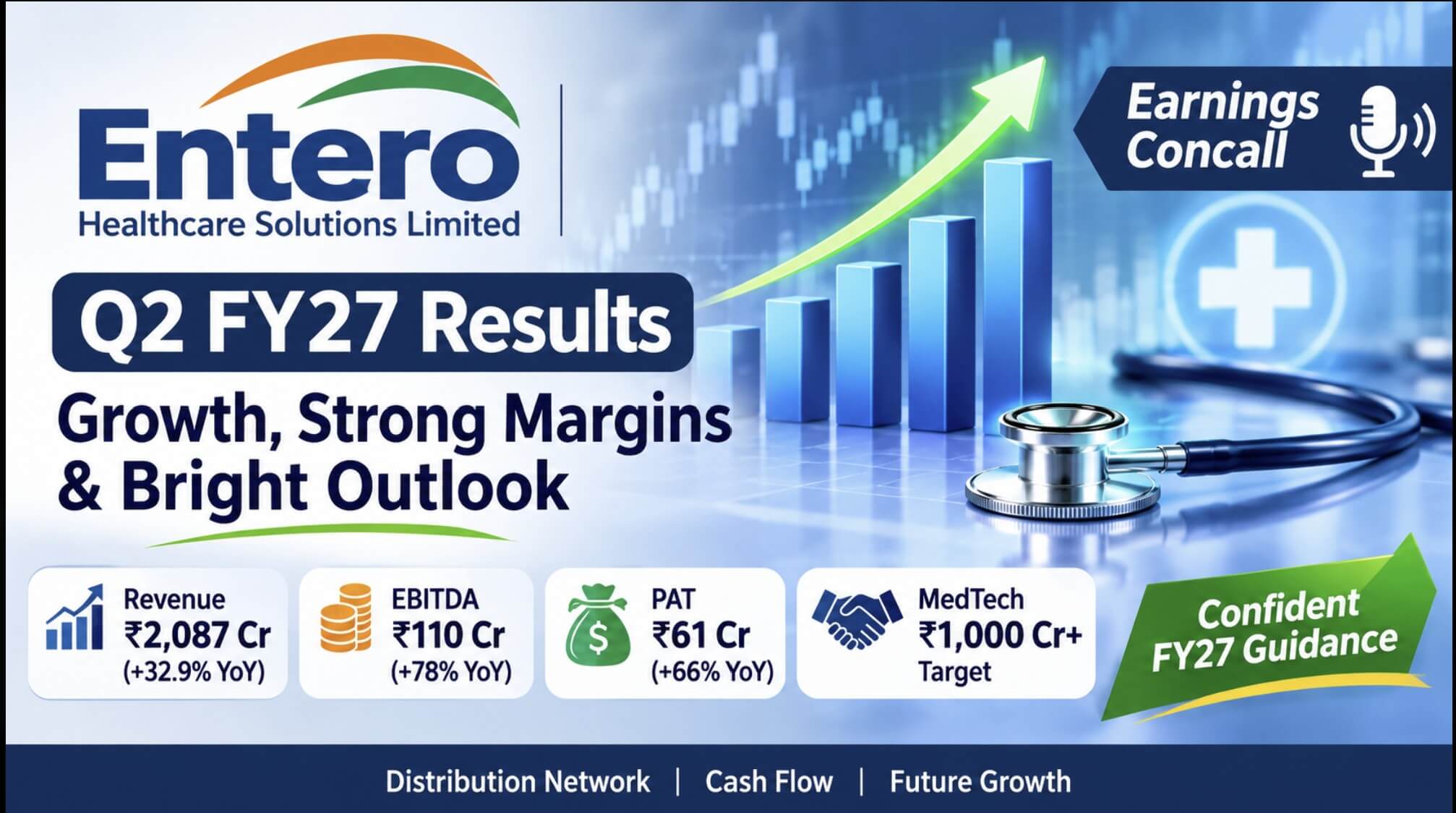
Entero Healthcare Q2 FY27 results highlight strong revenue growth, higher profits and improving operating margins. Entero Healthcare Solutions Limited reported revenue of ₹2,087 crore in Q2 FY27, marking a 32.9% increase over the previous year. Moreover, EBITDA grew by 78%, showing that profits increased faster than sales.
The company is expanding its pharmaceutical distribution network while building its medical technology business. As a result, Entero is gaining a stronger position in India’s organised healthcare supply chain.
However, strong sales growth is only one part of the story. Investors must also examine cash flow, debt, working capital and acquisition costs. In this analysis, we explain the latest financial results, management guidance, growth opportunities and risks that could affect Entero Healthcare’s future performance.
Entero Healthcare Q2 FY27 Results: Key Financial Highlights
The company delivered strong growth across its major financial indicators during the September quarter.
| Financial Metric | Q2 FY27 Performance | YoY Growth |
|---|---|---|
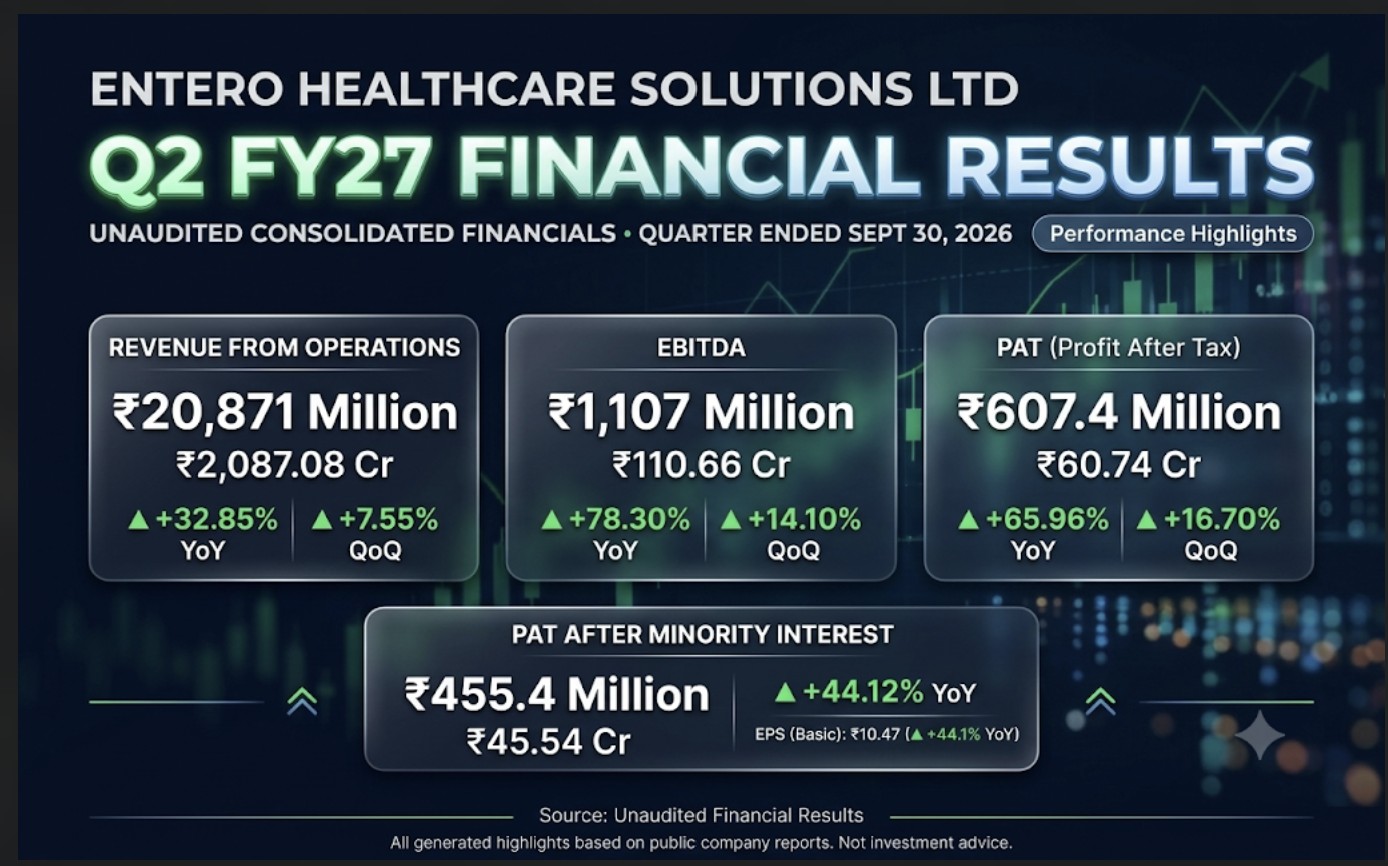
| Consolidated revenue | ₹2,087 crore | 32.9% |
| H1 FY27 revenue | ₹4,028 crore | 35% |
| EBITDA margin | 5.3% | +135 bps |
| Gross margin | 11.5% | +126 bps |
| EBITDA growth | — | 78% |
| Consolidated PAT | ₹61 crore | 66% |
| PAT attributable to owners | ₹46 crore | 44% |
| Return on Capital | 22.0% | — |
| Return on Equity | 22.4% | — |
| Net working capital days | 64 days | — |
What stands out?
Three developments deserve particular attention:
- Revenue increased by more than 30%, demonstrating strong business expansion.
- EBITDA grew considerably faster than revenue, suggesting improving operating efficiency.
- Management expects to outperform its original FY27 revenue growth guidance.
The combination of these factors makes this quarter important for understanding Entero’s long-term growth strategy.
1. Revenue Growth: Organic Expansion Is Becoming Important
Entero reported consolidated revenue of ₹2,087 crore in Q2 FY27, compared with the corresponding period last year, representing 32.9% growth.
For H1 FY27, revenue reached ₹4,028 crore, registering 35% year-on-year growth.
The most important aspect is the composition of this growth.
Management highlighted:
- 18.2% organic growth during Q2 FY27.
- Approximately 20% organic growth on a like-for-like basis.
- 14.7% contribution from inorganic growth and acquisition-related consolidation effects.
This distinction matters because acquisitions can increase reported revenue without necessarily improving the underlying performance of existing businesses.
Organic growth, on the other hand, indicates that the existing distribution network is generating additional business through customer acquisition, higher sales to existing customers and improved product penetration.
Why 20% organic growth matters
India’s pharmaceutical distribution market remains fragmented, with numerous regional distributors and smaller intermediaries.
Large organised distributors can potentially gain market share through:
- Better inventory availability.
- Wider pharmaceutical product portfolios.
- Faster order fulfilment.
- Stronger manufacturer relationships.
- Technology-enabled distribution.
- More efficient logistics.
- Better credit and collection processes.
Entero’s ability to maintain high-teens or approximately 20% organic growth would be a significant positive indicator.
However, investors should distinguish between market growth and market-share gains. The company’s future performance will depend on whether it continues to grow faster than the broader pharmaceutical distribution market.
Investor interpretation: Organic growth is one of the most important numbers to track in upcoming quarters. If Entero maintains this momentum after acquisition-related contributions moderate, it would strengthen the quality of its reported revenue growth.
2. Profitability Analysis: EBITDA Growth Is the Biggest Positive
Revenue growth alone does not establish whether a distribution company is creating shareholder value.
The ability to improve margins while expanding operations is equally important.
Entero demonstrated progress on this front during Q2 FY27.
Gross margin improvement
Gross margin increased by 126 basis points to 11.5%.
This improvement indicates better gross profitability relative to revenue.
Possible contributors include:
- Improved product and customer mix.
- Better commercial arrangements.
- Greater operational scale.
- Improved distribution efficiency.
The company reported H1 FY27 gross profit of ₹461 crore.
For a distribution business operating with relatively thin margins, even a small improvement in gross margin can have a meaningful impact on operating profitability.
EBITDA margin expansion
EBITDA margin improved by 135 basis points to 5.3%.
More importantly, EBITDA increased by 78% year on year.
This is substantially faster than the 32.9% revenue growth.
It suggests that the company is benefiting from operating leverage and better cost efficiency.
Operating leverage occurs when revenue increases faster than certain operating expenses. As the business expands, existing infrastructure, technology and distribution capabilities can support additional sales without requiring expenses to increase at the same rate.
However, investors should check whether this margin improvement is sustainable or partly influenced by temporary factors.
Net profit performance
Entero reported consolidated profit after tax of ₹61 crore, representing 66% year-on-year growth.
The profit attributable to owners of the parent company stood at ₹46 crore, up 44%.
The remaining approximately ₹15 crore was attributable to non-controlling interests.
This distinction is important because consolidated PAT and profit available to parent-company shareholders are not the same.
Investors should focus on earnings attributable to owners when evaluating the profitability available to equity shareholders.
| Profitability indicator | Q2 FY27 |
|---|---|
| Gross margin | 11.5% |
| EBITDA margin | 5.3% |
| PAT | ₹61 crore |
| PAT margin | 2.9% |
| PAT attributable to owners | ₹46 crore |
Investor interpretation: The improvement in EBITDA is encouraging, but sustainable growth in owner-attributable profit and operating cash flow will be more important than a single quarter of margin expansion.
3. Working Capital and Cash Flow: An Important Area to Monitor
Healthcare distribution is a working-capital-intensive business.
Companies must purchase medicines and medical products, maintain inventory, distribute products to customers and collect payments.
Consequently, revenue growth does not automatically translate into free cash flow.
Entero reported net working capital days of 64 during the quarter.
Management explained that the working capital cycle was temporarily affected by delayed collections of approximately ₹55 crore from Maharashtra government-related contracts.
According to management, funds were delayed because of government fund reallocation associated with drought-related requirements. The company subsequently received the delayed amount in November.
Management indicated that working capital days would have been approximately 61 instead of 64 after adjusting for this delay.
Why working capital days matter
A lower working capital cycle generally indicates that a company is converting its operating investment into cash more efficiently.
For Entero, investors should monitor:
- Receivable days.
- Inventory days.
- Supplier payment terms.
- Operating cash flow.
- Cash conversion.
- Government and institutional customer collections.
A company growing at 30% or more can still face financial pressure if receivables and inventory increase faster than revenue.
Management’s cash conversion target
Management reiterated its objective of converting approximately 50% of EBITDA into operating cash flow.
This is an important target because accounting profits and cash generation can differ considerably in distribution businesses.
For investors, the next few quarters should provide better evidence of whether the company can achieve this conversion consistently.
Investor interpretation: The receipt of the delayed ₹55 crore is encouraging. However, investors should not automatically assume that all future collection delays will be temporary. Consistent cash conversion is essential for sustainable expansion.
4. MedTech Business: A Potential Long-Term Growth Driver
One of the most interesting aspects of Entero’s business strategy is its medical technology distribution segment.
MedTech already contributes more than 15% of total revenue.
Management expects MedTech revenue to exceed ₹1,000 crore during FY27.
This segment offers an opportunity to expand beyond traditional pharmaceutical distribution.
Why MedTech matters
Medical technology distribution includes products and equipment used by hospitals, clinics and healthcare professionals.
The opportunity is supported by several long-term trends:
- Increasing healthcare expenditure.
- Expansion of private hospitals.
- Growing diagnostic infrastructure.
- Rising demand for medical equipment.
- Modernisation of healthcare facilities.
- Greater penetration of specialised medical technologies.
Entero’s existing hospital relationships and distribution infrastructure could support the introduction of additional medical technology categories.
What investors should monitor
The most important question is whether MedTech expansion can improve overall profitability.
Investors should evaluate:
- MedTech revenue growth.
- Segment-level EBITDA contribution, where disclosed.
- New manufacturer partnerships.
- Product category additions.
- Working capital requirements.
- Customer concentration.
Revenue diversification is positive, but the segment must also deliver attractive returns on capital.
Investor interpretation: MedTech could become an important contributor to Entero’s next growth phase. The ₹1,000 crore revenue ambition is worth monitoring, particularly if the segment delivers attractive margins and cash conversion.
5. Distribution Network: Entero’s Competitive Position
Entero has developed a sizeable distribution network across India’s healthcare supply chain.
During H1 FY27, the company reported:
| Operating Metric | Network |
|---|---|
| Retail customers | 92,200+ |
| Hospitals served | 2,900+ |
| Geographic coverage | Around 500 districts |
| States and territories | 20+ |
| Product SKUs | 90,400+ |
| Manufacturing partners | 3,200+ |
This network creates several potential competitive advantages.
Scale and product availability
A large product portfolio allows distributors to serve multiple customer requirements through a single supply relationship.
This can improve customer convenience and strengthen relationships with pharmacies and hospitals.
Manufacturer relationships
Working with more than 3,200 manufacturers gives Entero access to a broad product portfolio.
Strong manufacturer relationships can improve sourcing capabilities and product availability.
Geographic reach
Operating across approximately 500 districts gives the company a broader distribution footprint.
This infrastructure may also help Entero introduce new product categories without building an entirely separate distribution network.
Subsidiary branding strategy
Management indicated that acquired subsidiaries can retain their existing local names.
This is a practical approach in a fragmented market where established regional relationships are valuable.
Forcing immediate brand consolidation could create unnecessary disruption.
Retaining local brands may help preserve customer confidence while allowing the parent company to improve purchasing, logistics, technology and operational processes.
Investor interpretation: Entero’s distribution network is an important business asset. However, scale alone does not guarantee a competitive advantage. The company must continue improving customer retention, fulfilment efficiency and returns on invested capital.
6. FY27 Guidance: Management Expects to Outperform Its Original Target
Management expressed confidence about delivering better performance than its original FY27 guidance.
The earlier target indicated approximately 23% revenue growth, excluding new acquisitions.
Management did not provide a precise revised growth number during the call.
This distinction is important.
Investors should not treat management’s confidence as an officially revised numerical forecast.
Nevertheless, the commentary indicates that the business is performing better than initially anticipated.
Key management expectations
| Area | Management Commentary |
|---|---|
| Revenue growth | Expected to exceed original FY27 guidance |
| Organic growth | High-teens to approximately 20% ambition |
| EBITDA conversion | Around 50% into operating cash flow |
| Interest costs | Expected to decline from Q3 |
| MedTech revenue | Expected to exceed ₹1,000 crore |
| Acquisitions | Pharma and MedTech opportunities |
| Acquisition size | Targets above ₹100 crore |
The next two quarters will be particularly important.
The contribution from previously acquired businesses is expected to moderate as the calendarisation benefit fades.
Consequently, organic growth will become increasingly important in determining the quality of second-half performance.
7. Debt Reduction and Interest Cost: A Positive Development
Acquisitions can accelerate business expansion, but they can also increase debt and interest expenses.
Entero has used acquisitions as part of its growth strategy.
Management indicated that interest costs should begin declining from Q3 FY27 as acquisition-related debt is repaid.
This could support future earnings growth.
However, investors should monitor the following:
- Total borrowings.
- Net debt.
- Interest expenses.
- Debt repayment.
- Acquisition funding requirements.
- Cash flow after working capital investment.
Lower interest expenses could improve profit growth even if operating margins remain stable.
The most attractive scenario would be a combination of organic growth, improving operating margins and declining debt.
That would indicate that Entero is moving towards a stronger financial position while continuing to expand its business.
8. Acquisition Strategy: Growth Through Pharma and MedTech
Entero continues to evaluate acquisition opportunities in pharmaceutical distribution and medical technology.
Management indicated interest in opportunities above ₹100 crore.
The company appears more interested in expanding product categories than simply entering additional geographical markets.
This approach could be beneficial.
An acquisition that adds a complementary product portfolio or strengthens manufacturer relationships may create more value than buying another business with overlapping operations.
What makes an acquisition attractive?
Investors should assess:
- Purchase valuation.
- Revenue and EBITDA contribution.
- Return on invested capital.
- Debt requirements.
- Integration costs.
- Customer retention.
- Working capital requirements.
- Expected synergies.
An acquisition can increase consolidated revenue immediately, but shareholder value depends on the returns generated relative to the purchase price.
Investor interpretation: Entero’s acquisition strategy could strengthen its distribution ecosystem, but disciplined capital allocation is essential. Investors should avoid evaluating acquisitions only by the additional revenue they bring.
9. Key Risks Investors Should Not Ignore
Despite the strong Q2 FY27 performance, there are several risks worth monitoring.
Risk 1: Acquisition-related growth may moderate
Previous acquisitions contributed to reported revenue growth.
As the comparison base changes, this contribution may decline in Q3 and Q4.
Entero will need strong organic growth to maintain its overall momentum.
Risk 2: Customer credit risk
Management discussed a customer default at one of its subsidiaries.
The amount was written off under other expenses, while the company indicated that it retained legal and security-related recovery options.
Although the disclosed incident does not establish a broader credit problem, it highlights the importance of receivable quality.
Risk 3: Working capital pressure
Rapid expansion may require additional inventory and customer credit.
If collections slow down, operating cash flow could weaken.
Risk 4: Acquisition execution
Large acquisitions involve integration risks, valuation risks and possible increases in borrowing.
Poor capital allocation could reduce shareholder returns even when reported revenue increases.
Risk 5: Margin sustainability
Distribution businesses generally operate with relatively thin margins.
The recent improvement is encouraging, but investors should examine whether margins can remain elevated as the business expands.
Risk 6: Industry growth normalisation
Management did not provide a firm view on how long the currently elevated Indian pharmaceutical market growth rates could continue.
A slowdown in industry growth could affect the broader distribution environment.
10. What Should Investors Track in Q3 and Q4 FY27?
Rather than focusing only on the next quarterly revenue number, investors should monitor a combination of growth, profitability and financial discipline.
| Indicator | What Investors Want to See |
|---|---|
| Organic revenue growth | Sustained high-teens growth |
| EBITDA margin | Stability or further improvement |
| Owner-attributable PAT | Growth alongside consolidated earnings |
| Working capital days | Stable or improving trend |
| Operating cash flow | Strong conversion from EBITDA |
| Interest expenses | Declining trend |
| MedTech revenue | Progress towards ₹1,000 crore |
| Acquisition returns | Attractive returns on invested capital |
| Receivables | No deterioration in collection quality |
These indicators will provide a more complete picture of the company’s business quality than revenue growth alone.
11. Is Entero Healthcare Building a Sustainable Growth Business?
Entero operates in a market where organised distribution can potentially benefit from the consolidation of smaller regional distributors.
Its large customer network, extensive SKU portfolio and manufacturer relationships offer a foundation for further expansion.
The company also appears to be broadening its business beyond conventional pharmaceutical distribution through MedTech.
However, there is an important difference between becoming a large distributor and becoming a consistently profitable business.
Long-term value creation will depend on four factors:
First: Sustainable organic growth. The company must continue increasing sales through its existing business rather than depending excessively on acquisitions.
Second: Margin improvement. EBITDA margins need to remain healthy despite competitive pricing and distribution costs.
Third: Cash flow generation. The company must convert accounting earnings into actual cash while managing receivables and inventory.
Fourth: Disciplined acquisitions. New businesses should generate returns that justify their acquisition costs and funding requirements.
If Entero can deliver on these four factors, its expanding distribution infrastructure could become a valuable long-term business asset.
12. Final Verdict: Strong Quarter, But Cash Flow Remains Critical
Entero Healthcare’s Q2 FY27 performance was encouraging across several important financial indicators.
The strongest positives were:
- 32.9% consolidated revenue growth.
- 18.2% organic growth, with approximately 20% like-for-like growth.
- 78% EBITDA growth.
- EBITDA margin expansion to 5.3%.
- 66% growth in consolidated PAT.
- More than 15% revenue contribution from MedTech.
- Management’s confidence in outperforming original FY27 guidance.
- Expected reduction in interest costs from Q3.
However, investors should remain attentive to working capital, acquisition-related debt, receivable quality and the sustainability of margin improvements.
The most important question for the next few quarters is whether Entero can maintain strong organic growth while improving cash generation and reducing debt.
Our assessment: Entero Healthcare has demonstrated strong operating momentum in Q2 FY27. The results deserve attention from investors tracking India’s organised healthcare distribution sector. However, a positive quarterly performance should not automatically be interpreted as a buy recommendation.
Investors should evaluate the current market valuation, earnings expectations, balance sheet and future cash flows before making an investment decision.
The next two quarters will be important in determining whether the company’s current growth momentum translates into sustainable shareholder value.
Frequently Asked Questions (FAQs)
1. What was Entero Healthcare’s Q2 FY27 revenue?
Entero Healthcare reported consolidated revenue of ₹2,087 crore in Q2 FY27, representing 32.9% year-on-year growth.
2. What was Entero Healthcare’s Q2 FY27 PAT?
The company reported consolidated profit after tax of ₹61 crore, up 66% year on year. Profit attributable to owners was ₹46 crore.
3. What was Entero Healthcare’s EBITDA margin in Q2 FY27?
EBITDA margin improved by 135 basis points to 5.3%.
4. What was Entero Healthcare’s organic revenue growth?
Organic growth was 18.2% in Q2 FY27, while like-for-like organic growth was approximately 20%, according to management.
5. What is Entero Healthcare’s FY27 revenue guidance?
The original guidance indicated approximately 23% revenue growth excluding new acquisitions. Management expressed confidence in outperforming this target but did not provide a specific revised number.
6. What is Entero Healthcare’s MedTech revenue target?
Management expects the MedTech business to generate more than ₹1,000 crore in revenue during FY27.
7. What are the major risks for Entero Healthcare?
The important risks include working capital requirements, customer credit risk, acquisition integration, debt levels and the sustainability of organic growth and margins.
8. Is Entero Healthcare a good long-term investment?
The company has demonstrated encouraging revenue growth and margin improvement. However, an investment decision requires analysis of its current valuation, cash flow generation, debt, competitive position and future earnings potential. No single quarter can establish long-term investment suitability.
Disclaimer: This article is for educational and informational purposes only. It does not constitute investment advice or a recommendation to buy, sell or hold any security. Stock market investments are subject to market risks. Readers should conduct independent research or consult a registered investment adviser before making investment decisions.
About Multibagger Hunt: We analyse company earnings, management commentary, business fundamentals and emerging investment opportunities to help readers understand listed Indian companies.
Disclaimer: This article is for educational purposes only and not financial advice. Investors should do their own due diligence before investing.
Disclaimer: The projections of potential returns are based on current market conditions and company performance. Actual results may vary due to various factors, including market dynamics, economic conditions, and changes in the competitive landscape. Investors should conduct their own research and consult with financial advisors before making investment decisions.
Multibagger Stocks breakout stocks
⚠️ Not SEBI Registered—just here to share insights | 🚫 No paid services—everything shared is entirely free! 🧠 Always Learning and excited to grow together in this journey of market exploration.
📲 Join Our Investor Communities
🔹 Join our Telegram Channel: Multibagger Hunts
🔹 Join our WhatsApp Channel: Click to Join
✅ Free access
✅ Instant alerts
✅ Curated research for serious investors
TwitterXWhatsAppThreadsTelegramFacebookLinkedInGmailEmailShare