admin
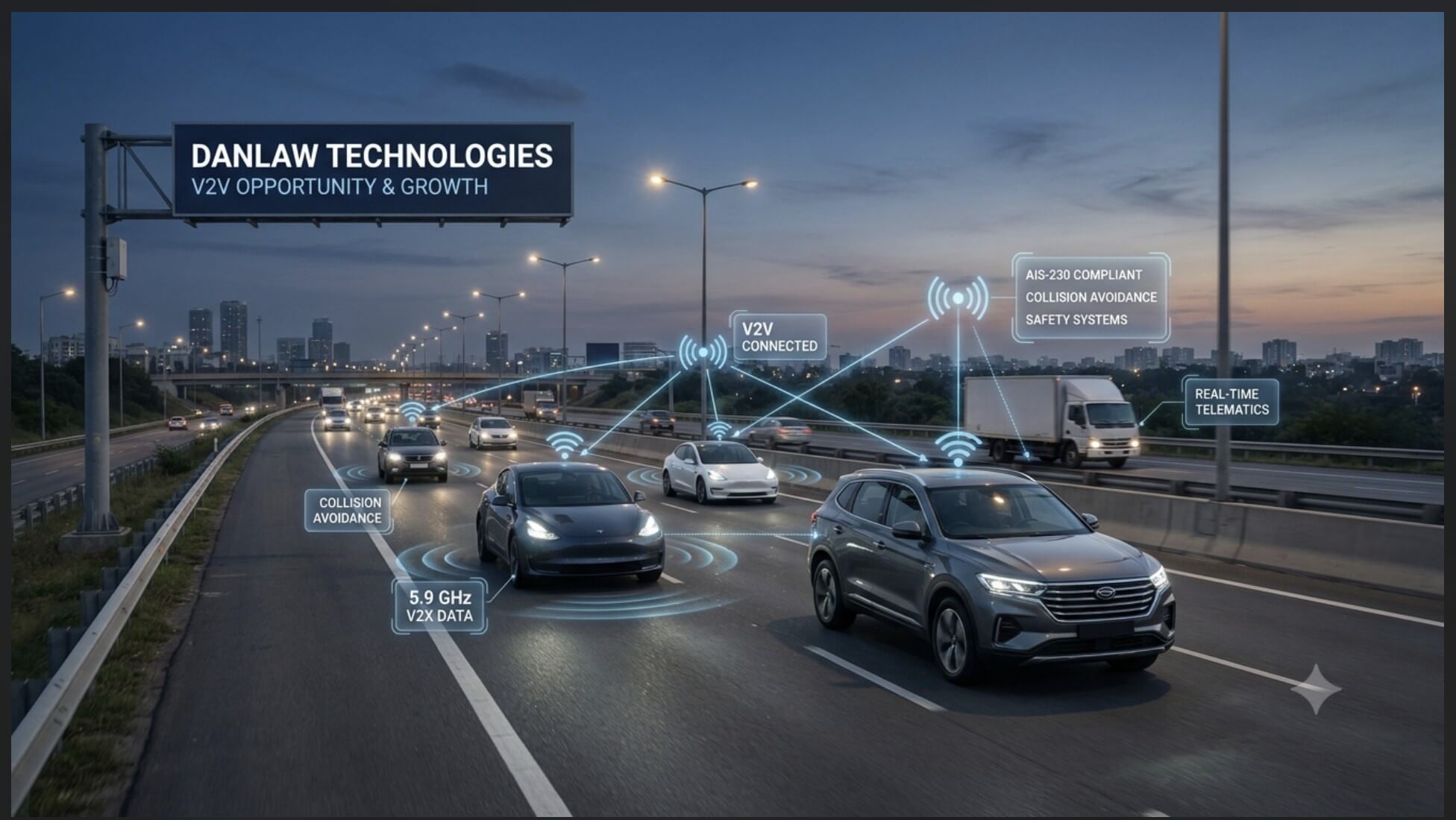
With the Ministry of Road Transport and Highways (MoRTH) proposing mandatory Vehicle-to-Vehicle (V2V) communication systems for newly manufactured vehicles starting October 2028, investors are closely evaluating the Danlaw Technologies V2V opportunity. However, separating genuine long-term earnings catalysts from regulatory speculation requires a disciplined look at both the company’s current operational momentum and the structural hurdles ahead.
This analysis breaks down Danlaw Technologies’ core investment thesis, dissects its Q2 FY27 financial performance and cash flow conversion, evaluates the 2028 V2V regulatory framework, and outlines the critical valuation and execution risks investors must monitor.
Executive Summary: Balancing Current Execution Against Future Policy
- Strong Core Earnings Momentum: Danlaw Technologies is not merely a speculative policy play; its core business delivered 32.1% year-on-year (YoY) revenue growth and 42.4% YoY net profit growth in Q2 FY27.
- Regulatory Catalyst on the Horizon: India’s draft proposal for mandatory V2V communication under the AIS-230 standard from October 2028 could dramatically expand the domestic addressable market for On-Board Units (OBUs) and embedded automotive software.
- Improved Cash Generation: Operating cash flow more than doubled in FY26, supported by stronger EBITDA-to-cash conversion and declining quarterly interest expenses.
- Key Execution Hurdles: Commercial OEM order wins for India’s V2V rollout remain unproven, regulatory timelines frequently face delays, and recent stock price appreciation has priced in substantial optimism.
Investment Thesis: Danlaw Technologies’ Core Capabilities
To understand why the Danlaw Technologies V2V opportunity has captured institutional and retail attention, investors must examine the company’s existing technological moat. Unlike pure-play IT services firms that rely on general software outsourcing, Danlaw operates deep within the automotive electronics and embedded systems ecosystem.
1. Deep Expertise in V2V and V2X Communication Protocols
- Proven Global Lineage: Through its global engineering roots and operational synergies with Danlaw Inc. (USA), the company has years of domain expertise in V2X and DSRC alongside Cellular-V2X (C-V2X) architectures.
- Early Ecosystem Readiness: Developing automotive-grade V2V modules requires rigorous testing for latency, packet loss, and cryptographic security. Danlaw’s prior exposure to global connected-vehicle pilot programs reduces its R&D learning curve compared to domestic newcomers.
2. Connected Vehicles and Automotive Electronics Hardware
- End-to-End Telematics Hardware: Danlaw designs and manufactures connected car devices, On-Board Diagnostics (OBD-II) dongles, and Telematics Control Units (TCUs) used by Original Equipment Manufacturers (OEMs) and fleet operators.
- Domestic Manufacturing Footprint: With electronics manufacturing capabilities in India, the company aligns with domestic localization incentives, making it an attractive Tier-1 or Tier-2 partner for Indian automakers seeking locally sourced hardware.
3. Embedded Software and Automotive Testing Solutions
- Software-Defined Vehicle (SDV) Positioning: Modern vehicles rely on dozens of Electronic Control Units (ECUs) that communicate over internal networks. Danlaw provides embedded software engineering, validation tools, and CAN bus testing frameworks.
- High Switching Costs: Once an automotive supplier’s embedded software or validation suite is integrated into an OEM’s vehicle platform, switching suppliers mid-cycle becomes prohibitively expensive, creating sticky, multi-year revenue streams.
4. Intelligent Transportation Systems (ITS) Exposure
- Beyond the Vehicle: Connected mobility requires roadside infrastructure—such as smart traffic signals, tolling gantries, and highway hazard beacons—to communicate with passing vehicles.
- Smart Mobility Alignment: Danlaw’s capabilities in vehicle telemetry and roadside unit integration position it to benefit from broader smart-city and highway modernization investments across India.
Regulatory Tailwind: India’s Proposed 2028 V2V Safety Mandate
The primary macro catalyst driving interest in the Danlaw Technologies V2V opportunity is the Indian government’s push to curb road fatalities through proactive collision-avoidance technology.
Understanding the MoRTH Draft Notification (AIS-230 Standard)
In August 2026, the Ministry of Road Transport and Highways (MoRTH) issued a draft notification proposing mandatory V2V communication systems for all newly manufactured vehicles starting October 1, 2028.
- Spectrum Allocation: The proposed framework utilizes On-Board Units operating in the 5.875 GHz to 5.925 GHz frequency band under the AIS-230 automotive industry standard.
- Broad Vehicle Coverage: Unlike Advanced Driver Assistance Systems (ADAS) that are currently restricted to premium passenger cars, the draft proposal spans Category L (two-wheelers and three-wheelers), Category M (passenger cars, SUVs, and buses), and Category N (commercial trucks and goods carriers).
- How V2V Differs from Cameras and Radar: Line-of-sight sensors struggle in heavy fog, blind intersections, sharp curves, or dense traffic where a large truck blocks visibility. V2V allows vehicles to broadcast speed, braking status, direction, and location up to several hundred meters away, triggering instant alerts for wrong-way drivers, sudden emergency braking ahead, or blind-spot two-wheelers.
Market Expansion Potential vs. Policy Reality
If implemented across all vehicle categories, India—one of the world’s largest automotive and two-wheeler markets—would generate demand for tens of millions of V2V communication modules annually. Every compliant vehicle would require:
- A certified V2V transceiver module and antenna system.
- Cryptographic security certificates and hardware security modules to prevent signal spoofing or cyberattacks.
- Integration software linking the V2V unit to the vehicle’s dashboard or audio alert system.
The Investor Caveat: A draft notification is not an irrevocable law. Public consultations, OEM cost-pushback (especially from price-sensitive entry-level two-wheeler manufacturers), spectrum clearance hurdles, and type-approval bottlenecks frequently push Indian automotive compliance deadlines back by 12 to 24 months.
Q2 FY27 Financial Performance: Dissecting the Numbers
While V2V represents a medium-term option value, Danlaw Technologies’ current stock valuation must be anchored in its financial execution. In Q2 FY27 (quarter ended September 30, 2026), the company delivered strong top-line expansion paired with meaningful operating leverage.
Quarterly & Half-Yearly Financial Comparison
| Financial Metric | Q2 FY27 | Q2 FY26 | YoY Change | QoQ Growth |
|---|---|---|---|---|
| Revenue from Operations | ₹86.66 Cr | ₹65.58 Cr | +32.1% | +17.6% |
| Operating Profit (EBITDA) | ₹13.53 Cr | ₹9.59 Cr | +41.1% | +36.8% |
| Operating Profit Margin | 15.61% | 14.62% | +99 bps | +220 bps |
| Net Profit (PAT) | ₹7.83 Cr | ₹5.50 Cr | +42.4% | +32.0% |
| Basic EPS | ₹16.08 | ₹11.29 | +42.4% | +32.0% |
| Quarterly Interest Expense | ₹0.30 Cr | ₹0.50 Cr | -40.0% | -26.8% |
Note: Swipe horizontally on mobile devices to view all columns. Figures compiled from Q2 FY27 unaudited financial disclosures. H1 FY27 net profit grew 53.4% YoY.
Key Takeaways from the Q2 FY27 Earnings Report
- Revenue Acceleration Across Horizons: Revenue rose 32.1% YoY to ₹86.66 Cr and jumped 17.6% sequentially over Q1 FY27. Synchronized growth across both annual and sequential timeframes indicates healthy order book execution and steady demand in core automotive electronics and engineering services.
- Operating Leverage Driving Margin Expansion: Operating profit grew 41.1% YoY—outpacing revenue growth by 900 basis points. Operating margins expanded by 99 basis points YoY (and 220 basis points QoQ) to reach 15.61%. Controlled employee benefit expenses alongside better fixed-cost absorption enabled higher incremental revenue to flow directly to the bottom line.
- Bottom-Line Compounding and Interest Reduction: Net profit climbed 42.4% YoY to ₹7.83 Cr, lifting quarterly EPS to ₹16.08. Additionally, quarterly finance costs dropped 40% YoY from ₹0.50 Cr to ₹0.30 Cr, reflecting disciplined debt reduction and improved balance sheet health.
- H1 FY27 Momentum: Cumulative net profit for the first half of FY27 expanded by 53.4% YoY, establishing a strong earnings run-rate for the remainder of the fiscal year.
Cash Flow Improvement and Working Capital Analysis
Rapid revenue growth in automotive hardware companies often traps cash in unpaid invoices and raw material stockpiles. Evaluating Danlaw’s cash flow statement provides crucial insight into earnings quality.
FY26 Cash Conversion Breakthrough
- Operating Cash Flow (CFO) More Than Doubled: Full-year FY26 operating cash flow surged 110% to ₹21 Cr, up from ₹10 Cr in the prior fiscal year.
- Free Cash Flow (FCF) Expansion: After accounting for capital expenditures, FY26 free cash flow climbed 140% to ₹12 Cr compared to ₹5 Cr previously.
- Superior CFO/EBITDA Conversion: The ratio of operating cash flow to EBITDA improved dramatically from 52% to 72%. A conversion rate above 70% demonstrates that reported accounting profits are translating into actual bank liquidity rather than sitting as paper receivables.
Working Capital Watchlist in H1 FY27
- As of September 30, 2026, trade receivables stood at ₹61.06 Cr and inventories rose to ₹52.50 Cr to support higher production volumes.
- Consequently, six-month operating cash flow in H1 FY27 moderated to ₹7.58 Cr. Sustaining a 70%+ CFO/EBITDA conversion ratio in H2 FY27 will depend on timely collections from OEM customers and disciplined inventory turnover.
Core Growth Drivers for FY27–FY30
Looking beyond single-quarter fluctuations, five structural pillars underpin Danlaw Technologies’ medium-term growth trajectory:
- Potential V2V Regulatory Adoption: Even a phased rollout starting with commercial vehicles and passenger cars in late 2028 would create a multi-year hardware and software replacement cycle.
- Rising Electronic Content Per Vehicle: Regardless of V2V mandates, Indian automakers are rapidly integrating connected telematics, digital instrument clusters, and OTA updates across mass-market models.
- Operating Leverage at Scale: As hardware manufacturing volumes scale up, fixed engineering and testing overheads get amortized across larger unit batches, supporting sustainable mid-teen operating margins.
- De-leveraging and Self-Funded Growth: Rising free cash flows and shrinking interest expenses allow Danlaw to fund R&D and capacity expansion internally without diluting equity shareholders.
- Cross-Selling Software and Hardware: Relationships built through telematics hardware open doors for higher-margin embedded software validation and cybersecurity compliance contracts.
Key Investment Risks and Red Flags
Every high-growth small-cap stock carries asymmetric risks. Before allocating capital based on the Danlaw Technologies V2V opportunity, weigh these five critical vulnerabilities:
1. Regulatory Delays and Scope Dilution
- Timeline Slippage: Indian regulatory mandates in the automotive sector frequently experience extensions after industry lobbying. If the October 2028 deadline is pushed to 2030, or if two-wheelers (Category L) are exempted due to cost sensitivity, near-term addressable market projections will shrink drastically.
- Technology Standard Shifts: Debates between DSRC-based systems and Cellular-V2X (C-V2X) standards could force suppliers into additional R&D expenditure before commercial clarity emerges.
2. Unproven Commercial Order Wins in V2V
- Capability Does Not Equal Contracts: Having technical expertise in V2V does not guarantee winning large-volume tenders from major Indian OEMs like Maruti Suzuki, Tata Motors, Mahindra, or Hero MotoCorp.
- Intense Tier-1 Competition: Global automotive giants (such as Bosch, Continental, Harman, and Valeo) alongside large domestic conglomerates (like Uno Minda, Tata Elxsi, and KPIT Technologies) will aggressively compete for V2V and connected-car market share.
3. Valuation Sensitivity and Volatility
- Priced for Perfection: Following a sharp rally in 2026—where the stock surged over 100% from its 52-week low of ₹428 to trade near ₹1,610–₹1,630 (a market capitalization of roughly ₹793 Cr and a P/E multiple around 28.5x trailing earnings)—the margin of safety has narrowed.
- Multiple Compression Risk: Any quarterly deceleration in YoY revenue growth or delay in V2V policy finalization could trigger sharp valuation multiple contraction in a low-liquidity small-cap counter.
4. Uncertain V2V Revenue Contribution and Pricing Pressure
- Commodity Hardware Margins: If V2V modules become a mandatory, standardized fitment across millions of budget vehicles, OEMs will exert relentless pricing pressure on hardware suppliers, potentially compressing gross margins unless offset by proprietary software licensing.
5. Working Capital and Client Concentration
- Receivables Stretch: Rising trade receivables and inventory levels during rapid scaling can temporarily strain cash flows if OEM payment cycles lengthen.
- Governance & Liquidity Dynamics: With a dominant promoter shareholding and relatively low public institutional participation, daily trading volumes remain modest, exposing retail investors to higher bid-ask spreads during market downturns.
Investor Action Plan: What to Track Next
Rather than relying on headlines around the 2028 mandate, disciplined investors should track concrete quarterly milestones over the next four quarters:
- MoRTH Final Gazette Notification: Monitor whether the August 2026 draft notification transitions into a binding final notification with firm compliance dates and clear AIS-230 technical specifications.
- OEM Pilot and Order Announcements: Look for formal disclosures of Request for Quotation (RFQ) wins, proof-of-concept trials with domestic OEMs, or partnerships with Tier-1 suppliers.
- Margin Sustainability Above 15%: Verify whether Danlaw can maintain its Q2 FY27 operating margin of 15.61% as it scales hardware volumes and absorbs annual wage revisions.
- Full-Year FY27 Cash Conversion: Check year-end balance sheet disclosures to ensure H1 FY27 working capital buildup converts back into operating cash flow.
For broader industry context on how domestic component makers are adapting to vehicle electrification and smart safety mandates, explore our detailed Indian Automotive Electronics & EV Sector Outlook. Official quarterly filings and shareholding disclosures can be verified directly via BSE India Corporate Filings and policy updates via the Ministry of Road Transport and Highways (MoRTH).
Frequently Asked Questions (FAQ)
What is the Danlaw Technologies V2V opportunity?
The Danlaw Technologies V2V opportunity centers on the company’s expertise in Vehicle-to-Vehicle communication hardware, telematics, and embedded software, which positions it to supply safety modules if India enforces its proposed October 2028 V2V mandate for new vehicles.
How did Danlaw Technologies perform financially in Q2 FY27?
In Q2 FY27, Danlaw Technologies reported revenue of ₹86.66 Cr (+32.1% YoY), operating profit of ₹13.53 Cr (+41.1% YoY), and net profit of ₹7.83 Cr (+42.4% YoY), with operating margins expanding to 15.61%.
Is India’s 2028 V2V safety mandate guaranteed to happen on time?
No. As of late 2026, the Ministry of Road Transport and Highways (MoRTH) has issued a draft proposal for an October 1, 2028 rollout under the AIS-230 standard. Final implementation timelines remain subject to industry consultations, cost assessments, and government approval.
What are the biggest risks of investing in Danlaw Technologies?
Key risks include potential delays in V2V regulatory enforcement, intense competition from larger Tier-1 automotive suppliers, unproven commercial V2V order wins, working capital buildup in receivables and inventory, and valuation sensitivity following strong stock price gains.
Disclaimer: This article is for informational and educational purposes only and does not constitute SEBI-registered investment advice, a stock recommendation, or an offer to buy or sell securities. Investors should conduct independent due diligence and consult a certified financial advisor before making investment decisions.
The Indian automotive landscape is undergoing a structural shift from mechanical engineering to connected, software-defined mobility. At the center of this transition sits Danlaw Technologies India Limited, a specialized engineering and automotive electronics firm positioned at the intersection of telematics, embedded software, and connected safety systems.
With the Ministry of Road Transport and Highways (MoRTH) proposing mandatory Vehicle-to-Vehicle (V2V) communication systems for newly manufactured vehicles starting October 2028, investors are closely evaluating the Danlaw Technologies V2V opportunity. However, separating genuine long-term earnings catalysts from regulatory speculation requires a disciplined look at both the company’s current operational momentum and the structural hurdles ahead.
This analysis breaks down Danlaw Technologies’ core investment thesis, dissects its Q2 FY27 financial performance and cash flow conversion, evaluates the 2028 V2V regulatory framework, and outlines the critical valuation and execution risks investors must monitor.
Executive Summary: Balancing Current Execution Against Future Policy
- Strong Core Earnings Momentum: Danlaw Technologies is not merely a speculative policy play; its core business delivered 32.1% year-on-year (YoY) revenue growth and 42.4% YoY net profit growth in Q2 FY27.
- Regulatory Catalyst on the Horizon: India’s draft proposal for mandatory V2V communication under the AIS-230 standard from October 2028 could dramatically expand the domestic addressable market for On-Board Units (OBUs) and embedded automotive software.
- Improved Cash Generation: Operating cash flow more than doubled in FY26, supported by stronger EBITDA-to-cash conversion and declining quarterly interest expenses.
- Key Execution Hurdles: Commercial OEM order wins for India’s V2V rollout remain unproven, regulatory timelines frequently face delays, and recent stock price appreciation has priced in substantial optimism.
Investment Thesis: Danlaw Technologies’ Core Capabilities
To understand why the Danlaw Technologies V2V opportunity has captured institutional and retail attention, investors must examine the company’s existing technological moat. Unlike pure-play IT services firms that rely on general software outsourcing, Danlaw operates deep within the automotive electronics and embedded systems ecosystem.
1. Deep Expertise in V2V and V2X Communication Protocols
- Proven Global Lineage: Through its global engineering roots and operational synergies with Danlaw Inc. (USA), the company has years of domain expertise in V2X and DSRC alongside Cellular-V2X (C-V2X) architectures.
- Early Ecosystem Readiness: Developing automotive-grade V2V modules requires rigorous testing for latency, packet loss, and cryptographic security. Danlaw’s prior exposure to global connected-vehicle pilot programs reduces its R&D learning curve compared to domestic newcomers.
2. Connected Vehicles and Automotive Electronics Hardware
- End-to-End Telematics Hardware: Danlaw designs and manufactures connected car devices, On-Board Diagnostics (OBD-II) dongles, and Telematics Control Units (TCUs) used by Original Equipment Manufacturers (OEMs) and fleet operators.
- Domestic Manufacturing Footprint: With electronics manufacturing capabilities in India, the company aligns with domestic localization incentives, making it an attractive Tier-1 or Tier-2 partner for Indian automakers seeking locally sourced hardware.
3. Embedded Software and Automotive Testing Solutions
- Software-Defined Vehicle (SDV) Positioning: Modern vehicles rely on dozens of Electronic Control Units (ECUs) that communicate over internal networks. Danlaw provides embedded software engineering, validation tools, and CAN bus testing frameworks.
- High Switching Costs: Once an automotive supplier’s embedded software or validation suite is integrated into an OEM’s vehicle platform, switching suppliers mid-cycle becomes prohibitively expensive, creating sticky, multi-year revenue streams.
4. Intelligent Transportation Systems (ITS) Exposure
- Beyond the Vehicle: Connected mobility requires roadside infrastructure—such as smart traffic signals, tolling gantries, and highway hazard beacons—to communicate with passing vehicles.
- Smart Mobility Alignment: Danlaw’s capabilities in vehicle telemetry and roadside unit integration position it to benefit from broader smart-city and highway modernization investments across India.
Regulatory Tailwind: India’s Proposed 2028 V2V Safety Mandate
The primary macro catalyst driving interest in the Danlaw Technologies V2V opportunity is the Indian government’s push to curb road fatalities through proactive collision-avoidance technology.
Understanding the MoRTH Draft Notification (AIS-230 Standard)
In August 2026, the Ministry of Road Transport and Highways (MoRTH) issued a draft notification proposing mandatory V2V communication systems for all newly manufactured vehicles starting October 1, 2028.
- Spectrum Allocation: The proposed framework utilizes On-Board Units operating in the 5.875 GHz to 5.925 GHz frequency band under the AIS-230 automotive industry standard.
- Broad Vehicle Coverage: Unlike Advanced Driver Assistance Systems (ADAS) that are currently restricted to premium passenger cars, the draft proposal spans Category L (two-wheelers and three-wheelers), Category M (passenger cars, SUVs, and buses), and Category N (commercial trucks and goods carriers).
- How V2V Differs from Cameras and Radar: Line-of-sight sensors struggle in heavy fog, blind intersections, sharp curves, or dense traffic where a large truck blocks visibility. V2V allows vehicles to broadcast speed, braking status, direction, and location up to several hundred meters away, triggering instant alerts for wrong-way drivers, sudden emergency braking ahead, or blind-spot two-wheelers.
Market Expansion Potential vs. Policy Reality
If implemented across all vehicle categories, India—one of the world’s largest automotive and two-wheeler markets—would generate demand for tens of millions of V2V communication modules annually. Every compliant vehicle would require:
- A certified V2V transceiver module and antenna system.
- Cryptographic security certificates and hardware security modules to prevent signal spoofing or cyberattacks.
- Integration software linking the V2V unit to the vehicle’s dashboard or audio alert system.
The Investor Caveat: A draft notification is not an irrevocable law. Public consultations, OEM cost-pushback (especially from price-sensitive entry-level two-wheeler manufacturers), spectrum clearance hurdles, and type-approval bottlenecks frequently push Indian automotive compliance deadlines back by 12 to 24 months.
Q2 FY27 Financial Performance: Dissecting the Numbers
While V2V represents a medium-term option value, Danlaw Technologies’ current stock valuation must be anchored in its financial execution. In Q2 FY27 (quarter ended September 30, 2026), the company delivered strong top-line expansion paired with meaningful operating leverage.
Quarterly & Half-Yearly Financial Comparison
| Financial Metric | Q2 FY27 | Q2 FY26 | YoY Change | QoQ Growth |
|---|---|---|---|---|
| Revenue from Operations | ₹86.66 Cr | ₹65.58 Cr | +32.1% | +17.6% |
| Operating Profit (EBITDA) | ₹13.53 Cr | ₹9.59 Cr | +41.1% | +36.8% |
| Operating Profit Margin | 15.61% | 14.62% | +99 bps | +220 bps |
| Net Profit (PAT) | ₹7.83 Cr | ₹5.50 Cr | +42.4% | +32.0% |
| Basic EPS | ₹16.08 | ₹11.29 | +42.4% | +32.0% |
| Quarterly Interest Expense | ₹0.30 Cr | ₹0.50 Cr | -40.0% | -26.8% |
Note: Swipe horizontally on mobile devices to view all columns. Figures compiled from Q2 FY27 unaudited financial disclosures. H1 FY27 net profit grew 53.4% YoY.
Key Takeaways from the Q2 FY27 Earnings Report
- Revenue Acceleration Across Horizons: Revenue rose 32.1% YoY to ₹86.66 Cr and jumped 17.6% sequentially over Q1 FY27. Synchronized growth across both annual and sequential timeframes indicates healthy order book execution and steady demand in core automotive electronics and engineering services.
- Operating Leverage Driving Margin Expansion: Operating profit grew 41.1% YoY—outpacing revenue growth by 900 basis points. Operating margins expanded by 99 basis points YoY (and 220 basis points QoQ) to reach 15.61%. Controlled employee benefit expenses alongside better fixed-cost absorption enabled higher incremental revenue to flow directly to the bottom line.
- Bottom-Line Compounding and Interest Reduction: Net profit climbed 42.4% YoY to ₹7.83 Cr, lifting quarterly EPS to ₹16.08. Additionally, quarterly finance costs dropped 40% YoY from ₹0.50 Cr to ₹0.30 Cr, reflecting disciplined debt reduction and improved balance sheet health.
- H1 FY27 Momentum: Cumulative net profit for the first half of FY27 expanded by 53.4% YoY, establishing a strong earnings run-rate for the remainder of the fiscal year.
Cash Flow Improvement and Working Capital Analysis
Rapid revenue growth in automotive hardware companies often traps cash in unpaid invoices and raw material stockpiles. Evaluating Danlaw’s cash flow statement provides crucial insight into earnings quality.
FY26 Cash Conversion Breakthrough
- Operating Cash Flow (CFO) More Than Doubled: Full-year FY26 operating cash flow surged 110% to ₹21 Cr, up from ₹10 Cr in the prior fiscal year.
- Free Cash Flow (FCF) Expansion: After accounting for capital expenditures, FY26 free cash flow climbed 140% to ₹12 Cr compared to ₹5 Cr previously.
- Superior CFO/EBITDA Conversion: The ratio of operating cash flow to EBITDA improved dramatically from 52% to 72%. A conversion rate above 70% demonstrates that reported accounting profits are translating into actual bank liquidity rather than sitting as paper receivables.
Working Capital Watchlist in H1 FY27
- As of September 30, 2026, trade receivables stood at ₹61.06 Cr and inventories rose to ₹52.50 Cr to support higher production volumes.
- Consequently, six-month operating cash flow in H1 FY27 moderated to ₹7.58 Cr. Sustaining a 70%+ CFO/EBITDA conversion ratio in H2 FY27 will depend on timely collections from OEM customers and disciplined inventory turnover.
Core Growth Drivers for FY27–FY30
Looking beyond single-quarter fluctuations, five structural pillars underpin Danlaw Technologies’ medium-term growth trajectory:
- Potential V2V Regulatory Adoption: Even a phased rollout starting with commercial vehicles and passenger cars in late 2028 would create a multi-year hardware and software replacement cycle.
- Rising Electronic Content Per Vehicle: Regardless of V2V mandates, Indian automakers are rapidly integrating connected telematics, digital instrument clusters, and OTA updates across mass-market models.
- Operating Leverage at Scale: As hardware manufacturing volumes scale up, fixed engineering and testing overheads get amortized across larger unit batches, supporting sustainable mid-teen operating margins.
- De-leveraging and Self-Funded Growth: Rising free cash flows and shrinking interest expenses allow Danlaw to fund R&D and capacity expansion internally without diluting equity shareholders.
- Cross-Selling Software and Hardware: Relationships built through telematics hardware open doors for higher-margin embedded software validation and cybersecurity compliance contracts.
Key Investment Risks and Red Flags
Every high-growth small-cap stock carries asymmetric risks. Before allocating capital based on the Danlaw Technologies V2V opportunity, weigh these five critical vulnerabilities:
1. Regulatory Delays and Scope Dilution
- Timeline Slippage: Indian regulatory mandates in the automotive sector frequently experience extensions after industry lobbying. If the October 2028 deadline is pushed to 2030, or if two-wheelers (Category L) are exempted due to cost sensitivity, near-term addressable market projections will shrink drastically.
- Technology Standard Shifts: Debates between DSRC-based systems and Cellular-V2X (C-V2X) standards could force suppliers into additional R&D expenditure before commercial clarity emerges.
2. Unproven Commercial Order Wins in V2V
- Capability Does Not Equal Contracts: Having technical expertise in V2V does not guarantee winning large-volume tenders from major Indian OEMs like Maruti Suzuki, Tata Motors, Mahindra, or Hero MotoCorp.
- Intense Tier-1 Competition: Global automotive giants (such as Bosch, Continental, Harman, and Valeo) alongside large domestic conglomerates (like Uno Minda, Tata Elxsi, and KPIT Technologies) will aggressively compete for V2V and connected-car market share.
3. Valuation Sensitivity and Volatility
- Priced for Perfection: Following a sharp rally in 2026—where the stock surged over 100% from its 52-week low of ₹428 to trade near ₹1,610–₹1,630 (a market capitalization of roughly ₹793 Cr and a P/E multiple around 28.5x trailing earnings)—the margin of safety has narrowed.
- Multiple Compression Risk: Any quarterly deceleration in YoY revenue growth or delay in V2V policy finalization could trigger sharp valuation multiple contraction in a low-liquidity small-cap counter.
4. Uncertain V2V Revenue Contribution and Pricing Pressure
- Commodity Hardware Margins: If V2V modules become a mandatory, standardized fitment across millions of budget vehicles, OEMs will exert relentless pricing pressure on hardware suppliers, potentially compressing gross margins unless offset by proprietary software licensing.
5. Working Capital and Client Concentration
- Receivables Stretch: Rising trade receivables and inventory levels during rapid scaling can temporarily strain cash flows if OEM payment cycles lengthen.
- Governance & Liquidity Dynamics: With a dominant promoter shareholding and relatively low public institutional participation, daily trading volumes remain modest, exposing retail investors to higher bid-ask spreads during market downturns.
Investor Action Plan: What to Track Next
Rather than relying on headlines around the 2028 mandate, disciplined investors should track concrete quarterly milestones over the next four quarters:
- MoRTH Final Gazette Notification: Monitor whether the August 2026 draft notification transitions into a binding final notification with firm compliance dates and clear AIS-230 technical specifications.
- OEM Pilot and Order Announcements: Look for formal disclosures of Request for Quotation (RFQ) wins, proof-of-concept trials with domestic OEMs, or partnerships with Tier-1 suppliers.
- Margin Sustainability Above 15%: Verify whether Danlaw can maintain its Q2 FY27 operating margin of 15.61% as it scales hardware volumes and absorbs annual wage revisions.
- Full-Year FY27 Cash Conversion: Check year-end balance sheet disclosures to ensure H1 FY27 working capital buildup converts back into operating cash flow.
For broader industry context on how domestic component makers are adapting to vehicle electrification and smart safety mandates, explore our detailed Indian Automotive Electronics & EV Sector Outlook. Official quarterly filings and shareholding disclosures can be verified directly via BSE India Corporate Filings and policy updates via the Ministry of Road Transport and Highways (MoRTH).
Frequently Asked Questions (FAQ)
What is the Danlaw Technologies V2V opportunity?
The Danlaw Technologies V2V opportunity centers on the company’s expertise in Vehicle-to-Vehicle communication hardware, telematics, and embedded software, which positions it to supply safety modules if India enforces its proposed October 2028 V2V mandate for new vehicles.
How did Danlaw Technologies perform financially in Q2 FY27?
In Q2 FY27, Danlaw Technologies reported revenue of ₹86.66 Cr (+32.1% YoY), operating profit of ₹13.53 Cr (+41.1% YoY), and net profit of ₹7.83 Cr (+42.4% YoY), with operating margins expanding to 15.61%.
Is India’s 2028 V2V safety mandate guaranteed to happen on time?
No. As of late 2026, the Ministry of Road Transport and Highways (MoRTH) has issued a draft proposal for an October 1, 2028 rollout under the AIS-230 standard. Final implementation timelines remain subject to industry consultations, cost assessments, and government approval.
What are the biggest risks of investing in Danlaw Technologies?
Key risks include potential delays in V2V regulatory enforcement, intense competition from larger Tier-1 automotive suppliers, unproven commercial V2V order wins, working capital buildup in receivables and inventory, and valuation sensitivity following strong stock price gains.
⚠️ Not SEBI Registered—just here to share insights | 🚫 No paid services—everything shared is entirely free! 🧠 Always Learning and excited to grow together in this journey of market exploration.
Disclaimer: All content is shared strictly for educational and informational purposes only and does not constitute investment advice or a stock recommendation. Please consult a SEBI-registered financial advisor before making investment decisions.
📲 Join Our Investor Communities
🔹 Join our Telegram Channel: Multibagger Hunts →🔹 Join our WhatsApp Channel: Click to Join →
✅ Free access
Share This Post