admin
⚠️ Not SEBI Registered—just here to share insights | 🚫 No paid services—everything shared is entirely free! 🧠 Always Learning and excited to grow together in this journey of market exploration.
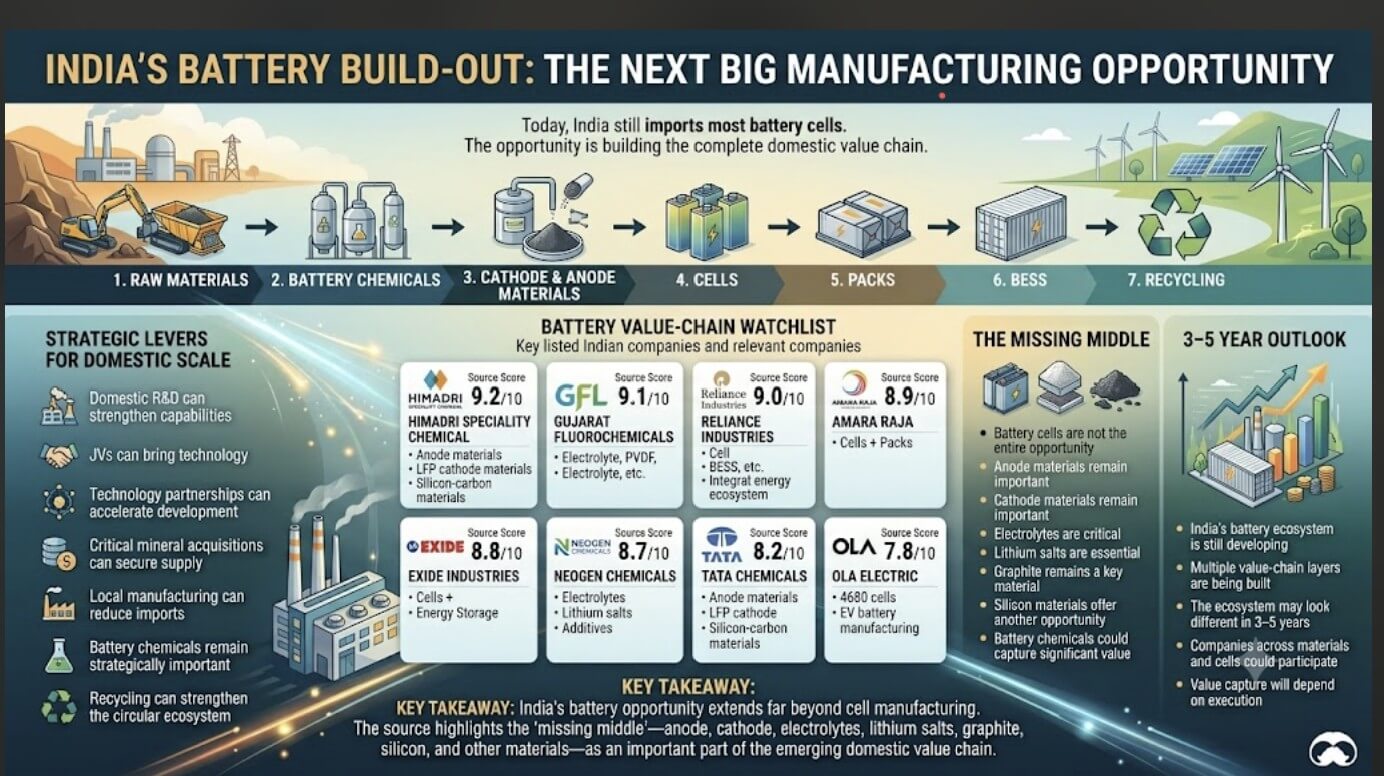
India’s clean energy transition is entering a major industrial phase. Until recently, most investors focused on electric vehicle (EV) makers and solar panel firms. However, the real value and supply bottleneck lie upstream in India battery chemicals stocks.
Domestic chemical companies have announced over ₹20,000 crore in planned capital spending to build a local lithium-ion battery supply chain. Moreover, strict Western trade rules against Chinese supply chains and Indian localization laws are accelerating this shift. As a result, this multi-year investment cycle offers a major growth runway for Indian manufacturers.
Still, heavy spending alone does not guarantee strong stock returns. Oversupply in certain segments, falling Chinese prices, and slow testing approvals create real risks. Therefore, this research guide breaks down battery cell costs, examines all six core chemical segments, and analyzes the top Indian contenders.
Table of Contents
- 1. Core Investment Thesis: Why Battery Chemicals Matter Now
- 2. The Six Battery Chemical Building Blocks & Cost Breakdown
- 3. Global Supply-Chain Shift: FEOC Rules & EU Battery Passport
- 4. India’s Domestic Demand Trajectory & Policy Catalysts
- 5. Return Ratios (ROCE), Qualification Moats & Key Risks
- 6. Top 3 Contenders & Steady Runners-Up: Fundamental Analysis
- 7. Actionable Investor Checklist & Segment Preferences
- 8. Frequently Asked Questions (FAQ)
1. Core Investment Thesis: Why Battery Chemicals Matter Now
To see why chemical firms are investing thousands of crores, investors must check the cost structure of a battery cell. While cell assembly factories grab headlines, battery chemicals make up 75% to 85% of total cell manufacturing costs.
Currently, India has almost no upstream battery chemical independence. Although local battery pack assembly has crossed 60 GWh, actual cell manufacturing stood near 1.4 GWh in early 2026. Consequently, India still imports nearly all its cathode powders, anode graphite, electrolytes, and separator films from China.
- Massive Capex Commitment: Leading Indian firms—including Gujarat Fluorochemicals (GFL), Himadri Speciality Chemical, Neogen Chemicals, HEG, and Hindalco—have pledged over ₹20,000 crore.
- Extreme Global Concentration: China currently controls between 80% and 99% of global refining across every major battery material.
- Geopolitical De-Risking: In addition, Western automakers in the US and Europe are actively seeking non-Chinese suppliers to meet strict legal mandates.
- Domestic Localization Rules: Under India’s PLI scheme for Advanced Chemistry Cells (ACC), cell makers must achieve up to 60% local value addition within five years.
Because of these dual drivers, Indian chemical makers can supply new local gigafactories while exporting compliant materials to Western buyers at higher prices.
2. The Six Battery Chemical Building Blocks & Cost Breakdown
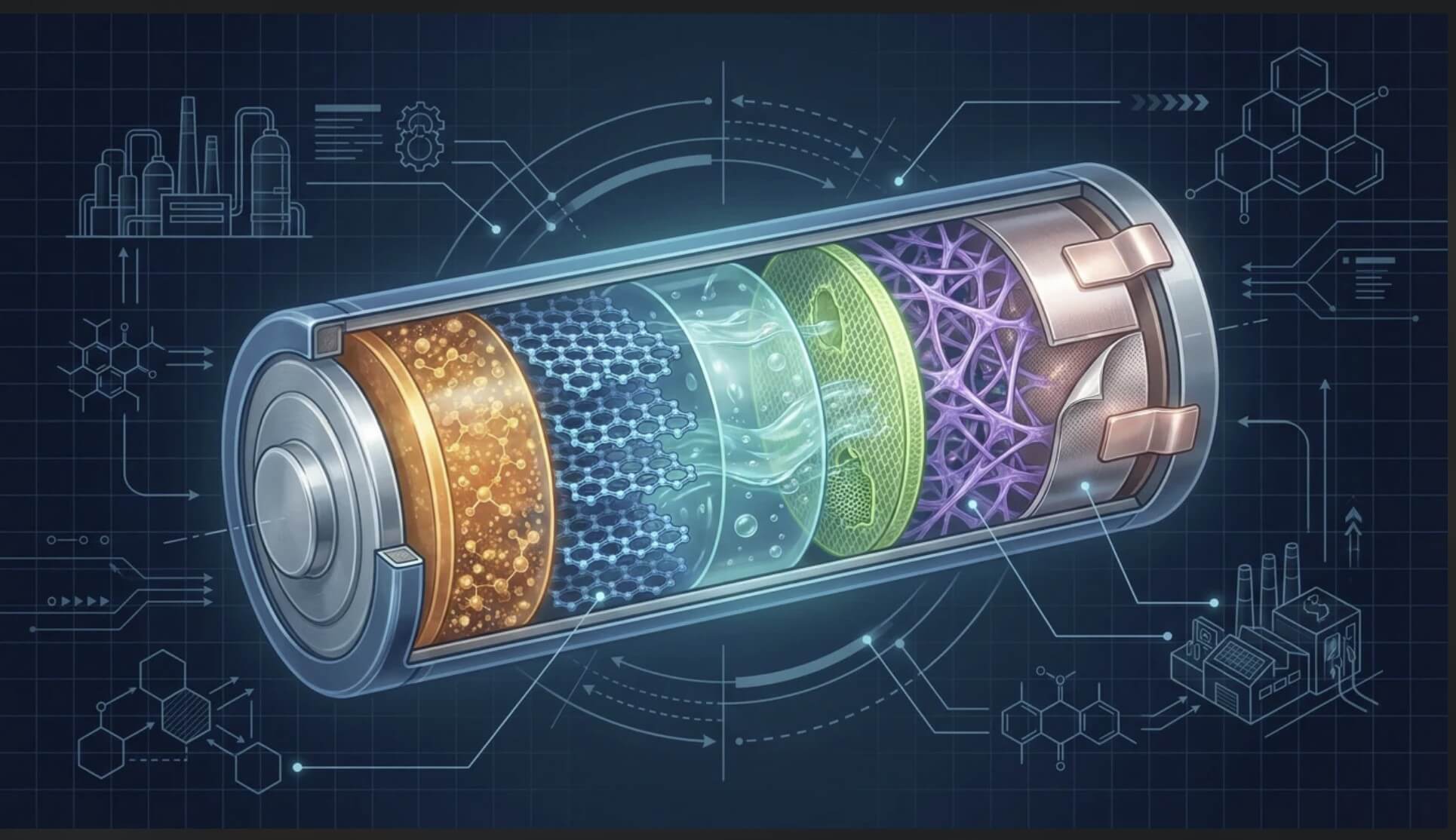
A lithium-ion battery cell relies on six distinct chemical and material categories. However, each segment involves very different technical hurdles, capital needs, and competition levels.
| Battery Component | Share of Cell Cost | Global China Dominance | Key Indian Players | Moat & Risk Level |
|---|---|---|---|---|
| 1. Cathode Active Material (CAM) | 40% – 55% | ~99% | Gujarat Fluorochemicals (GFL), Himadri, Sudeep Pharma (Precursor) | High Moat; Highest Value Share |
| 2. Anode Active Material (AAM) | 10% – 15% | >90% | Himadri, HEG, Graphite India, Epsilon Carbon, GFL | High Domestic Oversupply Risk |
| 3. Electrolyte System | 10% – 12% | 80% – 85% | GFL, Neogen Chemicals, Tatva Chintan, Aether Industries | Moderate-High Moat; Fast Approval |
| 4. Separator Films | 8% – 10% | ~80% | TCPL Energy Materials | High Technical Precision Needed |
| 5. Binders & CNTs | 3% – 5% | ~75% – 85% | GFL (PVDF), Himadri (CNTs) | Very High Entry Barrier |
| 6. Current Collector Foils | 4% – 5% | ~80% | Hindalco Industries, SRF | Scale & Purity Driven |
1. Cathode Active Material (CAM) — 40% to 55% of Cell Cost
The cathode is the single costliest part of a lithium-ion battery. Specifically, it controls energy storage capacity, heat safety, and battery lifespan. Globally, Lithium Iron Phosphate (LFP) chemistry now leads mass-market EVs and grid storage because it is safer and cheaper than nickel-based batteries.
- Supply Bottleneck: China controls roughly 99% of global LFP cathode supply, whereas Indian commercial production is currently tiny.
- Indian Capex Push: Both GFL (via GFCL EV Products) and Himadri are building large LFP plants for ramp-up between FY27 and FY28. Meanwhile, Sudeep Pharma is developing iron phosphate raw materials locally.
2. Anode Active Material (AAM) — 10% to 15% of Cell Cost
The anode stores lithium ions during charging using synthetic graphite or purified natural graphite. Currently, China controls over 90% of global anode processing.
- Crowded Domestic Pipeline: Unlike cathodes, anodes have attracted heavy local spending. Players like Himadri, HEG, Graphite India, Epsilon Carbon, and GFL have announced over 220,000 MTPA of planned capacity by FY30.
- Investor Caution: Although local output is still at pilot scale, this huge pipeline could exceed Indian demand and trigger price wars.
3. Electrolyte System — 10% to 12% of Cell Cost
Electrolytes allow lithium ions to move between the cathode and anode. Specifically, they combine lithium salts—mainly LiPF6—with organic solvents and special safety additives.
- Commercial Leaders: China holds 80% to 85% of global capacity. In India, however, GFL has already started commercial LiPF6 production and supplies major global clients.
- Technology Tie-Ups: Furthermore, Neogen Chemicals is scaling electrolytes through a Japanese technology partnership with MUIS. Tatva Chintan is testing specialized salts, while Aether Industries delayed its rollout due to cheap Chinese imports.
4. Separator Films — 8% to 10% of Cell Cost
Separators are thin plastic membranes placed between the positive and negative electrodes. They prevent short circuits while letting lithium ions pass through freely.
- Import Dependence: China supplies roughly 80% of global demand, and India currently imports 100% of its separator films.
- Early Mover: Therefore, TCPL Energy Materials is investing in a coating line to reach 70 million square meters (MSM) by Q4 FY28.
5. Fluoropolymer Binders & Carbon Nanotubes (CNTs) — 3% to 5% of Cell Cost
Although binders and conductive additives form a small cost share, they are vital for battery durability. Polyvinylidene Fluoride (PVDF) glues cathode powders onto metal foils, while Carbon Nanotubes (CNTs) speed up charging.
- High Technical Barriers: Making battery-grade PVDF requires complex fluorine chemistry. GFL already produces battery-grade PVDF, whereas Himadri is scaling local battery-grade CNT plants.
6. Current Collector Foils — 4% to 5% of Cell Cost
Ultra-thin aluminium and copper foils collect electrical current inside the cell and send it out to power the vehicle or grid.
- Commissioned Scale: Hindalco Industries has already opened a 25,000 MTPA battery aluminium foil plant in Odisha, enough for 100 GWh of cells. In addition, Hindalco is developing EV copper foils, while SRF approved a ₹600 crore aluminium foil expansion.
3. Global Supply-Chain Shift: FEOC Rules & EU Battery Passport
Investors often ask how Indian chemical firms can beat established Chinese rivals. Currently, Chinese battery chemical plants run at low utilization rates of 50% to 55%. Consequently, Chinese oversupply has pushed global prices down and squeezed profit margins.
However, strict Western trade laws are splitting the global market into two separate supply chains. As a result, compliant non-Chinese suppliers are shielded from pure price wars:
- US FEOC & PFE Rules: Under the US Inflation Reduction Act, EV tax credits are blocked if battery materials come from Chinese-linked entities.
- EU Battery Passport (February 2027): Starting in February 2027, every EV and industrial battery sold in Europe must carry a digital passport proving its raw material origin.
- EU Carbon Limits (February 2028): Furthermore, Europe will enforce strict carbon footprint limits by February 2028, penalizing coal-heavy supply chains.
- Ex-China Capacity Growth: Non-Chinese cell manufacturing capacity is projected to jump from 451 GWh toward 1.3 TWh over the next decade.
Analyst Insight: Western battery makers cannot use Chinese chemicals if they want government tax credits or European market access. Therefore, Western buyers pay a 15% to 25% price premium for verified non-Chinese chemicals, directly boosting margins for compliant Indian exporters.
For more insights on how global policy shifts affect domestic manufacturers, read our guides on Indian Specialty Chemicals Sector Outlook and Grid-Scale Energy Storage & BESS Stocks in India.
4. India’s Domestic Demand Trajectory & Policy Catalysts
Even without exports, India’s own clean energy transition creates huge local demand. According to industry studies by IEEFA and the Central Electricity Authority, domestic battery needs are set to surge:
- EV Battery Demand: Electric vehicle battery demand is projected to reach 210 to 272 GWh annually by FY30 across two-wheelers, buses, and passenger cars.
- Grid-Scale BESS Demand: Moreover, India needs roughly 236 GWh of Battery Energy Storage Systems by FY32 to balance solar and wind power on the national grid.
- Domestic Gigafactory Pipeline: Major groups—including Reliance, Ola Electric, Exide, Amara Raja, and Tata Agratas—plan to build 80 to 110 GWh of cell capacity by FY30.
Government policy strongly backs this demand. Under the ₹18,100 crore PLI-ACC scheme, cell makers must reach 60% local value addition. Because chemicals represent 75% to 85% of cell costs, gigafactories must buy locally made chemicals to earn subsidies. In addition, the government is considering a ₹12,000 to ₹13,000 crore upstream incentive scheme specifically for battery chemical makers.
5. Return Ratios (ROCE), Qualification Moats & Key Risks
From a valuation standpoint, battery chemical plants can deliver strong financial returns once they reach steady production:
- Strong Return Ratios: Integrated battery chemical facilities can earn a pre-tax Return on Capital Employed (ROCE) of 18% to 22%+.
- Brownfield Savings: Furthermore, firms expanding inside existing chemical hubs—like GFL and Neogen in Gujarat—save heavily on land and utility setup costs.
- Sticky Customer Approvals: Battery chemicals require strict safety and cycle-life testing that takes 18 to 36 months. Once a supplier is approved, cell makers rarely switch vendors, creating high customer loyalty.
Three Major Risks Investors Must Monitor
- Domestic Anode Overcapacity: Over 220,000 MTPA of planned Indian anode capacity could exceed local demand, leading to price cuts and weak returns.
- Raw Material Origin Rules: Simply processing chemicals in India is not enough for US exports. If an Indian firm uses Chinese lithium or phosphoric acid, its product still fails US FEOC rules.
- Gigafactory Delays: Indian cell factories have faced slow rollouts, with only 1.4 GWh running by early 2026. Consequently, chemical plants finishing early must rely on export orders until local gigafactories scale up.
6. Top 3 Contenders & Steady Runners-Up: Fundamental Analysis
Not every company in this sector offers the same risk-reward balance. Below is a clear breakdown of the top three contenders and two steady industrial runners-up.
1. Gujarat Fluorochemicals Ltd (GFL) — The Diversified Leader
Core Portfolio: LFP Cathodes, LiPF6 Salts, Electrolytes, PVDF Binders, and Anodes.
- Commercial Lead: Unlike peers still in testing, GFL already sells commercial LiPF6 salts and PVDF binders to five major global electrolyte makers.
- LFP Cathode & Global Backing: GFL has stabilized its LFP cathode plant and started sending customer samples for full ramp-up in FY27–FY28. Moreover, the International Finance Corporation (IFC) approved a ₹430 crore investment in GFL’s EV subsidiary.
- Oman Export Hub: In addition, GFL is building an export hub in Oman to serve US and European battery makers with low-cost energy and free-trade benefits.
- Investor Takeaway: GFL offers the widest, highest-margin battery chemical portfolio, supported by stable cash flows from its core fluoropolymer business.
2. Himadri Speciality Chemical Ltd — The Integrated Leverage Play
Core Portfolio: LFP Cathodes, Graphite Anodes, and Conductive Carbon Nanotubes (CNTs).
- Raw Material Advantage: Himadri’s core coal-tar pitch business supplies the key raw material for synthetic graphite anodes, which protects profit margins.
- Major Capex Plan: The company plans to invest ₹3,500–4,000 crore, including ₹1,125 crore for a 40,000 MTPA LFP cathode plant targeting Q4 FY28 commissioning.
- Strategic Partnerships: Its pilot anode plant is already running. Furthermore, Himadri owns a 20.5% stake in US battery firm IBC, helping speed up product testing.
- Investor Takeaway: Himadri offers strong earnings growth potential if its LFP and CNT plants scale on time, though investors should watch debt and execution closely.
3. Neogen Chemicals Ltd — The Focused Electrolyte Specialist
Core Portfolio: Lithium Electrolyte Salts (LiPF6) and Formulated Liquid Electrolytes.
- Japanese Technology Edge: Through its joint venture with Japan’s MUIS, Neogen gained proven commercial electrolyte manufacturing technology.
- Gujarat Expansion: Neogen is scaling large electrolyte and salt plants at Dahej and Pakhajan. It has already won sole-supplier approval from a domestic gigafactory and targets ₹2,400–2,900 crore in battery revenue by FY29.
- Investor Takeaway: Neogen gives focused exposure to the fastest-qualifying segment, though rising debt levels remain a key factor to monitor.
Steady Industrial Runners-Up
- HEG Limited: HEG is building a synthetic graphite anode plant backed by ₹609.5 crore in government incentives and green power. Commissioning is expected in early FY28, though core graphite electrode cycles still drive near-term earnings.
- Hindalco Industries: Hindalco has already commissioned India’s first 25,000 MTPA battery aluminium foil plant in Odisha and is developing EV copper foils. However, its huge core metals business dilutes pure-play battery upside.
7. Actionable Investor Checklist & Segment Preferences
Before investing in any battery chemical stock, apply these four simple screening rules to manage downside risk:
- High Cell Cost Share: Focus on materials that make up a large share of cell costs, such as LFP cathodes (40–55%) and electrolytes (10–12%).
- Severe Non-Chinese Shortage: Prefer segments where Western and Indian gigafactories face acute non-Chinese supply gaps, like PVDF binders and LiPF6 salts.
- Low Local Crowding: Avoid crowded segments like graphite anodes unless the company has captive raw materials or firm export contracts.
- Fast Customer Approvals: Favor firms that have already moved beyond pilot labs into commercial sample testing or binding supply deals.
| Segment | Conviction Level | Key Reason |
|---|---|---|
| LFP Cathodes (CAM) | High Conviction | Largest cost share (40–55%), 99% China control, and booming EV/grid storage demand. |
| Electrolytes & LiPF6 | High Conviction | Faster customer testing, critical safety role, and immediate local gigafactory orders. |
| PVDF Binders | High Conviction | High technical entry barriers, minimal local rivals, and strong profit margins. |
| Graphite Anodes (AAM) | Cautious / Selective | Over 220,000 MTPA of planned Indian capacity creates high oversupply risk by FY30. |
To learn more about analyzing capital-intensive manufacturing firms, read our guides on How to Analyze Capex-Heavy Chemical Stocks and Understanding ROCE & Operating Leverage in Indian Equities.
8. Frequently Asked Questions (FAQ)
Which Indian companies are leading the battery chemicals sector?
Gujarat Fluorochemicals (GFL), Himadri Speciality Chemical, and Neogen Chemicals are the top three contenders. Specifically, GFL leads in commercial LiPF6 salts, PVDF binders, and LFP cathodes; Himadri focuses on LFP cathodes, anodes, and CNTs; and Neogen specializes in Japanese-licensed electrolytes.
How big is India’s battery chemical capex opportunity?
Indian chemical and material firms have committed over ₹20,000 crore in planned capital spending. This investment supports India’s projected 210–272 GWh EV battery demand by FY30 and 236 GWh grid storage need by FY32.
What is the biggest risk for Indian battery chemical stocks?
The three main risks are domestic oversupply in graphite anodes, Chinese raw-material origin rules blocking US exports, and delays in local gigafactory rollouts.
Official Policy & Industry References:
• Ministry of Heavy Industries – National Programme on Advanced Chemistry Cell (ACC) Battery Storage
• IEEFA India – Securing India’s Battery Supply Chain Report
⚠️ Not SEBI Registered—just here to share insights | 🚫 No paid services—everything shared is entirely free! 🧠 Always Learning and excited to grow together in this journey of market exploration.
📲 Join Our Investor Communities
🔹 Join our Telegram Channel: Multibagger Hunts →
🔹 Join our WhatsApp Channel: Click to Join →
✅ Free access
<p style="font-weight: 700; font-size: 15px; margin-bottom: 6px;">Share This Post</p>
<div class="mbh-share-bar">
  <a class="mbh-share-btn" href="https://twitter.com/intent/tweet?text=India%20Battery%20Chemicals%3A%20%E2%82%B920%2C000%2B%20Cr%20Capex%20Opportunity" target="_blank" rel="noopener noreferrer">Twitter / X</a>
  <a class="mbh-share-btn" href="https://api.whatsapp.com/send?text=India%20Battery%20Chemicals%3A%20%E2%82%B920%2C000%2B%20Cr%20Capex%20Opportunity" target="_blank" rel="noopener noreferrer">WhatsApp</a>
  <a class="mbh-share-btn" href="https://www.threads.net/intent/post?text=India%20Battery%20Chemicals%3A%20%E2%82%B920%2C000%2B%20Cr%20Capex%20Opportunity" target="_blank" rel="noopener noreferrer">Threads</a>
  <a class="mbh-share-btn" href="https://t.me/share/url?url=https://multibaggerhunt.com&text=India%20Battery%20Chemicals%3A%20%E2%82%B920%2C000%2B%20Cr%20Capex%20Opportunity" target="_blank" rel="noopener noreferrer">Telegram</a>
  <a class="mbh-share-btn" href="https://www.facebook.com/sharer/sharer.php?u=https://multibaggerhunt.com" target="_blank" rel="noopener noreferrer">Facebook</a>
  <a class="mbh-share-btn" href="https://www.linkedin.com/sharing/share-offsite/?url=https://multibaggerhunt.com" target="_blank" rel="noopener noreferrer">LinkedIn</a>
  <a class="mbh-share-btn" href="mailto:?subject=India%20Battery%20Chemicals%20Capex%20Opportunity&body=Check%20out%20this%20deep-dive%20analysis%20on%20India%20battery%20chemicals%20stocks." target="_blank" rel="noopener noreferrer">Gmail / Email</a>
</div>